
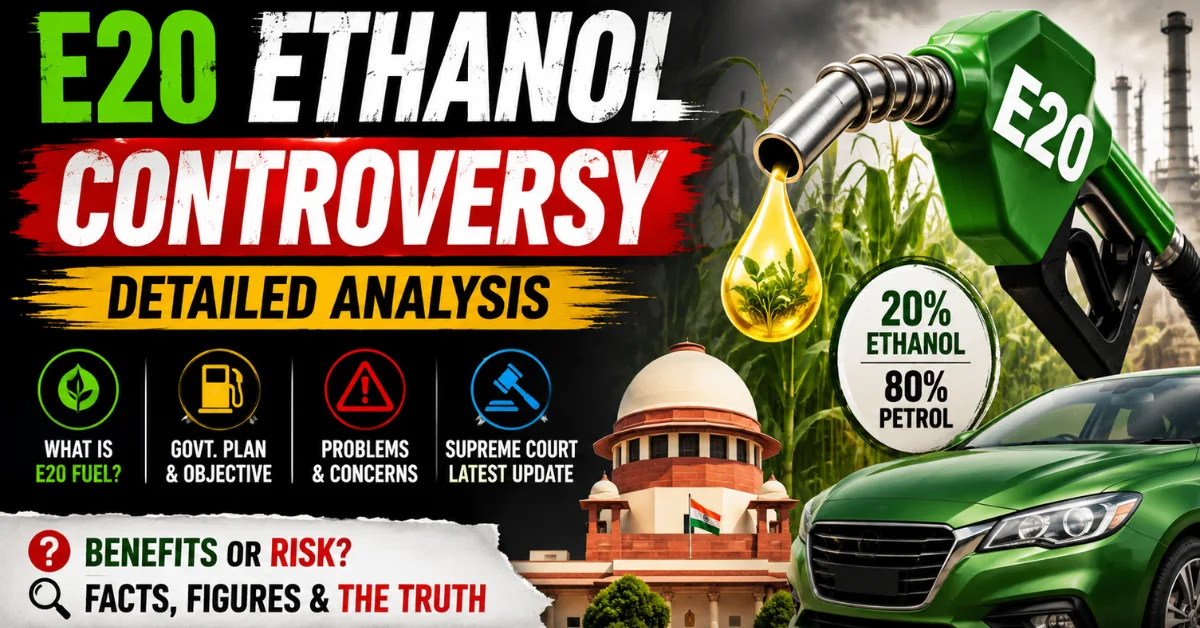
E20 Ethanol Controversy: India is in the middle of one of its loudest fuel-policy debates in years. What started as a routine court hearing has snowballed into street protests, viral videos of “damaged engines,” and a full-blown war of words between the government, automakers, and angry motorists. At the centre of it all is one question: is E20 — petrol blended with 20% ethanol — actually safe for your vehicle, or has India rushed a half-tested experiment onto 300 million vehicles?
We went through government data, court records, industry statements, and independent studies to separate what’s verified from what’s viral.
Table of Contents
What Exactly Is E20?
E20 is petrol containing 20% ethanol and 80% regular petrol, compared to the earlier E10 blend (10% ethanol) that most Indian vehicles ran on until recently. India made E20 the default fuel at pumps nationwide starting in April 2023, with the full rollout completed ahead of the original 2030 target under the Ethanol Blended Petrol (EBP) Programme, which began back in 2003 and gained serious momentum after 2018’s National Policy on Biofuels.
Your Leadership Story Deserves the Spotlight
Get featured on TheAshNow — the editorial platform trusted by founders, CEOs & executives worldwide for Google visibility, LinkedIn authority & global recognition.
Apply for Featured Profile →The stated goals of the policy are straightforward: cut India’s crude oil import bill, reduce carbon emissions, and boost farmer incomes by creating fresh demand for sugarcane, maize, and surplus grain. Ethanol blending has risen sharply — from around 1.5% in 2013-14 to 20% by December 2025, and government figures cited in industry reports point to substitution of over 245 lakh metric tonnes of crude oil so far.
How the Current Controversy Started
The immediate trigger wasn’t a technical report — it was a courtroom slip. During a hearing, Attorney General R. Venkataramani reportedly described E20 as an “experiment,” a comment whose video clip spread rapidly across social media. The government pushed back, and Venkataramani later clarified to Reuters that he used the word in the context of ethanol supply volumes, not the fuel policy itself.
That clarification did little to calm things down. The clip landed at a moment when complaints about mileage and repair costs were already building on social media, and it gave critics a ready-made talking point: if even the government’s top law officer calls it an experiment, why is it mandatory with no opt-out at the pump?
Political activist Tehseen Poonawalla announced a protest in Delhi against the mandatory rollout, and opposition leaders — including Congress’s Priyank Kharge — argued the policy was pushed through without adequate consultation or public data on vehicle impact. Petroleum Minister Hardeep Singh Puri responded by comparing ethanol’s performance benefits to motor racing fuel, acknowledging a “minor” mileage dip while insisting there was no cause for alarm.
This Week: From Social Media Row to Street Protest
The dispute moved off X and Instagram and onto the street for the first time on July 5, when Poonawalla led car and bike owners under the banner “Team Bharat” to a demonstration at Delhi’s Jantar Mantar. Organisers said they were not opposed to ethanol blending itself but wanted a genuine choice of fuel at the pump, formal release of the underlying ARAI test data, and a compensation mechanism for pre-2023 vehicles they say have been damaged. Citing Thomson Reuters Foundation’s Context journalism desk, protest organisers pointed out that roughly 80% of vehicles on Indian roads as of April 2024 were not built or certified for E20.
Road Transport Minister Nitin Gadkari responded combatively rather than defensively. At the Viksit Bharat Conclave on July 7, he dismissed the backlash as a “paid campaign” aimed at damaging both his reputation and the ethanol programme, and publicly challenged critics: name even one vehicle that failed solely because of E20 fuel. He cited an investigation into a Toyota malfunction that critics had blamed on ethanol, saying it was actually traced to water contamination in the fuel, not the ethanol blend itself. Gadkari also said automakers, including Maruti Suzuki, Toyota, Tata Motors, and Mahindra, had reported no verified cases linking E20 to vehicle damage, and offered that the government would investigate and compensate any owner who could produce a genuine, verified case.
Poonawalla treated this as a direct challenge and accepted it on July 9, saying he had located six vehicle owners willing to show their damaged vehicles on camera. He said Delhi Police had denied his group permission to meet Gadkari at his residence and asked instead for a live-streamed, media-covered meeting so the cases could be verified transparently. As of this update, that meeting had not yet taken place.
The conflict-of-interest angle: Separately, the Congress party escalated its political attack, with spokesperson Pawan Khera alleging that Gadkari’s sons have financial interests in sugar and ethanol-producing companies in Maharashtra, and demanding a Lokpal probe. Khera also cited a NITI Aayog figure claiming a 6% mileage decline — at the higher end of what automakers themselves have acknowledged. Gadkari rejected the charge directly, stating his personal stake in India’s roughly 1,500-crore-litre annual ethanol production (spread across about 550 production units nationwide) is only 0.07%, calling it too small to represent any meaningful personal financial motive. He added that his family’s sugar business predates the ethanol policy by years, and that the programme was a Cabinet-level, multi-institution decision — not something one minister could have engineered for personal gain.
Where things stand as of July 14: No independent, government-verified case of E20-caused vehicle failure has been confirmed in public records so far. The promised meeting between Poonawalla’s group and Gadkari’s ministry to examine the six claimed cases remains pending. The core demands from protesters — public release of full ARAI test data and a genuine E10/E20 choice at fuel pumps — have not been met, and the government has reiterated there is no plan to walk back the mandatory E20 rollout.

Claim 1: “E20 Fuel Destroys Mileage”
What people are saying: Widely shared posts claim mileage drops of 20-30%, with some even higher.
BUILD YOUR LEGACY IN PRINT
Editorial features for founders, CEOs & executives — engineered for search visibility, LinkedIn credibility & industry authority.
APPLY NOW →What the data shows: The actual picture is more nuanced and depends heavily on the vehicle’s age.
- Newer vehicles (post-April 2023, BS6 Phase-2 compliant): These are built and tuned for E20. Maruti Suzuki — India’s largest carmaker — has stated its own service data shows a mileage reduction of roughly 3-3.5%, translating to about 0.6 km/litre lost on a car that otherwise delivers 20 km/l. The company also said this effect is frequently offset by other everyday factors like tyre pressure, driving style, and routine maintenance.
- Older, non-E20-certified vehicles: Here, the drop is more noticeable, generally cited in the 3-6% range by automakers, though a LocalCircles survey found nearly half of older-vehicle owners reported a perceptible mileage decline, with some individual complaints going much higher.
- ARAI’s own field trials — covering roughly 40,000 km of car testing and 20,000 km on two-wheelers — found only a marginal mileage impact overall, attributing most of the variation people feel to non-fuel factors.
Verdict: Some mileage loss is real and confirmed even by carmakers — but it is in the low single digits for most vehicles, not the 20-30% figures circulating online. Those extreme numbers are not backed by any controlled study currently in the public domain.
Claim 2: “E20 Fuel Damages Engines and Voids Insurance”
What people are saying: Viral videos claim ethanol corrodes engines, degrades rubber seals, and could even void your insurance if something breaks.
What the data shows: This is the claim government agencies have pushed back on most forcefully.
- Dr. Reji Mathai, Director of the Automotive Research Association of India (ARAI), has stated on record that E20 does not cause structural damage to vehicle engines.
- Maruti Suzuki reported that out of 2.84 crore vehicles it serviced in 2025-26 — including over 1.5 crore vehicles that were not originally E20-certified — there were no reported cases of corrosion, abnormal wear, or reduced component life linked to E20.
- Hero MotoCorp has separately said its service network has recorded no rise in vehicle damage tied to E20 use.
- A Supreme Court public interest litigation that specifically argued E20 was unsafe for non-compatible vehicles and could trigger insurance denial was dismissed, with the government’s testing record cited as adequate.
- The Ministry of Petroleum & Natural Gas says the rollout was preceded by multi-year studies from ARAI, IOCL, SIAM, BPCL, and HPCL covering engine durability, material compatibility, and emissions — not a decision made overnight.
The one legitimate caveat: Automakers do acknowledge that older vehicles may need rubber gaskets, seals, or fuel-line components replaced somewhat earlier than they would on pure petrol, since ethanol is more chemically corrosive to certain older rubber compounds. This is described as a routine, inexpensive fix during normal servicing — not the catastrophic engine failure shown in some viral clips.
Verdict: No credible evidence currently supports the “engine-destroying” narrative. The corrosion risk is real but limited to specific ageing rubber components, not core engine parts, and is manageable through regular servicing.
Claim 3: “Ethanol Production Is Starving India of Food and Water”
This is the most substantive criticism of the ethanol programme — and it’s less about your car and more about long-term farm economics.
The concern: As sugar mills and grain processors divert sugarcane juice/syrup and surplus rice toward ethanol, critics — including agriculture experts and former bureaucrats — warn this could squeeze sugar availability, push up prices, and gradually shift cropping patterns toward “energy crops” at the cost of food crops and soil health. India has maintained a sugar export ban since 2022, partly to manage this exact tension. A former IAS officer has publicly argued the programme risks creating “nutritional dependence” on imported maize even as it delivers energy independence.
The counter-argument: The ethanol industry maintains that diversion is limited — not more than 15-20% of the total grain basket — and that protected staples like wheat and FCI-procured rice remain shielded. They also point out that maize is barely a human food crop in India (1-2% for direct human consumption), and that using surplus/damaged grain for ethanol is preferable to letting it rot in FCI warehouses that already hold roughly three times the prescribed buffer stock.
What actually happened on policy: The government has flip-flopped here in a way that shows it’s aware of the risk — imposing a cap on sugar diversion for ethanol in December 2023 over price concerns, then lifting it eight months later in August 2024 once supply stabilised, with a system of periodic review now in place between the Ministry of Petroleum and the Ministry of Consumer Affairs.
Verdict: This is a genuine, ongoing policy trade-off — not a myth. Both the “food security risk” and the “surplus grain shouldn’t be wasted” arguments have credible backing, and the government’s own on-again, off-again capping suggests even it doesn’t consider this fully settled.
What the Government Is Actually Saying, Officially
To its credit, the Ministry of Petroleum & Natural Gas has issued point-by-point public rebuttals to several viral claims, including the frequently repeated statistic that one litre of ethanol consumes 10,000 litres of water — a figure the Ministry says wrongly attributes the entire water footprint of paddy farming (grown mainly for food, under MSP procurement) to ethanol, when only surplus rice after food needs are met is actually used, and modern distilleries use closer to 3-5 litres of processed water per litre of ethanol under Zero Liquid Discharge norms.
The government’s consistent position: mileage impact is real but minor, engine damage claims are unsubstantiated, and the programme’s macro benefits — foreign exchange savings, lower emissions, and higher farmer incomes — outweigh the costs. In early July 2026, the Ministry organised a press conference in New Delhi, bringing together Toyota Kirloskar, Maruti Suzuki, and Hero MotoCorp on one stage, reinforcing this message: that E20 is not a novel or untested fuel, that testing follows internationally recognised UNECE protocols, and that field service data across crores of vehicles shows no pattern of E20-linked damage.
So, Is the Outrage Justified?
A fair reading of the evidence suggests the controversy is really three separate issues that have gotten fused into one:
- The AG “experiment” remark — mostly a communications and trust problem, not a technical one. The clarification came late, and confusion filled the gap.
- Mileage and engine-damage fears — largely overstated in their viral form, but not entirely baseless. A small, real efficiency cost exists for older vehicles, and that’s a legitimate grievance for millions of daily commuters, even if it isn’t the disaster being portrayed online. This is now the frontline of the debate: Gadkari’s public “name one victim” challenge and Poonawalla’s promise to produce six cases has turned an abstract data argument into a concrete, verifiable test — one that, as of July 14, still hasn’t actually happened on camera.
- Food security and crop diversion — the most defensible long-term concern, and one where the government itself has already had to reverse course once.
- Politics and personal motive — the newest and messiest layer. Congress’s conflict-of-interest allegations against Gadkari’s family and his 0.07% ethanol stake rebuttal have shifted part of the conversation away from fuel chemistry and toward political credibility, which risks making an already technical debate harder for ordinary vehicle owners to follow.

Frequently Asked Questions Related to E20 Ethanol Controversy
Does E20 petrol really reduce mileage?
Yes, to a small degree — this is one of the few claims both the government and automakers openly admit rather than deny. Maruti Suzuki’s own service data points to roughly a 3-3.5% mileage drop on E20-certified vehicles, translating to about 0.6 km/litre on a car that would otherwise deliver 20 km/l. SIAM, the industry body representing carmakers, has cited a similar 2-4% range. For older, non-certified vehicles, the drop tends to run a bit higher, generally in the 3-6% band, based on ARAI/IIP/Indian Oil field trials conducted back in 2014-15. The figures being shared virally — 20%, 25%, even 30% mileage loss — are not supported by any controlled study currently in the public domain. Some of the perceived loss is also genuinely caused by unrelated factors like tyre pressure, AC use, and driving style, which owners often attribute to fuel instead.
Does E20 fuel damage car and bike engines?
This is the single most disputed claim, and the evidence currently available does not support it in its viral form. ARAI’s Director, Dr. Reji Mathai, has stated publicly that E20 does not cause structural engine damage. Maruti Suzuki says that among 2.84 crore vehicles it serviced in FY2025-26 — over 1.5 crore of them pre-2023, non-E20-certified vehicles — it recorded no cases of corrosion, abnormal wear, or reduced component life linked to E20. Hero MotoCorp reports the same for two-wheelers. Road Transport Minister Nitin Gadkari has gone further, publicly and repeatedly daring critics since July 7, 2026, to produce even one verified case, and citing an investigation into a viral Toyota malfunction that traced the actual cause to water-contaminated fuel, not ethanol. The one genuine, acknowledged risk is to older rubber gaskets, seals, and fuel-line components, which can wear faster with higher ethanol content — a routine, low-cost fix during servicing, not the catastrophic engine failure shown in some viral videos.
Can I still buy pure petrol (E0) or E10 if I don’t want E20 Fuel?
In practice, no — this is arguably the most legitimate grievance behind the protests. As of the 2026 nationwide rollout, E20 is the default and effectively the only petrol available at nearly all of India’s roughly 90,000-plus fuel stations. Protesters at the July 5 Jantar Mantar demonstration explicitly listed “availability of E0, E5, E10 and E20 blended fuels” as their top demand, arguing that owners of older, non-compatible vehicles have been given no real choice. The government has not committed to reintroducing lower-blend or ethanol-free options at scale, and has indicated there’s no plan to reverse the mandatory rollout.
Will using E20 Fuel void my car’s warranty or insurance claim?
No confirmed cases support this fear. A Supreme Court public interest litigation specifically arguing that E20 was unsafe for non-compatible vehicles and could trigger insurance denial was dismissed by the court in 2025, with the government’s multi-year testing record (from ARAI, IIP, Indian Oil, SIAM, BPCL and HPCL) cited as adequate justification for the rollout. Automakers have not reported denying warranty claims specifically because a vehicle ran on E20. That said, if a component fails for a documented, unrelated reason (like water contamination or normal wear), that claim would be assessed on its own merits — E20 use alone isn’t cited as an automatic warranty disqualifier.
Did India’s Attorney General call E20 an “experiment,” admitting it isn’t properly tested?
This viral clip is technically accurate but was taken out of context. Attorney General R. Venkataramani did use the word “experiment” during a Supreme Court hearing, and the clip spread rapidly online. He later clarified to Reuters that the remark referred to variability in ethanol supply volumes — not to the safety or technical readiness of the fuel blend itself. Separately, in the same court proceedings, he told the bench that the E20 rollout was a well-considered government policy, made after weighing benefits to sugarcane farmers, and unlikely to be reversed. The clarification came after the clip had already gone viral, which is largely why the “experiment” framing stuck despite the correction.
Is ethanol production for fuel taking food away from Indians?
This is a genuine, unresolved policy debate rather than a clear myth or fact. Critics — including agricultural policy experts and a former IAS officer — argue that diverting sugarcane juice/syrup and surplus grain toward ethanol risks squeezing food-crop supply, pushing up sugar prices, and gradually shifting farmland toward “energy crops.” India has maintained a sugar export ban since 2022, partly to manage this tension. The ethanol industry counters that total grain diversion stays under roughly 15-20% of the total basket, that protected staples like wheat and FCI-procured rice are shielded, and that maize — a major ethanol feedstock — is barely used for direct human consumption in India (1-2%) anyway. Notably, the government itself capped sugar diversion for ethanol in December 2023 over price concerns, then lifted the cap in August 2024 once supply stabilised — a flip-flop that suggests even policymakers see this as a real trade-off, not a settled non-issue.
Is it true that making one litre of ethanol uses 10,000 litres of water?
The Ministry of Petroleum & Natural Gas has specifically rebutted this widely shared statistic, calling it misleading rather than false. The Ministry says the 10,000-litre figure wrongly attributes the entire water footprint of growing paddy (rice) — a crop grown primarily for food and procured under MSP — to ethanol production, when in reality only the surplus rice left over after food requirements are met is diverted to ethanol. On the distillery side specifically, the Ministry cites modern water use of closer to 3-5 litres of processed water per litre of ethanol produced, under Zero Liquid Discharge norms. The viral number conflates upstream farming water use with downstream industrial water use, which inflates it dramatically.
Does Nitin Gadkari personally profit from the ethanol policy?
This allegation is actively contested and unresolved as a matter of public record. The Congress party, through spokesperson Pawan Khera, has alleged that Gadkari’s sons hold financial interests in Maharashtra-based sugar and ethanol companies, and has demanded a Lokpal probe into the matter. Gadkari has rejected the charge directly, stating his own personal stake in India’s roughly 1,500-crore-litre annual ethanol production (spread across about 550 production units nationwide) is only 0.07% — too small, he argues, to represent a meaningful financial motive — and that his family’s sugar business predates the ethanol policy by years. Neither side has produced independently verified financial disclosures settling the matter as of this update, making it a political allegation rather than a proven fact either way.
Has any vehicle owner actually proven their car or bike was damaged by E20 Petol?
Not yet, in a way that’s been independently and publicly verified. Gadkari’s July 7 public challenge — asking critics to name even one confirmed case — was accepted by activist Tehseen Poonawalla on July 9, who says he has identified six vehicle owners willing to present their cases. However, Poonawalla says Delhi Police have so far not allowed a meeting with Gadkari, and has requested that any such meeting be live-streamed and media-covered for transparency. As of July 14, 2026, that verification meeting has not taken place, meaning both the government’s “zero proven cases” claim and the protesters’ “we have six” claim remain unresolved in public.
Will the government roll back E20 Fuel and go back to lower ethanol blends?
There is no indication of this happening. Officials, including Gadkari, have repeatedly said the ethanol-blending programme is the result of years of Cabinet-level, multi-institution decision-making — not a policy that will bend to social media pressure or a single legal challenge. The Supreme Court already dismissed a PIL seeking to halt the rollout in 2025. The government continues to point to the programme’s economic wins — over ₹1.44 lakh crore in forex savings, roughly ₹1.18 lakh crore paid directly to farmers, and about 736 lakh tonnes of CO₂ emissions avoided over the past decade — as reasons to stay the course. What remains genuinely open is whether the government offers concessions short of a rollback, such as publishing full ARAI test data or creating a formal, verified complaint-and-compensation channel for owners who believe their vehicles were damaged.
Conclusion
If you own a car or bike made after April 2023, the data consistently shows you have little to worry about — the mileage dip is small, and there’s no verified pattern of engine damage. If you’re driving an older vehicle, a modest mileage loss and slightly earlier replacement of rubber fuel-system parts is the realistic cost, not a wrecked engine. The bigger question India still needs to answer honestly is the one about food crops, water, and land — because unlike the engine-damage claims, that debate doesn’t have a tidy, myth-busted answer yet.
What’s changed this week is tone, not substance: the fight has gone from hashtags to a face-off between a minister publicly daring critics to produce evidence, and protesters saying they now have it. Until that promised, camera-verified meeting actually happens, both sides’ strongest claims — “there’s not a single real case” and “we have six” — remain unproven in public. That single meeting, whenever it happens, may end up being the most consequential update to this story yet.
Latest Post
- Why Sugar Prices Are Rising in India: Is Ethanol Behind the Price Surge?
 Why Sugar Prices Are Rising? Sugar has long been one of India’s most affordable kitchen staples. Whether it’s morning tea, homemade desserts, bakery products, or festive sweets, millions of households rely on it every day. But in recent weeks, consumers across India have noticed something unusual: sugar prices have climbed sharply, leaving many wondering what…
 - Colombia Earthquake: A 7.4-Magnitude Disaster Exposes the Human Cost of Seismic Risk Across Western ColombiaA Morning That Turned Into a National Emergency A powerful magnitude 7.4 earthquake struck western Colombia at approximately 7:34 a.m. local time on Monday, August 10, 2026, transforming an ordinary morning into one of the country’s most serious natural disasters in years. The earthquake was centered near San José del Palmar in the department of…
- Bankipur By-Election Result 2026 LIVE: Counting Updates, Vote Margin & Latest Trends🔴 LIVE | Last Updated: 3 August 2026 | 05:40 PM IST Bankipur By-Election Result 2026 LIVE: The counting of votes for the Bankipur Assembly By-Election 2026 is currently underway. This page is updated throughout the counting process with the latest official vote totals, candidate-wise results, lead margins, round-wise trends, and the outcome. Bookmark this…
- Assam Floods 2026: When the Brahmaputra Turns Into a SeaAssam Floods 2026: Every year, millions of people in Assam prepare for a season they know all too well—the monsoon. For many, the arrival of rain is no longer associated with prosperity or agriculture alone; it has become a season of uncertainty, displacement, and survival. The 2026 Assam floods have once again demonstrated how one…
- Pralhad Joshi Takes Charge as India’s New Education MinisterFollowing the appointment of Pralhad Joshi as India’s new Education Minister, the country enters a new phase of educational leadership. Known for his administrative experience, disciplined work ethic, and long parliamentary career, Joshi brings decades of governance experience to one of India’s most important ministries. A Veteran Leader with Proven Administrative Experience Pralhad Joshi has…



This article is based on statements from the Ministry of Petroleum & Natural Gas, ARAI, Maruti Suzuki, Toyota Kirloskar, Hero MotoCorp, Nitin Gadkari, Tehseen Poonawalla’s Team Bharat, Congress party statements, Supreme Court proceedings, and independent agricultural policy analysis. Last updated July 14, 2026 — TheAshNow will continue tracking this story as new data emerges.

Disclaimer
This article is a journalistic fact-check compiled from publicly available government statements, court proceedings, industry data, and news reports current as of July 14, 2026. It is intended for general informational purposes only and does not constitute legal, technical, automotive, medical, or financial advice.
- This is a rapidly evolving, politically contested story. Claims from all sides — government, industry bodies, activists, and opposition parties — are presented here as reported, along with their current verification status. Where a claim remains unproven or disputed, this article says so explicitly rather than presenting it as settled fact.
- The mileage and engine-wear figures cited are drawn from statements by ARAI, SIAM, and individual automakers (Maruti Suzuki, Hero MotoCorp). Actual impact can vary by vehicle make, model, age, and maintenance history. Readers should consult their vehicle manufacturer or an authorised service centre for guidance specific to their own vehicle.
- Political allegations (e.g., conflict-of-interest claims against Nitin Gadkari) are reported as allegations and rebuttals, not as fact. Neither claim has been independently adjudicated as of publication.
- TheAshNow is not affiliated with the Government of India, any political party, automobile manufacturer, or the individuals named in this article.
- This article will be updated as the story develops; the “last updated” date at the top reflects the most recent revision.
Sources
- Ministry’s ethanol strategy & July 2026 industry press conference — Daily Pioneer
- E20 rollout row: Govt has no plan to go back to E0 (ARAI/IIP/IOC 2014-15 study, blending timeline, forex/CO₂ savings data) — Deccan Herald
- India’s carmakers say ethanol fuel hurts mileage but is safe (SIAM’s 2-4% mileage figure) — Malay Mail
- SC dismisses challenge to govt rollout of 20% ethanol-blended fuel (Attorney General’s Supreme Court statements, PIL dismissal) — Deccan Herald https://www.deccanherald.com/dhie/news-and-trends/2025/09/01/sc-dismisses-challenge-to-govt-rollout-of-20-ethanol-blended-fuel
- E20 Fuel Protest in Delhi: Tehseen Poonawalla with car owners stage protest (July 5 Jantar Mantar protest, Team Bharat’s 4 demands) — Oneindia News https://www.oneindia.com/india/e20-fuel-protest-in-delhi-tehseen-poonawalla-car-owners-stage-protest-what-are-their-demands-8138033.html
- E20 Fuel Rollout Faces First Major Public Protest (protest background, 80% non-compatible vehicle figure) — Gulistan News TV https://gulistannewstv.com/e20-fuel-rollout-faces-first-major-public-protest-tehseen-poonawalla-calls-protest-against-ethanol-blended-petrol/
- ‘Gadkari Asked for One E20 Victim, We’ll Bring Six’: Poonawalla Accepts Challenge — O Heraldo https://www.heraldgoa.in/globe-nation/gadkari-asked-for-one-e20-victim-well-bring-six-poonawalla-accepts-challenge/481273/
- ‘Delhi Police not allowing us to meet you’: 6 vehicle owners come forward (Gadkari’s July 7 Viksit Bharat Conclave remarks, Toyota water-contamination case) — The Week https://www.theweek.in/news/biz-tech/2026/07/09/e20-petrol-car-damage-reports-nitin-gadkari-dare.html
- ‘I gain nothing from ethanol policy’: Nitin Gadkari rejects conflict of interest charge — Business Today https://www.businesstoday.in/india/story/i-gain-nothing-from-ethanol-policy-nitin-gadkari-rejects-conflict-of-interest-charge-541858-2026-07-08
- Gadkari rejects conflict of interest allegations over ethanol policy (0.07% stake, 1,500 crore litre annual production, 550 production units) — ChiniMandi https://www.chinimandi.com/gadkari-rejects-conflict-of-interest-allegations-over-ethanol-policy/
- ‘Conflict of interest’: Congress alleges Gadkari’s sons profited from ethanol policy; demand Lokpal probe — Deccan Herald https://www.deccanherald.com/amp/story/india%2Fconflict-of-interest-congress-alleges-gadkaris-sons-profited-from-ethanol-policy-demand-lokpal-probe-3712105
- Ethanol policy enriched Gadkaris’ family, not farmers: Congress (Pawan Khera’s NITI Aayog 6% mileage-drop citation) — The Tribune https://www.tribuneindia.com/news/india/ethanol-policy-enriched-gadkaris-family-not-farmers-congress
- ‘Paid campaign’ against E20, ethanol saving billions: Gadkari (SIAM convention remarks) — The Tribune https://www.tribuneindia.com/news/india/paid-campaign-against-e20-ethanol-saving-billions-gadkari/amp
- India hits 20% ethanol blending in petrol 5 years ahead of target (Hardeep Singh Puri’s forex/farmer-payment/CO₂ figures) — News on Air (Government of India) https://www.newsonair.gov.in/india-hits-20-ethanol-blending-in-petrol-5-years-ahead-of-target-union-minister-hardeep-singh-puri/?noshow=1
- ‘Gadkari Wanted One Ethanol Victim, We’ll Present Six’ — Bombay Samachar (English) https://english.bombaysamachar.com/india-news/gadkari-wanted-one-ethanol-victim-well-present-six-e20-fuel-protesters-accept-ministers-challenge/
E20 Ethanol Controversy, E20 petrol, E20 fuel, E20 petrol news, what is E20 fuel




[…] Journey of Anjali Singh◆Why FIFA World Cup 2026 Is the Biggest World Cup in History?◆E20 Ethanol Controversy: Separating Fact From Fear◆The End of Paper Invitations? Why Digital Invitations Are Taking Over Weddings and Events […]
[…] Journey of Anjali Singh◆Why FIFA World Cup 2026 Is the Biggest World Cup in History?◆E20 Ethanol Controversy: Separating Fact From Fear◆The End of Paper Invitations? Why Digital Invitations Are Taking Over Weddings and Events […]
[…] E20 Ethanol Controversy: Separating Fact From FearSources […]