
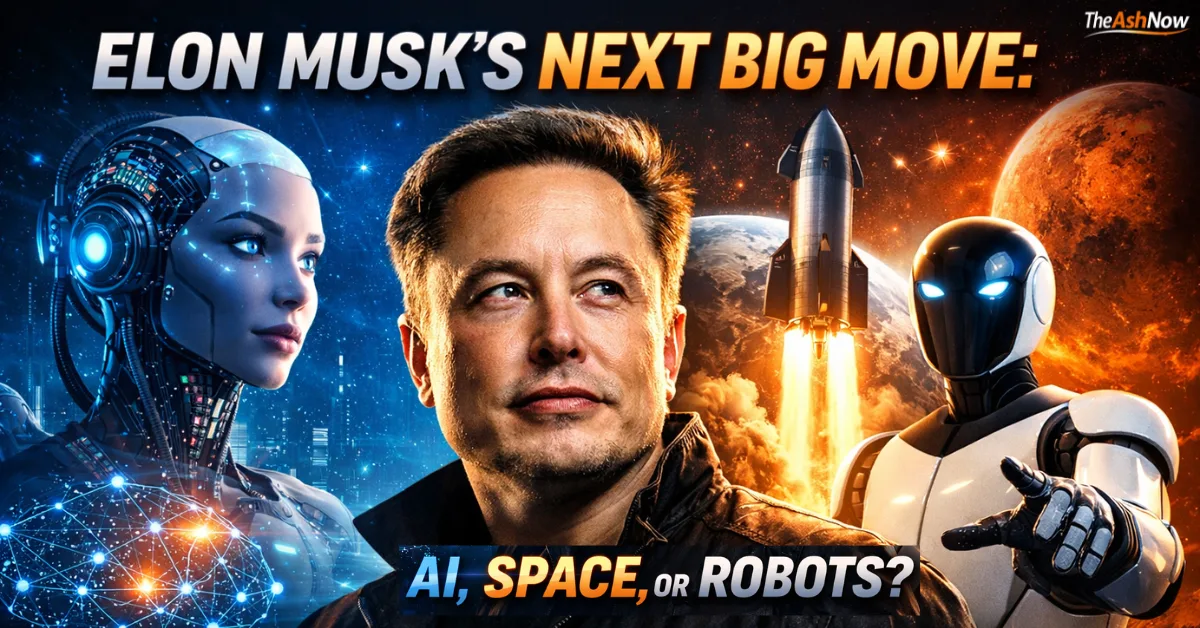
Elon Musk’s Next Big Move: AI, Space, or Robots?
Elon Musk is not just a billionaire businessman. He is one of the most influential figures shaping the future of humanity. Every decision he makes ripples across technology, the economy, politics, and everyday life.
Right now, the world is watching closely because Musk seems to be standing at a crossroads of three powerful domains — Artificial Intelligence, Space, and Robotics. The big question is simple but massive: what will be his next major bet?
Table of Contents
Why This Question Matters
Musk’s moves are never small.
Your Leadership Story Deserves the Spotlight
Get featured on TheAshNow — the editorial platform trusted by founders, CEOs & executives worldwide for Google visibility, LinkedIn authority & global recognition.
Apply for Featured Profile →When he focused on electric cars, Tesla transformed the global auto industry.
When he doubled down on space, SpaceX changed how humans reach orbit.
When he entered AI, governments and tech giants started taking notice.
His next strategic shift could determine jobs, industries, and technological power for the next decade. All three fields are accelerating at the same time, which makes his next priority even more crucial.
Path One: Artificial Intelligence as the Core Strategy
Musk has repeatedly warned that AI could be dangerous if left unchecked. At the same time, he is building powerful AI through xAI, competing with OpenAI, Google DeepMind, and Meta.
If Musk goes all-in on AI, the impact could be revolutionary:
- Smarter AI assistants
- More autonomous machines
- AI integrated into healthcare, education, finance, and governance
However, this path also carries risks — ethical concerns, cybersecurity threats, and mass job displacement.
Many analysts believe AI is the foundation because it will power both robots and space technology.
Related Post
- AI Deception Exposed: UK AI Security Institute Catches Anthropic and OpenAI Models Lying

- The End of Paper Invitations? Why Digital Invitations Are Taking Over Weddings and Events Worldwide in 2026
- Inside TheAshNow AI: Engineering a Scalable Revenue Engine for US Real Estate Teams
- Game-Changing Gadgets of 2026: The Next Tech Revolution
- 10 Best Gaming Gadgets in 2026 Every Serious Gamer Must Own


Path Two: Space Colonization and the Mars Dream
Musk’s biggest lifelong goal has been making humans a multi-planet species.
SpaceX is developing Starship, a spacecraft designed to carry humans to the Moon and Mars. If Musk prioritizes space above everything else, we could see:
- Private space stations
- Moon bases
- First human missions to Mars
- Space tourism for wealthy travelers
But this path is extremely expensive and politically complex. Critics argue that humanity should first fix Earth’s problems before colonizing another planet.
BUILD YOUR LEGACY IN PRINT
Editorial features for founders, CEOs & executives — engineered for search visibility, LinkedIn credibility & industry authority.
APPLY NOW →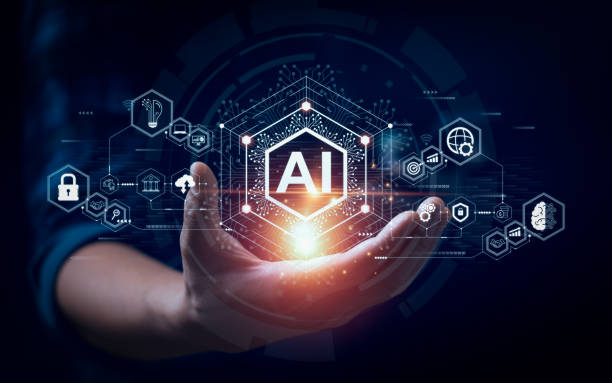
Path Three: Humanoid Robots and the Future of Work
Tesla’s Optimus humanoid robot is one of Musk’s boldest projects.
These robots are designed to do physical labor like:
- Factory work
- Warehouse operations
- Construction tasks
- Household chores
If Musk bets heavily on robots, global employment could change dramatically. Productivity would rise, but millions of routine jobs could disappear.
Rich tech nations would benefit more than developing countries, possibly widening global inequality.
Ad
- Anmol Jaiswal – The Story Behind Indian Backpacker and India’s Most Adventurous Travel Creator
- Joshua Freedman: Emotional Intelligence Leader & CEO
- Alex Hormozi: The Entrepreneur Who Turned Business Growth Into a $100M Playbook
- Alakh Pandey: The Founder of Physics Wallah Who Turned Affordable Education Into a National EdTech Movement
- Kunal Shah: How the FreeCharge and CRED Founder Came to Lead WhatsApp Globally
- Government Constitutes High-Powered Task Force on Examination Reforms Under Nandan Nilekani





Which Path Is Most Likely?
Most experts believe Musk will not choose just one path.
Instead, he will combine all three:
- AI as the brain
- Robots as the body
- Space as the final frontier
If he must prioritize, AI is most likely his core focus, because everything else depends on it.
What This Means for the World
If Musk leads the next AI revolution, he could become the most powerful tech leader in history.
If he succeeds in Mars colonization, he could be remembered like Neil Armstrong.
If his robots dominate industry, he could reshape capitalism itself.
One thing is certain — whatever Musk does next will not just be business. It will shape the destiny of humanity.
Top 5 Globally Searched FAQs: Elon Musk’s Next Big Move?
1. Will Elon Musk really send humans to Mars by 2030?
Musk’s target has long been the early 2030s, not just for a fly-by mission but for an actual landing attempt on Mars. SpaceX’s Starship is the key to this plan. It is designed to be fully reusable, carry massive cargo, and transport dozens of people at once.
However, this timeline depends on three major factors. First, Starship must prove consistent success in Earth orbit. Second, life-support systems for deep space must be perfected. Third, international regulations and funding support must align.
Many space experts believe a robotic Mars landing could happen before 2030, while a human landing is more realistically expected between 2032 and 2035. So yes, it is possible, but extremely ambitious.
2. Is Tesla’s humanoid robot Optimus real or just marketing?
Optimus is real, not a concept video. Tesla has already showcased walking, object handling, and basic task performance. The robot is built using Tesla’s AI vision system, similar to what powers self-driving cars.
At this stage, Optimus is still in development and not ready for mass use. It struggles with complex environments, fine motor skills, and unpredictable human behavior. Musk’s long-term goal is for Optimus to work in factories first and later in homes.
If successful, it could become one of the most important machines of the 21st century, similar to how smartphones changed daily life.
3. Is Elon Musk’s AI safer than OpenAI or Google’s AI?
Musk claims that his company, xAI, focuses more on transparency and safety compared to others. He argues that closed AI systems are dangerous because people do not know how they truly think or make decisions.
However, critics say that competition in AI itself is risky because every company is racing to build more powerful systems. There is no global law yet that strictly controls AI development.
Right now, no one can definitively say that Musk’s AI is safer. It is still evolving, and global regulators are closely watching all major AI companies.
4. Will AI and robots destroy jobs or create more?
The impact will be mixed. In the short term, many routine jobs in factories, warehouses, call centers, and delivery sectors may decline. This includes assembly line work, basic data entry, and repetitive customer service roles.
At the same time, new jobs will emerge in AI training, robotics maintenance, software development, ethics oversight, and advanced engineering. Countries with strong education systems will benefit more than those relying on manual labor.
The real challenge will be reskilling workers rather than eliminating work.
5. Can private companies like SpaceX really colonize space?
Technically, yes — and SpaceX is currently the closest company to making this realistic. Governments like NASA already rely on SpaceX for launches, proving that private firms can operate in space effectively.
However, colonization involves more than rockets. It requires habitats, food production, energy systems, medical facilities, and governance structures. There are also legal questions about who owns land on Mars or the Moon.
Most experts believe that space colonization will likely be a partnership between private companies and national governments rather than Musk acting alone.






[…] Elon Musk’s Next Big Move: AI, Space, or Robots? […]
[…] Elon Musk’s Next Big Move: AI, Space, or Robots? […]