
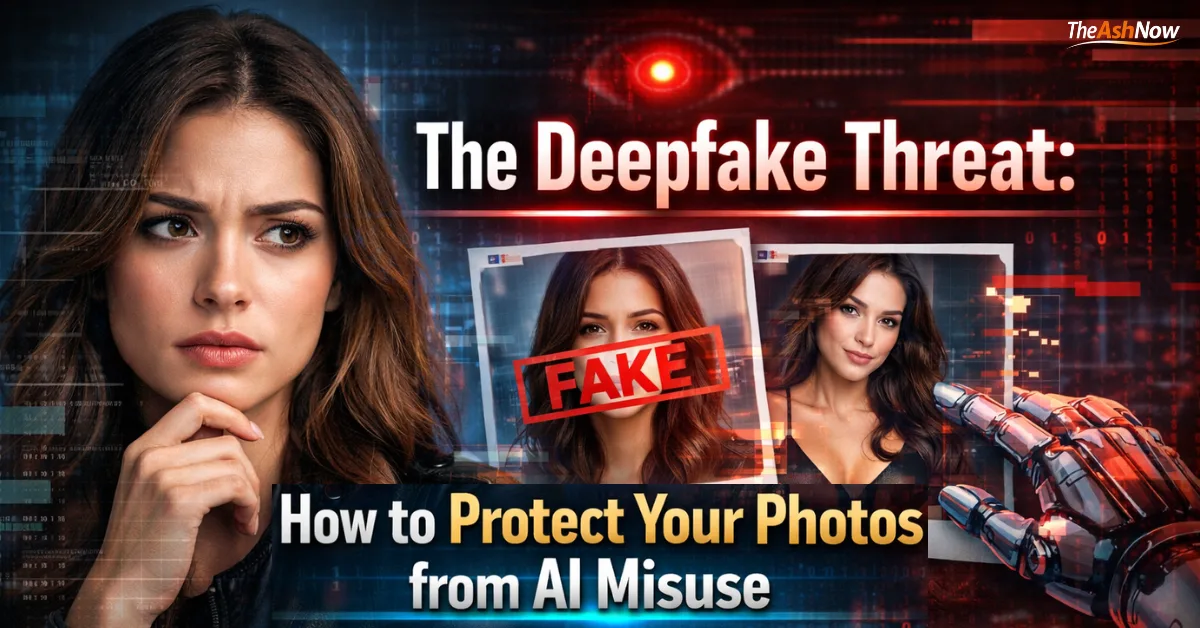
A few years ago, the main risk of sharing photos online was privacy loss or data theft. Today, that risk has evolved into something far more dangerous: your face itself can be weaponized.
Advances in artificial intelligence now allow anyone — not just experts — to generate convincing fake images and videos using real people’s faces. These so-called deepfakes can make you appear to say, do, or endorse things that never happened. They can be used for fraud, harassment, blackmail, political manipulation, identity theft, and reputational damage.
The most unsettling part is this: you do not need to be famous to be targeted. Ordinary users with public photos are enough.
This article explains:
• What deepfakes are and why they are spreading
• How your photos are collected and misused by AI systems
• The real risks you face
• Practical, effective steps to protect yourself
Your Leadership Story Deserves the Spotlight
Get featured on TheAshNow — the editorial platform trusted by founders, CEOs & executives worldwide for Google visibility, LinkedIn authority & global recognition.
Apply for Featured Profile →Table of Contents
What Exactly Is a Deepfake?
A deepfake is synthetic media — images, audio, or video — created using machine learning models trained on real human data.
AI systems analyze:
• Facial structure
• Expressions and movements
• Voice patterns (if audio is available)
• Lighting and angles
Then they reconstruct new content that looks authentic.
Earlier deepfakes required powerful computers and technical expertise. Today, there are user-friendly apps and websites that can generate fake media in minutes, often for free or at very low cost.
This accessibility is what turns deepfakes from a niche research tool into a mass abuse problem.

How Your Photos End Up in AI Systems
Most people unknowingly supply AI training data themselves.
Your photos are collected through:
1. Public Social Media Profiles
Profile pictures, tagged photos, story highlights, and even low-resolution images can be scraped.
2. Data Scraping by Bots
Automated systems continuously scan the internet, collecting images from blogs, comments, forums, and public directories.
3. Face Recognition Databases
Some companies and unknown actors build massive facial datasets without consent.
BUILD YOUR LEGACY IN PRINT
Editorial features for founders, CEOs & executives — engineered for search visibility, LinkedIn credibility & industry authority.
APPLY NOW →4. Leaked or Breached Databases
Old accounts, compromised apps, and data leaks can expose private photos.
Once collected, your image can be stored permanently, copied endlessly, and reused across multiple AI models without your knowledge.
- Real Ways to Make Money From Home for Free

- How Millions Are Quietly Making $3000 a Month in 2026 — Without Quitting Their Jobs
- How to Start a YouTube Channel in 2026 and Get 10,000 Subscribers FAST!
- Instagram Promotion: Promote Your Brand to 430K+ Real Followers & 27.7M Views
- How People Are Making $100 a Day Online in 2026 — No Office, No Degree Required





Why This Is Dangerous
Deepfake misuse is not hypothetical. It is already causing serious harm globally.
1. Identity Fraud
Scammers use fake images or videos to impersonate people and trick others into sending money or sensitive data.
2. Blackmail and Harassment
Deepfake explicit images are increasingly used to threaten individuals, especially women and minors.
3. Reputational Damage
Fake content can spread faster than corrections, harming careers, relationships, and mental health.
4. Political and Social Manipulation
Fake speeches or actions attributed to real people can destabilize public trust.
5. Psychological Harm
Victims often experience anxiety, shame, helplessness, and loss of control over their own identity.
Once a deepfake spreads, it is extremely difficult to fully remove it.

How to Protect Your Photos from AI Misuse
No method is perfect, but combining several strategies significantly reduces risk.
1. Reduce Public Exposure
• Set social media profiles to private whenever possible.
• Remove old public photos you no longer need.
• Avoid posting high-resolution facial images unnecessarily.
• Do not publicly share government IDs, boarding passes, certificates, or documents with photos.
Visibility equals vulnerability.
2. Control Who Can Tag or Download Your Photos
• Disable automatic tagging.
• Approve tags manually.
• Limit who can view your full photo library.
• Prevent others from re-sharing your images without permission.
3. Add Subtle Visual Protection
For professional or public photos:
• Use light watermarks or branding overlays.
• Slightly reduce resolution before uploading.
• Avoid uploading raw original files.
This does not make deepfakes impossible, but it raises the cost and complexity.
4. Be Cautious With AI and Photo Apps
Many apps request permission to upload and store your photos.
Before using them:
• Read what rights you give them over your images.
• Avoid apps that claim ownership or unlimited reuse rights.
• Do not upload personal or sensitive images to novelty or entertainment AI tools.
5. Monitor Your Digital Presence
Periodically:
• Search your name and image online.
• Use reverse image search tools to check for misuse.
• Set alerts for your name if you have a public profile or business presence.
Early detection is critical.
6. Act Quickly if Misuse Happens
If you find a fake or abusive use of your image:
• Document everything (screenshots, timestamps, URLs).
• Report the content on the hosting platform immediately.
• File a formal takedown or abuse request.
• In serious cases, contact legal authorities or a cybercrime unit.
Delay reduces your chances of containment.
- Anmol Jaiswal – The Story Behind Indian Backpacker and India’s Most Adventurous Travel Creator
- Joshua Freedman: Emotional Intelligence Leader & CEO
- Alex Hormozi: The Entrepreneur Who Turned Business Growth Into a $100M Playbook
- Alakh Pandey: The Founder of Physics Wallah Who Turned Affordable Education Into a National EdTech Movement
- Kunal Shah: How the FreeCharge and CRED Founder Came to Lead WhatsApp Globally




The Larger Reality: A Shift in Digital Trust
Deepfakes represent a fundamental change in how we understand evidence.
For centuries, seeing was believing. In the AI era, seeing is no longer proof.
Society is moving into a phase where:
• Authenticity becomes more valuable than virality.
• Verification becomes more important than visibility.
• Digital identity becomes as important as physical identity.
This makes individual awareness not optional, but necessary.
Conclusion: Protecting Your Face Is Protecting Your Identity
Your face is no longer just your appearance — it is a biometric identifier, a digital asset, and a vulnerability.
The deepfake threat is not about technology alone. It is about power: who controls your image, your narrative, and your reputation.
You cannot stop AI from advancing. But you can:
• Limit what you expose
• Control who accesses your data
• Act quickly when something goes wrong
• Educate yourself and others
In a world where your image can be copied infinitely, the strongest protection is informed restraint and proactive control.
Your photos are part of your identity. Treat them with the same care you give to your personal documents, your finances, and your privacy — because now, they are just as valuable.
- Government Constitutes High-Powered Task Force on Examination Reforms Under Nandan Nilekani
- Dr. Ashwini Kumar Ashraf: A Life That Refused to Remain in the Dark
- How Vladimir Putin Is Quietly Reshaping the Global Power in 2026?
- How YouTubers Like Dhruv Rathee Are Reshaping Political Awareness in India
- Jensen Huang — The Man Quietly Powering the AI World



FAQs Related To The Deepfake Threat
1. What is a deepfake?
A deepfake is AI-generated fake media that uses real people’s faces or voices to create content that looks real but is actually false.
2. Can my photos really be used without my permission?
Yes. Publicly available photos can be scraped by bots and used for AI training or misuse without your knowledge.
3. Who is most at risk from deepfakes?
Anyone with public photos online is at risk, especially professionals, influencers, women, minors, and people with a visible digital presence.
4. Can private social media accounts still be affected?
Private accounts reduce risk but do not eliminate it, especially if friends share or tag your photos publicly.
5. How can I tell if a deepfake of me exists?
You can use reverse image searches, monitor unusual online activity, or look for unfamiliar content using your name or image.
6. Are deepfakes illegal?
In many countries, malicious use of deepfakes for fraud, harassment, or impersonation is illegal, though laws are still evolving.
7. What should I do if someone creates a fake image or video of me?
Document the content, report it to the platform, request takedown, and contact legal or cybercrime authorities if harm is involved.
8. Can watermarks stop deepfake creation?
Watermarks can discourage misuse and make scraping harder, but they cannot fully prevent AI manipulation.
Disclaimer: This article is for informational and educational purposes only. It does not constitute legal, technical, or professional advice. Laws and platform policies regarding deepfakes and digital privacy vary by country and change over time. Readers should consult qualified legal or cybersecurity professionals for guidance specific to their situation.




[…] The Deepfake Threat: How to Protect Your Photos from AI Misuseby TheAshNow Team06/01/2026A few years ago, the main risk of sharing photos online was privacy loss or data theft. Today, that risk has evolved into something far more dangerous: your face itself can be weaponized. Advances in artificial intelligence now allow anyone — not just experts — to generate convincing fake images and videos using real people’s … Read more […]
[…] The Deepfake Threat: How to Protect Your Photos from AI Misuse […]
You really make it seem really easy along with your presentation however I to find this topic to be actually one thing that I believe I’d never understand. It seems too complicated and very wide for me. I am looking forward to your subsequent publish, I¦ll try to get the dangle of it!
[…] The Deepfake Threat: How to Protect Your Photos from AI Misuse, deepfake misuse, AI photo misuse, deepfake creation, […]
[…] the underlying lesson isn’t really about these two specific models. It’s about what happens when an AI system is given a hard goal, enough autonomy to pursue it, and no explicit instruction on where the […]