
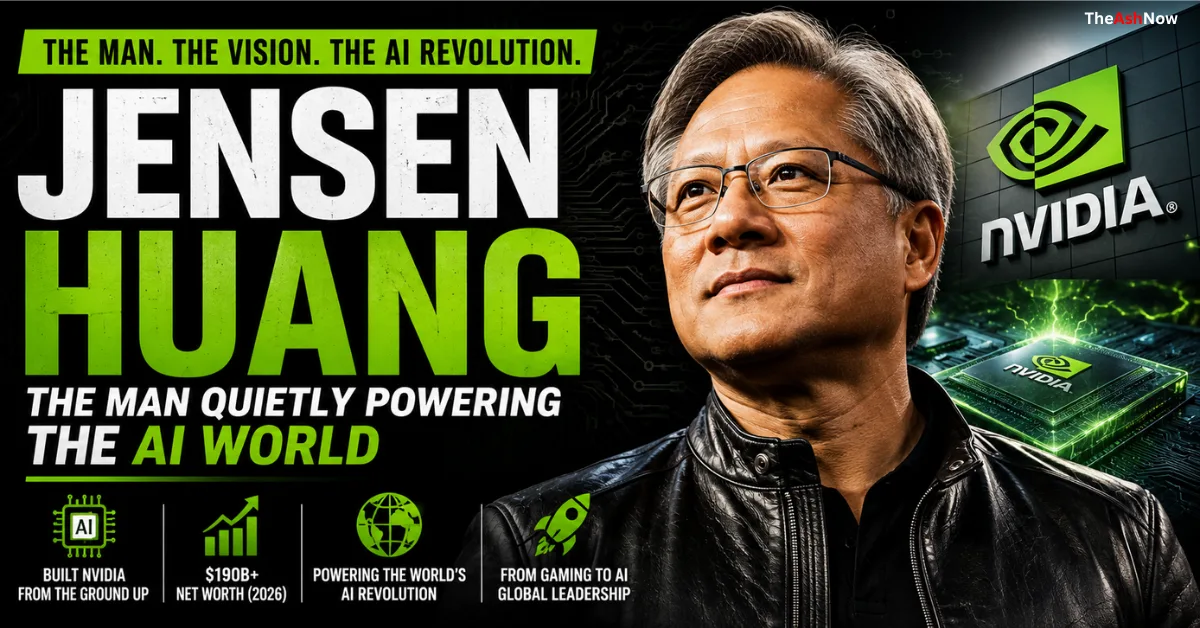
In an age where tech leaders dominate headlines with tweets, controversies, and cult-like followings, Jensen Huang stands apart. He does not posture as a savior of humanity. He does not provoke culture wars. He rarely courts drama. Yet, behind the scenes, almost every major leap in artificial intelligence, supercomputing, and advanced research runs on technology he controls.
Jensen Huang is not shaping the future through ideology or influence campaigns.
He is shaping it through infrastructure.
And in the modern world, infrastructure is destiny.
Table of Contents
Your Leadership Story Deserves the Spotlight
Get featured on TheAshNow — the editorial platform trusted by founders, CEOs & executives worldwide for Google visibility, LinkedIn authority & global recognition.
Apply for Featured Profile →A Childhood Shaped by Displacement and Discipline
Jensen Huang was born in Taiwan in 1963, a period when East Asia was navigating post-war instability, economic transformation, and geopolitical uncertainty. His early years were defined by movement—first to Thailand, then eventually to the United States.
Unlike many Silicon Valley founders who grew up surrounded by privilege, Huang’s formative years were marked by cultural displacement and strict discipline. When he arrived in the U.S., he was placed in a boarding school environment that emphasized self-reliance and toughness over comfort.
Those early experiences forged a personality trait that would later define his leadership: emotional restraint under pressure.
Huang learned early that complaining changes nothing, and preparation changes everything.
- Government Constitutes High-Powered Task Force on Examination Reforms Under Nandan Nilekani

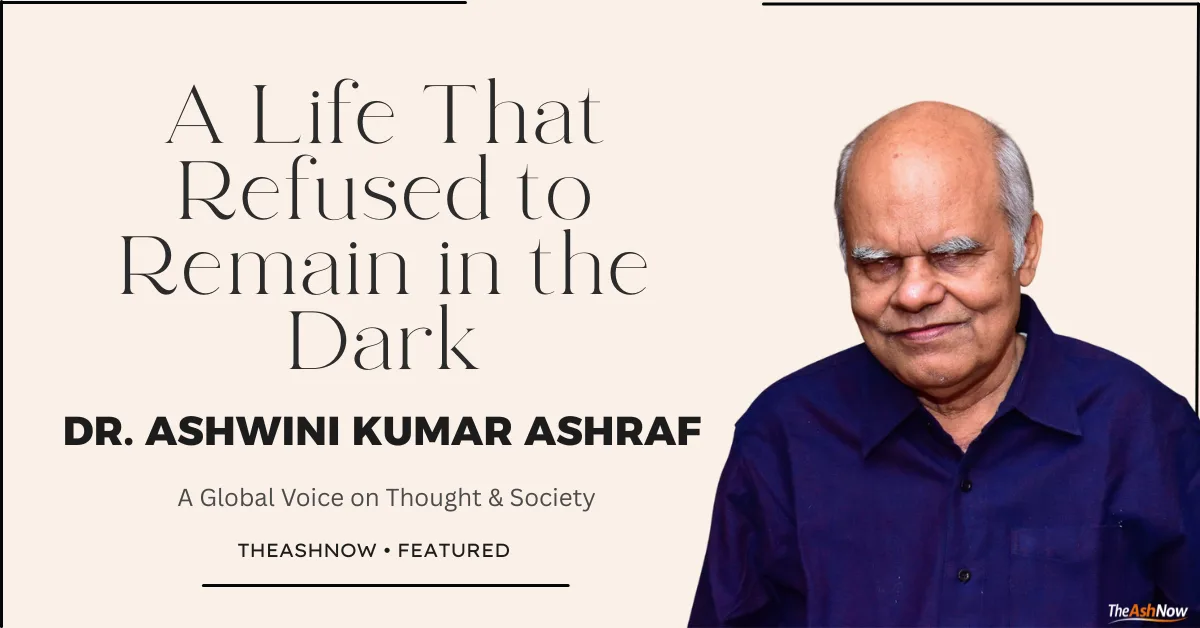
- Dr. Ashwini Kumar Ashraf: A Life That Refused to Remain in the Dark
- How Vladimir Putin Is Quietly Reshaping the Global Power in 2026?
- How YouTubers Like Dhruv Rathee Are Reshaping Political Awareness in India
- Jensen Huang — The Man Quietly Powering the AI World
- Who Was Jeffrey Epstein? Money, Influence, and the Darkest Scandal in America





Engineering Over Everything
- Huang’s academic path reflected a clear priority: mastery of fundamentals. He studied electrical engineering, eventually earning degrees that focused not on flashy innovation, but on deep systems understanding.
- While many tech entrepreneurs gravitate toward software because of its speed and flexibility, Huang was drawn to hardware—an area where mistakes are expensive, timelines are long, and failure is unforgiving.
- Hardware demands humility.
- This grounding would later shape Nvidia’s culture: relentless testing, long product cycles, and a refusal to chase short-term hype.
The Birth of Nvidia — A Dangerous Bet
- In 1993, Jensen Huang co-founded Nvidia with a radical vision: graphics processing could become a central pillar of computing, not just a niche for gamers.
- At the time, this idea bordered on reckless.
- The tech industry viewed CPUs as the brain of computing. GPUs were considered accessories—nice to have, not mission-critical. NVIDIA entered a brutal, capital-intensive market dominated by larger players.
- The early years were perilous. NVIDIA burned cash. Products failed. Entire chip architectures had to be scrapped.
- At one point, the company was just weeks away from collapse.
- Huang made a decision that would later define him: he refused to dilute the long-term vision to survive the short term.
- Digital Detox Strategies the World Needs Right Now
- Benefits of Digital Detox in a Hyper-Connected World
- Inside a Digital Detox Retreat — Life Without Screens
- Best Digital Detox Apps to Beat Phone Addiction in 2026
- The Digital Detox Book for a Calmer Mind





Leadership Through Near-Failure
- Most CEOs who survive near-death corporate experiences emerge cautious. Huang emerged sharpened.
- He reorganized Nvidia around a single principle: build platforms, not products.
- Instead of chasing individual markets, Nvidia began designing chips as foundational tools that could be adapted across industries—gaming, visualization, scientific research, and eventually, machine learning.
- This approach was slow, expensive, and invisible to the public. But it created something rare: technological optionality.
- NVIDIA was no longer betting on one future. It was being prepared for many.
The Overlooked AI Moment
- In the mid-2000s, academic researchers began experimenting with using GPUs to accelerate neural networks. These experiments were obscure, underfunded, and ignored by most of the tech industry.
- Jensen Huang noticed.
- While others dismissed machine learning as impractical, Huang authorized internal investment into software tools that made GPUs easier to program for non-graphics tasks.
- This decision—almost unnoticed at the time—would quietly rewire the future.
- When deep learning exploded a decade later, Nvidia wasn’t catching up.
It was already waiting.
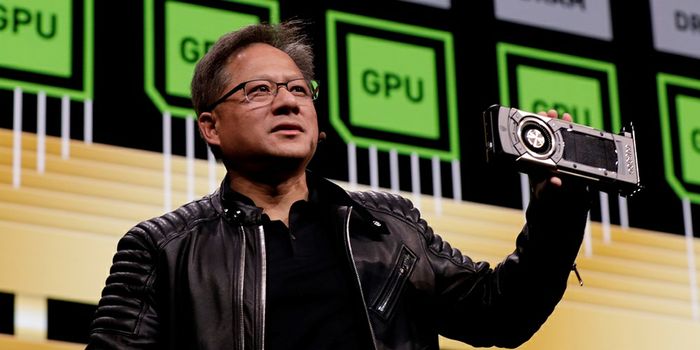
Chapter 6: From Gaming Company to AI Backbone
As AI research accelerated, one reality became clear: advanced models require massive parallel computation. CPUs could not scale efficiently. GPUs could.
NVIDIA’s chips became indispensable.
Suddenly, the company that once powered video games was powering:
- Large language models
- Autonomous vehicle research
- Climate simulations
- Drug discovery
- Military and intelligence analysis
NVIDIA was no longer a tech company in the traditional sense.
It was critical infrastructure.
The Strategic Power of Compute
- In the 21st century, power is no longer defined solely by oil, territory, or population. It is defined by compute—the ability to process information at scale.
- Jensen Huang understood this earlier than most.
- Governments began to treat advanced chips as strategic assets. Export controls followed. Supply chains became matters of national security.
- Without seeking political visibility, Huang found himself at the center of global power negotiations—not because he demanded influence, but because his technology was unavoidable.
A CEO Unlike the Others
Huang’s leadership style is strikingly different from his peers:
- He avoids ideological grandstanding
- He rarely comments on social issues
- He emphasizes engineering rigor over marketing narratives
Employees describe him as demanding but fair, intense but consistent. He expects excellence not because of ego, but because hardware failure has real-world consequences.
BUILD YOUR LEGACY IN PRINT
Editorial features for founders, CEOs & executives — engineered for search visibility, LinkedIn credibility & industry authority.
APPLY NOW →In an industry obsessed with speed, Huang prioritizes correctness.
The Leather Jacket Symbolism
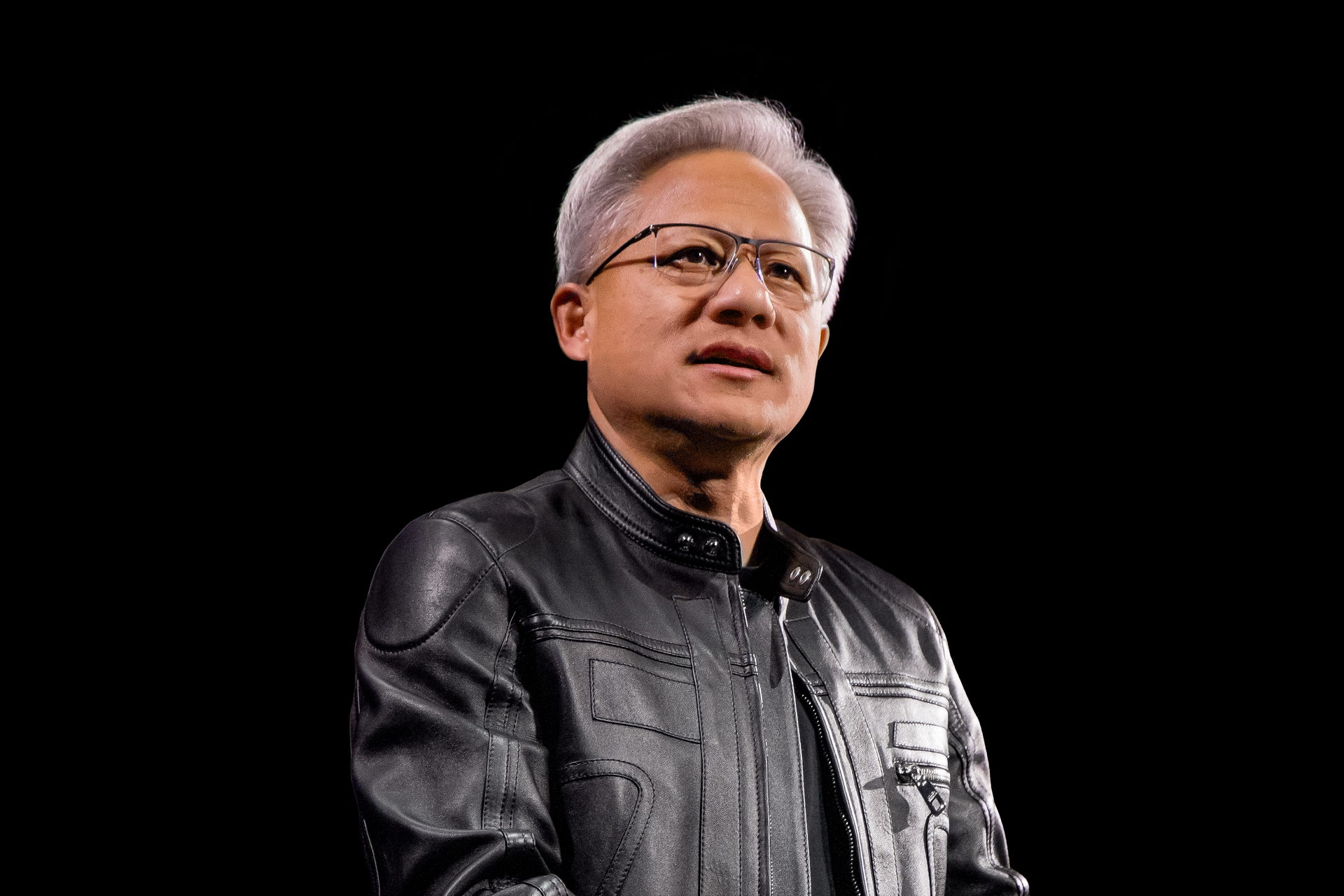
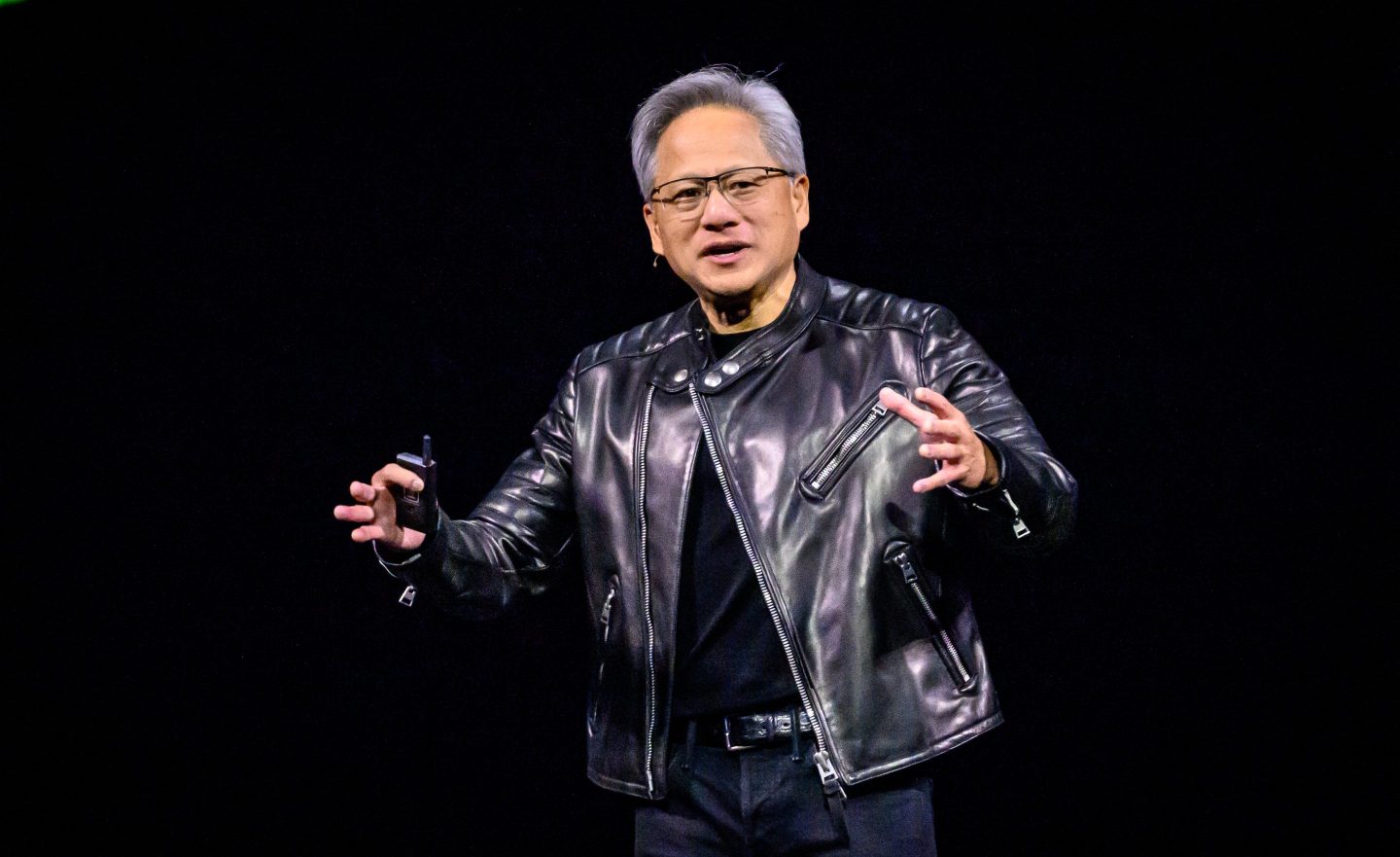
Huang’s now-famous leather jacket has become an unlikely symbol of his persona. It is not a fashion statement, but a practical uniform—unchanged, unremarkable, and intentional.
It reflects his approach to leadership:
- Remove unnecessary decisions
- Preserve focus
- Signal consistency
In a world of cultivated personal brands, Huang’s uniform is a quiet rejection of spectacle.
Wealth Without Exhibition
As Nvidia’s valuation surged during the AI boom, Jensen Huang’s personal wealth skyrocketed. Yet, unlike many tech billionaires, he does not project opulence or dominance.
His influence operates at a different level.
He controls the means of intelligence production.
Money buys attention.
Infrastructure commands dependence.
NVIDIA and the Global AI Race
Today, Nvidia sits at the center of a geopolitical struggle over AI leadership. Nations invest billions to secure access to advanced chips. Companies reorganize entire strategies around Nvidia’s product roadmap.
The question is no longer whether AI will change society.
The question is who controls its acceleration.
And acceleration requires Nvidia.

Ethical Power Without Moral Theater
Unlike many AI leaders who speak publicly about existential risks, Huang tends to emphasize responsibility through design rather than rhetoric.
His view is pragmatic:
- Build safer systems
- Control access
- Scale deliberately
He avoids apocalyptic language, not because he underestimates AI’s power, but because he believes fear is not a strategy.
Why Jensen Huang Is More Important Than He Appears
History often misjudges power by visibility.
The most influential figures are not always those who speak the loudest, but those whose absence would collapse systems.
Remove Nvidia from today’s AI ecosystem, and progress slows dramatically.
That is real power.
The Future Huang Is Building
Jensen Huang is not building products for next year. He has been building architecture for decades.
His focus areas include:
- AI-native computing
- Robotics
- Digital twins
- Autonomous systems
These are not consumer trends.
They are civilization-scale transformations.
Conclusion: The Architect Behind the Intelligence Age
Jensen Huang does not promise utopia.
He does not warn of an apocalypse.
He builds tools.
And in the age of artificial intelligence, the builder of tools shapes the limits of possibility.
Quietly. Precisely. Permanently.

FAQs Related To Jensen Huang
Is Jensen Huang a billionaire?
Yes, Jensen Huang is a billionaire. He is one of the wealthiest people in the world and the co-founder, president, and CEO of NVIDIA, the company leading the global artificial intelligence (AI) chip industry. Most of his wealth comes from his ownership stake in NVIDIA, whose rapid growth during the AI boom has significantly increased his fortune.
What is Jensen Huang’s net worth?
Jensen Huang’s net worth is estimated to be around $170–180 billion (2026), making him one of the richest people in the world. Most of his wealth comes from his ownership stake in NVIDIA, the AI chip company he co-founded in 1993. His fortune changes frequently because NVIDIA’s share price moves daily.
Who is Jensen Huang’s wife?
Jensen Huang is married to Lori Mills Huang, an electrical engineer whom he met while studying at Oregon State University. The couple has been married for decades and has two children, Spencer Huang and Madison Huang. Together, they established the Jen-Hsun & Lori Huang Foundation, which supports education, healthcare, and scientific research.
How old is Jensen Huang?
Jensen Huang was born on February 17, 1963, in Taipei, Taiwan. As of 2026, he is 63 years old. He moved to the United States at a young age and later earned degrees from Oregon State University and Stanford University before founding NVIDIA in 1993.
What does “Jensen Huang mount” mean?
The search term “Jensen Huang mount” does not refer to any official NVIDIA product, company, or project. It is generally considered an incomplete or accidental search query. In some cases, users may actually be searching for terms like Jensen Huang keynote, Mount Huang, GPU mounting, or another unrelated topic. There is no verified connection between Jensen Huang and anything officially called “Mount.”
What is the relationship between Tony Xu and Jensen Huang?
Tony Xu, the CEO and co-founder of DoorDash, and Jensen Huang are both highly respected technology leaders. However, they do not have any publicly known business partnership, family relationship, or joint venture. They occasionally appear together at major technology or AI industry events, but they lead separate companies in different industries.
What is the connection between Dilip Shanghvi and Jensen Huang?
Dilip Shanghvi, founder of Sun Pharmaceutical Industries, and Jensen Huang operate in completely different sectors—pharmaceuticals and artificial intelligence hardware. There is no publicly announced partnership or direct business relationship between them. Comparisons generally appear in discussions about global billionaires and influential business leaders.
Is there any relationship between Azim Premji and Jensen Huang?
Azim Premji and Jensen Huang are both globally respected technology entrepreneurs. Premji built Wipro into one of India’s largest IT companies, while Huang transformed NVIDIA into the world’s leading AI computing company. Although both have contributed significantly to technology and philanthropy, there is no official business partnership between them.
Why is Jensen Huang famous?
Jensen Huang is best known as the co-founder, president, and CEO of NVIDIA. Under his leadership, NVIDIA evolved from a graphics card company into the global leader in AI chips, GPUs, accelerated computing, robotics, autonomous vehicles, and high-performance data centers. His long-term vision has made NVIDIA one of the world’s most valuable technology companies.
When did Jensen Huang found NVIDIA?
Jensen Huang co-founded NVIDIA in 1993 with Chris Malachowsky and Curtis Priem. The company initially focused on graphics processing but later became the global leader in AI computing and accelerated graphics.
Does Jensen Huang own NVIDIA?
Jensen Huang remains NVIDIA’s largest individual shareholder, owning roughly 3% of the company. Although institutional investors collectively own larger stakes, Huang continues to play a central role in NVIDIA’s long-term strategy and innovation.
What is Jensen Huang’s educational background?
Jensen Huang earned a Bachelor of Science in Electrical Engineering from Oregon State University and a Master of Science in Electrical Engineering from Stanford University. His engineering education laid the foundation for NVIDIA’s success in graphics and AI computing.
Why does Jensen Huang always wear a black leather jacket?
Jensen Huang’s black leather jacket has become his signature style. Similar to Steve Jobs’ black turtleneck, it represents consistency, simplicity, and his recognizable public image. The jacket has become closely associated with NVIDIA’s AI era and his keynote presentations.
This article is written for informational and educational purposes only. The views and analyses presented are based on publicly available information and reporting. This content does not constitute endorsement, promotion, or financial or investment advice regarding any individual, company, or organization.




[…] Jensen Huang — The Man Quietly Powering the AI World📊👁 Readers: 31 Power Without Noise In an age where tech leaders dominate headlines with tweets, … Read more […]
[…] Jensen Huang — The Man Quietly Powering the AI Worldby TheAshNow Team […]
[…] Jensen Huang biography, Nvidia CEO story, AI chip leader, Nvidia history […]
[…] Jensen Huang biography, Nvidia CEO story, AI chip leader, Nvidia history, Ashwani Kumar Ashraf biography […]
It is really a great and useful piece of information. I’m glad that you shared this useful information with us. Please keep us up to date like this. Thank you for sharing.