
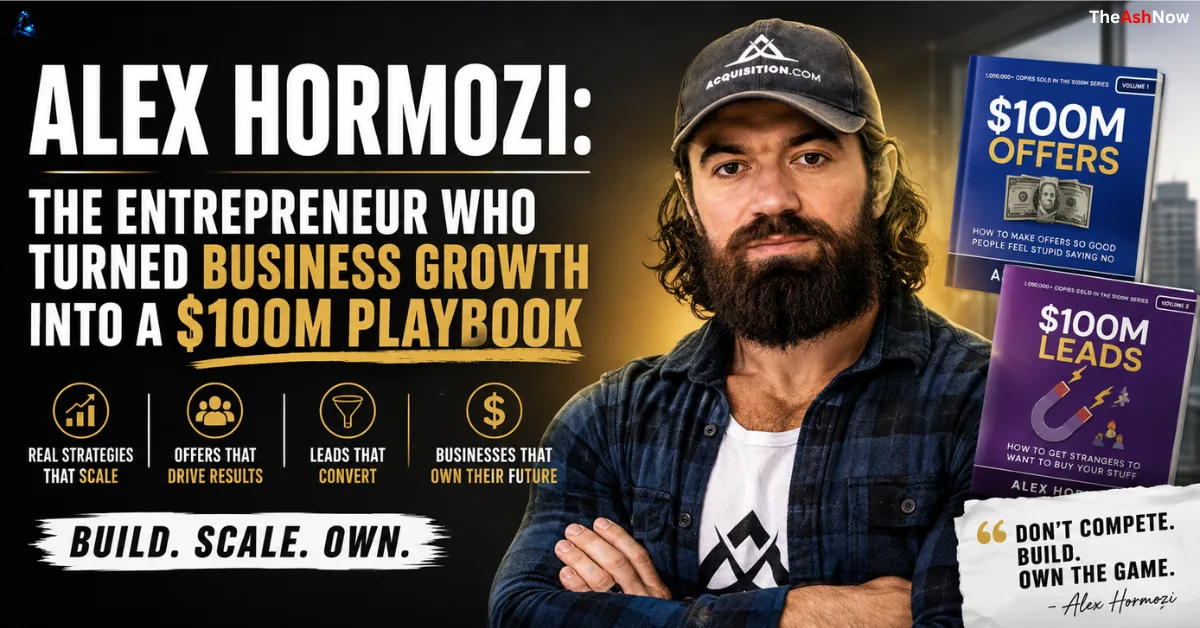
There is a particular kind of entrepreneur who becomes famous by building a company. Then there is a different kind who becomes famous by repeatedly and relentlessly explaining how companies are built.
Alex Hormozi belongs to the second category—but that distinction is only useful up to a point.
Before the books, the viral clips, the packed business events, the millions of social-media followers, and Acquisition.com, Hormozi was a young entrepreneur trying to make a gym business work. His early story was not built around a revolutionary technology company or a venture-capital-backed startup. It began in the far more ordinary—and often unforgiving—world of brick-and-mortar fitness.
That background matters.
Your Leadership Story Deserves the Spotlight
Get featured on TheAshNow — the editorial platform trusted by founders, CEOs & executives worldwide for Google visibility, LinkedIn authority & global recognition.
Apply for Featured Profile →Hormozi’s business philosophy did not emerge in a vacuum. Much of what later became his public framework for acquiring customers, improving offers, increasing revenue, and scaling companies can be traced back to practical problems he encountered while operating gyms and helping other gym owners survive.
His career is therefore best understood not as a sudden internet phenomenon, but as a sequence of transformations: operator to consultant, consultant to business builder, business builder to investor, and investor to educator and media entrepreneur.
Today, Alex Hormozi is best known as the founder and managing partner of Acquisition.com, an investment and education company he built with Leila Hormozi. The firm focuses on businesses with an emphasis on sales, cash flow, asset-light models, and scalability. Before Acquisition.com, Hormozi and Leila built companies including Gym Launch, Prestige Labs, and ALAN. In 2021, Gym Launch and Prestige Labs were sold in a $46.2 million transaction, according to Acquisition.com’s account of the deal.
But the financial milestones are only one part of the story.
The more consequential development has been Hormozi’s evolution into a prominent voice in modern entrepreneurship. His books, particularly $100M Offers and $100M Leads, turned his operational philosophy into repeatable frameworks. His social-media content then converted those frameworks into short, highly shareable lessons on pricing, sales, marketing, discipline, business strategy, and personal responsibility.

That combination has made him unusually influential among online entrepreneurs.
It has also made him unusually scrutinized.
Hormozi’s style is deliberately direct. He favors blunt language over corporate polish, frameworks over abstractions, and measurable outcomes over inspirational rhetoric. Supporters see that as refreshing clarity. Critics sometimes see the same communication style as oversimplification or excessive certainty.
Both observations are useful.
The most interesting question about Alex Hormozi is not whether every one of his ideas should be copied. It is why his ideas have found such a large audience—and what his trajectory reveals about the changing relationship between entrepreneurship, media, education, and personal branding.
BUILD YOUR LEGACY IN PRINT
Editorial features for founders, CEOs & executives — engineered for search visibility, LinkedIn credibility & industry authority.
APPLY NOW →Table of Contents
Alex Hormozi at a Glance
| Category | Profile |
|---|---|
| Full Name | Alex Hormozi |
| Known For | Entrepreneurship, investing, business education, customer acquisition and monetization |
| Current Role | Founder and Managing Partner, Acquisition.com |
| Major Earlier Ventures | Gym Launch, Prestige Labs, ALAN |
| Education | Vanderbilt University |
| Degree | Bachelor of Science in Human & Organizational Development, with a focus on Corporate Strategy |
| Major Books | $100M Offers, $100M Leads, $100M Money Models |
| Business Focus | Sales, customer acquisition, monetization, scaling, asset-light businesses |
| Major Transaction | Sale involving Gym Launch and Prestige Labs valued at $46.2 million in 2021 |
| Business Partner | Leila Hormozi |
| Primary Public Influence | Entrepreneurship education, business strategy, digital media |
Much of the current financial and scale-related information associated with Hormozi comes from Acquisition.com’s own published materials. Where figures are company-reported rather than independently audited public-company disclosures, they should be understood in that context.
Early Life and Background
Alex Hormozi was born into an Iranian-American family and grew up in the United States. His background is relevant to understanding the broader cultural dimension of his later identity: he became part of a generation of American entrepreneurs who increasingly built businesses in public and used digital platforms as distribution channels for ideas.
Unlike the mythology that often surrounds successful founders, Hormozi’s early years did not immediately point toward the creation of a multimillion-dollar investment platform.
He attended Gilman School and later Vanderbilt University, where he studied Human and Organizational Development with a focus on Corporate Strategy. According to Acquisition.com’s biography, he graduated magna cum laude in three years.
That academic path offers an early clue about something that later became central to his career: Hormozi has consistently been interested less in a single technical discipline than in how people, organizations, incentives, and strategies interact.
He did not emerge as an engineer building a proprietary technology platform.
He emerged as an operator.
After college, Hormozi worked for a boutique strategy consulting firm for approximately two years. Consulting provided exposure to the language of business strategy, but it did not ultimately become his long-term career.
The entrepreneurial pull was stronger.

From Corporate Strategy to Entrepreneurship
Hormozi has described his early entrepreneurial decision as less about discovering a perfect calling than figuring out what kind of work he did not want to spend his life doing.
That is an important distinction.
Many entrepreneurial success stories are narrated backward. Once the outcome is known, every earlier decision can appear inevitable. In reality, the path is usually much messier.
Hormozi’s transition was a series of experiments.
He was deeply interested in fitness and eventually entered the gym business. In 2013, he started his first brick-and-mortar business. Within a few years, he had expanded to six locations.
The significance of this period is greater than the number of gyms alone.
Operating physical businesses forces entrepreneurs to confront a collection of problems that abstract business plans often ignore: rent, payroll, customer acquisition, retention, staffing, sales performance, local competition, operating procedures, and cash flow.
A gym can have a great product and still fail.
People may like exercising without wanting to buy a membership. A facility can be impressive without generating enough leads. An owner can be passionate about fitness and still be poor at selling.
Hormozi began focusing intensely on that gap between having a business and having a business that reliably acquires and retains customers.
That gap eventually became the foundation of his career.
The Gym Years Changed the Direction of His Career
The early gym business taught Hormozi an idea that would later dominate his books and public teaching: growth is often constrained not by the quality of the underlying product, but by the system surrounding it.
A gym owner might believe the problem is competition.
Another might believe it is pricing.
Another might blame the economy.
Hormozi increasingly looked for a more operational explanation.
Where are the leads coming from?
What does the sales process look like?
What exactly is being offered?
How is value being communicated?
What happens after someone buys?
And perhaps most importantly: which constraint is actually limiting growth?
This problem-solving mentality later became one of the most recognizable features of his business philosophy.
Learning From Other Gym Owners
After building his own locations, Hormozi moved into the business of helping other brick-and-mortar gyms.
According to Acquisition.com’s account, he spent nearly two years working with more than 32 brick-and-mortar businesses, helping turn around their operations using the systems he had developed.
This stage was pivotal because it transformed his experience from something local and personal into something repeatable.
A gym operator can make one location work through personal effort.
But a scalable business requires something different.
A process has to be documented.
The sales script has to be transferable.
The offer has to be replicable.
The marketing system has to be understandable by employees who are not the founder.
The model has to work outside a single neighborhood.
In other words, Hormozi began discovering that business knowledge itself could become a product.
That realization would eventually become one of the most valuable lessons of his career.
The Moment a Gym Business Became an Intellectual Property Business
One of the most revealing stories from Hormozi’s early career involves a salesman who wanted access to the materials Hormozi had developed.
Hormozi has recounted that he initially named a price of $6,000 for his sales scripts and launch materials, expecting the person to decline.
Instead, the person accepted.
The response changed Hormozi’s perception of what he had built.
The scripts were not merely internal tools.
They had economic value outside his own company.
That insight led him to approach other gym owners and license the systems he had developed. Acquisition.com’s published history says the licensing model scaled rapidly, eventually contributing to the growth of Gym Launch.
The episode is important because it illustrates a principle that became central to Hormozi’s career:
A process becomes dramatically more valuable when it can be transferred.
That idea is easy to state and difficult to execute.
Many founders understand their businesses through intuition. They know what to do because they have done it hundreds of times. But intuitive knowledge is difficult to scale.
Hormozi’s response was to turn experience into systems.
The gym was the laboratory.
The licensing model was the experiment.
The intellectual property was the scalable asset.
The Role of Leila Hormozi
Any serious profile of Alex Hormozi is incomplete without discussing Leila Hormozi.
The two became business partners and later married. Their collaboration became fundamental to the next stage of their careers.
Leila was involved in the businesses that followed Gym Launch, and the couple eventually built their portfolio together.
Alex has publicly credited Leila as a critical influence on his development. In discussions of their partnership, he has often described the relationship in terms of complementary strengths rather than simple duplication.
That distinction is important.
Successful founder partnerships often work because the two people do not approach every problem identically.
One may be more oriented toward strategy.
Another may focus more heavily on operations.
One may naturally think in terms of opportunity.
Another may concentrate on execution and risk.
The Hormozis’ public business story reflects this complementary model.
The result was not simply a personal brand built around Alex. It became an operating platform capable of supporting multiple businesses and eventually an investment company.
From Gym Launch to a Broader Business Portfolio
Gym Launch was only the beginning.
Hormozi and Leila went on to build or participate in businesses in multiple sectors, including supplementation and software-related ventures.
Prestige Labs became part of the expansion beyond gym consulting.
ALAN represented another move into software.
According to Acquisition.com’s biography, the broader group of businesses generated more than $120 million in cumulative sales across four industries during one four-year period without outside capital, while Hormozi says he scaled and exited seven companies.
These figures are company-reported and should therefore be interpreted accordingly, but the strategic pattern is easier to identify than any individual number.
Hormozi was moving away from dependence on a single operating business.
He was learning how to transfer a common commercial playbook across categories.
That playbook centered on a recurring set of questions:
What is the customer actually buying?
How valuable is the outcome?
How clearly is the value communicated?
How efficiently can customers be acquired?
How predictable is the revenue?
How much of the operation depends on the founder?
And what would have to change for the company to grow without proportional increases in complexity?
These questions became the backbone of Hormozi’s approach to scaling.
The 2021 Transaction Was a Major Turning Point
In 2021, a private-equity sponsor purchased Gym Launch and Prestige Labs in a transaction valued at $46.2 million, according to Acquisition.com’s published history.
The significance of the transaction goes beyond the headline number.
For Hormozi, the sale represented a transition from operator to owner-investor.
A founder who spends years thinking about customers, employees, salespeople, advertising, and operational problems eventually accumulates a kind of business pattern recognition.
The next question becomes:
What if that knowledge could be deployed across companies rather than inside one?
That question helped lead to Acquisition.com.
Why Acquisition.com Matters
Acquisition.com was founded as a platform through which Hormozi could deploy both financial and intellectual capital into other businesses.
The company’s stated investment thesis has emphasized asset-light, high-cash-flow businesses, particularly sales-focused service and digital-product companies.
This is consistent with the intellectual trajectory of Hormozi’s earlier career.
He did not suddenly become an investor.
He became an investor after years of operating.
That distinction is meaningful.
Venture capital often emphasizes future potential, technological differentiation, market size, and rapid growth.
Hormozi’s public framework tends to place greater emphasis on fundamentals such as customer acquisition, pricing, sales conversion, operating efficiency, and cash generation.
The underlying philosophy can be summarized simply:
A business becomes more valuable when it can generate predictable economic results without relying excessively on the founder.
That idea sits at the heart of the Acquisition.com model.
The Philosophy Behind Hormozi’s Business Strategy
Hormozi’s approach can appear complicated because he has developed dozens of frameworks, formulas, examples, and teaching concepts.
At a deeper level, however, many of them revolve around a relatively small number of principles.
Value Before Volume
One of Hormozi’s most influential ideas is that companies should increase the perceived and actual value of what they sell before simply trying to sell more of it.
This became the foundation of $100M Offers.
His argument is essentially that a weak offer cannot always be rescued by stronger advertising.
If customers do not perceive the proposition as compelling, generating additional traffic only scales the inefficiency.
In that sense, acquisition and monetization are connected.
A business does not merely need leads.
It needs a reason for those leads to become customers.
The Offer as a Strategic Asset
Traditional marketing often focuses on promotion.
Hormozi focuses heavily on the thing being promoted.
His concept of the “Grand Slam Offer” is built around increasing the value proposition through elements such as desirable outcomes, perceived likelihood of achievement, reduced effort or delay, bonuses, guarantees, scarcity mechanisms, and improved packaging.
Whatever one thinks of the terminology, the broader commercial insight is straightforward:
Marketing becomes easier when the product is easier to say yes to.
That is a powerful idea because it moves the conversation from advertising tactics toward product-market communication.
Leads Are a Separate Problem
After an offer exists, there is another problem.
Who sees it?
That became the organizing question behind $100M Leads.
Hormozi’s framework treats lead generation as a system rather than a single advertising channel. Organic content, paid acquisition, referrals, affiliates, strategic partnerships, warm outreach, and other mechanisms can all create demand.
The important conceptual shift is that customer acquisition is treated as an operating capability.
In a mature business, lead generation should not depend on random bursts of inspiration.
It should be engineered.
The Books That Turned Hormozi Into a Global Business Educator
Hormozi’s books changed the scale of his influence.
$100M Offers
Published in 2021, $100M Offers introduced the framework that made Hormozi particularly recognizable outside his immediate business network.
The book focuses on creating offers that are easier for customers to understand and harder to reject.
Its appeal lies partly in simplification.
Business education is often filled with terminology that makes straightforward concepts sound inaccessible. Hormozi reverses that approach. His writing tends to reduce complicated commercial questions into formulas, scorecards, equations, and practical decisions.
The book is not a traditional management text.
It reads more like a field manual.
That is precisely why it resonated with online entrepreneurs.
It gives readers something to do.
$100M Leads
His second major book, $100M Leads, extended the same philosophy to customer acquisition.
The sequence was intentional.
First, build an attractive offer.
Then, create a predictable system for putting that offer in front of enough people.
This structure reflects a fundamental reality of business: a company can have a remarkable product and still fail if insufficient customers discover it.
$100M Money Models
The subsequent $100M Money Models expanded the framework into the economics of how businesses structure customer relationships and revenue.
Together, the books are more than a collection of business advice.
They represent Hormozi’s attempt to turn years of operating experience into a teachable architecture.
That effort is central to his larger impact.
He is not simply selling books.
He is packaging business intuition.
Why Alex Hormozi’s Content Spread So Quickly
Hormozi’s rise coincided with a major transformation in entrepreneurial media.
The traditional business authority once needed a magazine, television appearance, published book, conference circuit, or corporate platform.
Today, a founder can distribute an idea directly.
Hormozi has become particularly effective at this.
His videos are often built around a single proposition.
A founder has a problem.
Hormozi names it.
He explains the mechanism.
He gives a framework.
He provides a blunt conclusion.
That structure is ideal for short-form content.
It also makes complex ideas portable.
A 45-minute business lecture is difficult to share.
A single sentence about pricing, customer acquisition, discipline, or business constraints can travel across LinkedIn, Instagram, YouTube, X, TikTok, Facebook, and podcasts.
Hormozi effectively turned business education into a media distribution system.
The Psychology of His Personal Brand
The Hormozi brand is not conventionally polished.
That is partly the point.
His appearance, language, delivery, and visual presentation project intensity rather than corporate sophistication.
There is a deliberate contrast between the wealth associated with his career and the straightforward, sometimes almost austere presentation of his content.
He often speaks in the language of effort, discipline, sacrifice, and repetition.
That makes his content recognizable within seconds.
From a branding perspective, this is highly effective.
A strong personal brand is not necessarily built by appearing universally likable.
It can be built through unmistakable positioning.
Hormozi’s positioning is clear:
- Practical over theoretical.
- Execution over motivation.
- Measurable results over vague ambition.
- Ownership over status.
- Long-term thinking over shortcuts.
- Skills over credentials.
- Business systems over founder heroics.
Whether an individual agrees with every conclusion is secondary to the clarity of the position.
Leadership Style: Systems Over Heroics
One of the most consequential themes in Hormozi’s work is the rejection of founder dependency.
Many entrepreneurs become the bottleneck in their own companies.
Every decision passes through them.
Every major sale requires their involvement.
Every operational problem eventually reaches their desk.
This can create the appearance of control while quietly creating fragility.
Hormozi’s response is to systematize.
Document the process.
Delegate responsibility.
Build managers.
Create repeatable acquisition systems.
Transfer knowledge.
Make decisions measurable.
The goal is not to remove the founder because founders are unimportant.
The goal is to make the company valuable without the founder needing to personally touch every part of it.
This philosophy also changes the way a business should be valued.
A company dependent on one charismatic operator may generate substantial revenue, yet remain operationally fragile.
A company with repeatable systems can potentially scale and survive leadership transitions more effectively.
That is a major distinction between entrepreneurship as personal labor and entrepreneurship as asset creation.
The “One Constraint” Philosophy
One of Hormozi’s recurring business concepts is the search for the single constraint that is preventing further growth.
This is a powerful managerial idea because organizations often respond to stagnation by creating long lists of initiatives.
New software.
New hires.
New advertisements.
New products.
New social channels.
New meetings.
New strategies.
The assumption is that more activity will produce more growth.
Hormozi’s approach is almost the opposite.
Find the bottleneck.
Fix the bottleneck.
Then identify the next bottleneck.
That creates a sequence rather than a pile of priorities.
The principle resembles ideas found in the broader disciplines of operations management and constraint-based optimization, but Hormozi communicates it in language accessible to an entrepreneur who has never studied those fields.
That is part of his strength as an educator.
What Makes His Approach Different From Traditional “Guru” Culture
The internet has no shortage of business influencers.
Hormozi’s differentiation comes partly from the fact that his public identity is connected to businesses he actually operated before he became primarily known for education.
That does not mean every business claim should automatically be accepted without scrutiny.
It does mean his content has a different starting point from purely motivational entrepreneurship media.
He tends to teach from commercial mechanics.
Customer acquisition.
Offer design.
Pricing.
Sales.
Retention.
Margins.
Systems.
Cash flow.
These are operational subjects.
They can be tested.
A business owner can implement a change and observe what happens.
That practical testability is one reason Hormozi’s framework has become influential.
Criticism and the Limits of the Hormozi Framework
The popularity of Hormozi’s approach has naturally generated criticism.
Some observers argue that his formulas can make entrepreneurship appear more predictable than it really is.
That criticism deserves consideration.
A framework can improve decision-making without eliminating uncertainty.
Customer behavior remains unpredictable.
Markets change.
Competition responds.
Economic conditions shift.
Regulation evolves.
A strategy that works in a service business may perform very differently in biotechnology, manufacturing, heavy industry, or a consumer brand with complex distribution requirements.
There is also a broader philosophical concern around the culture of extreme optimization.
Entrepreneurial media often rewards messages that are absolute.
Work harder.
Charge more.
Sell better.
Stop making excuses.
Focus on the bottleneck.
Those messages can be powerful.
But business is not merely an optimization problem.
Company culture, ethics, employee well-being, customer trust, product quality, market timing, and social responsibility also matter.
The most useful interpretation of Hormozi is therefore not that his frameworks are universal laws.
It is that they are decision-making tools.
Used appropriately, they can sharpen commercial thinking.
Used mechanically, they can oversimplify reality.
The Difference Between Hormozi the Operator and Hormozi the Educator
This distinction may become more important as his career develops.
The Alex Hormozi who built gyms was solving immediate operational problems.
The Alex Hormozi who now produces large amounts of public business education is solving a different problem: how to communicate patterns across thousands or millions of entrepreneurs.
Teaching at scale requires simplification.
An operator may need 50 variables to understand a business.
An educator often needs one memorable principle.
That creates a trade-off.
The clearer a framework becomes, the easier it is to remember.
But greater simplicity can also hide edge cases.
Hormozi’s strength lies in making business ideas memorable.
The responsibility of the reader is to understand the context in which those ideas were developed.

Acquisition.com and the Next Phase of Hormozi’s Career
Acquisition.com represents the clearest expression of Hormozi’s current direction.
The company’s stated mission is to make business education more accessible while investing in and helping grow businesses.
This creates an unusual business model.
The company operates simultaneously as an investment platform, educational organization, and media brand.
Each component reinforces the others.
Investment provides real operating experience.
Operating experience produces intellectual property.
Intellectual property becomes educational content.
Educational content builds audience.
Audience expands distribution.
Distribution creates opportunities to identify founders and businesses.
The cycle can then continue.
That is not simply personal branding.
It is a business ecosystem.
Why His Story Matters to the Modern Entrepreneur
Hormozi’s rise is significant partly because it reflects the democratization of business education.
A generation ago, many entrepreneurs learned through books, consultants, MBA programs, conferences, and personal networks.
Today, large portions of business education are consumed through social platforms.
This has advantages.
Knowledge can reach people who cannot afford traditional business education.
A teenager can study pricing concepts from the same video watched by a seasoned business owner.
A small-business founder can learn customer-acquisition frameworks without hiring a consultant.
But accessibility also creates a new challenge: information without context.
The abundance of advice does not guarantee the quality of execution.
Hormozi has repeatedly emphasized action, and that may be one of the most useful aspects of his philosophy.
Information is not the same as capability.
Watching a thousand business videos does not build a company.
Implementing a good idea does.
Notable Facts and Lesser-Known Details
His Career Began With Brick-and-Mortar Businesses
Despite his current reputation as a digital entrepreneur and media personality, Hormozi’s first major business experience came from physical gym locations.
That origin strongly influenced his later obsession with customer acquisition and sales.
He Learned to Package Knowledge
One of the key transitions in his career happened when he realized that the sales systems he had developed could be sold separately from the physical gym operations.
This is a classic example of converting labor into intellectual property.
He Built Before He Taught at Scale
His books and social-media presence came after years of direct business experience.
That sequence distinguishes his career from creators who begin with content and only later attempt to build businesses around it.
He Focuses Heavily on Cash Flow
Hormozi’s public investment philosophy has consistently emphasized businesses with strong cash generation rather than businesses that depend solely on speculative future valuations.
That reflects the perspective of an operator-investor rather than a pure venture capitalist.
He Treats Business Education as a Product
Instead of keeping his accumulated knowledge inside consulting engagements, Hormozi increasingly turned it into books, frameworks, workshops, media, and training.
This greatly expanded the number of people he could reach.
His Most Important Asset May Be Distribution
The books are valuable.
The investment portfolio is valuable.
The operating experience is valuable.
But the combination of audience, content systems, and distribution may be the most scalable asset in his modern career.
What Entrepreneurs Can Learn From His Trajectory
The most useful lessons from Hormozi’s career are not necessarily the dramatic ones.
They are structural.
Start With a Real Problem
Hormozi’s original experience began with an actual business problem: gyms needed more customers and better commercial systems.
That is a stronger starting point than trying to invent an abstract product and then searching for a market.
Turn Experience Into Systems
Doing something successfully once is not the same as knowing how to reproduce it.
The progression is:
Experience → Process → Documentation → Training → System → Scalable Business.
Hormozi’s career illustrates that progression unusually clearly.
Productize What You Know
Many professionals possess valuable knowledge but sell it only through their time.
Consulting hour by hour creates a ceiling.
A repeatable method can be packaged.
A packaged method can be licensed.
A licensed method can become a business.
The economics change dramatically.
Build Distribution Alongside the Product
A great product without distribution is difficult to scale.
Hormozi’s career demonstrates the increasing importance of owning both.
The business creates proof.
The content communicates the proof.
The audience creates distribution.
Distribution lowers the cost of reaching future customers and opportunities.
Build the Company, Not Just the Founder
Founder dependence can look like success.
A founder who closes every deal, approves every decision, solves every operational problem, and produces every piece of important content may appear indispensable.
But indispensability can become a weakness.
The more durable ambition is to create systems that continue to work without constant founder intervention.
The Public Image: Discipline, Wealth, and the Anti-Excuse Message
Hormozi’s public persona exists at the intersection of entrepreneurship and self-improvement.
He speaks about business, but many of his followers consume his work for broader life philosophy.
Responsibility.
Discipline.
Delayed gratification.
Consistency.
Hard work.
Competence.
Long-term thinking.
This creates an unusually broad audience.
Someone does not need to own a company to find his message relevant.
At the same time, the intensity of the message can be polarizing.
Not everyone believes that every problem can be solved through greater effort or better execution.
That disagreement is healthy.
One of the risks of modern entrepreneurial media is the tendency to convert complicated structural problems into personal morality.
Hormozi is most useful when his emphasis on accountability is combined with an understanding that markets and institutions impose genuine constraints.
The entrepreneur’s job is not to deny those constraints.
It is to identify which ones can actually be changed.
Why Alex Hormozi Matters in 2026
By 2026, the business landscape has changed significantly from the environment in which Hormozi launched his first gym.
Digital advertising is more crowded.
Artificial intelligence is transforming content creation, customer service, software development, sales operations, and research.
Consumers are exposed to unprecedented volumes of marketing messages.
Entrepreneurs can launch faster than ever.
They can also disappear faster than ever.
In that environment, the fundamentals Hormozi emphasizes may become more important rather than less.
An AI tool can generate marketing copy.
It cannot automatically make an offer valuable.
Automation can distribute a message.
It cannot guarantee that customers want what is being sold.
Software can reduce labor.
It cannot create product-market fit by itself.
In an increasingly automated economy, the distinction between activity and value creation becomes even more important.
That is where Hormozi’s philosophy remains particularly relevant.
The technology changes.
The commercial questions remain.
What problem are you solving?
For whom?
Why is your solution better?
Why should someone buy now?
How cheaply can you acquire a customer?
How much value can you generate after the sale?
Can the process scale?
Can the company operate without constant founder intervention?
Those questions existed before social media.
They will exist after the current AI cycle ends.

The Future Direction of Alex Hormozi
The next chapter of Hormozi’s career is likely to be less about proving that he can build a company and more about determining how much of his methodology can be institutionalized.
That distinction matters.
The ultimate test of a founder’s philosophy is whether someone else can use it.
A great system should survive the person who created it.
Acquisition.com appears designed around that idea.
Its investment activity, educational products, internal operating processes, workshops, books, and public media all point toward a larger institutional mission.
The ambition is no longer simply to build businesses.
It is to build an infrastructure around business building.
That is a much larger undertaking.
It also introduces new challenges.
As an entrepreneur becomes more visible, every public claim receives greater scrutiny.
As educational products scale, maintaining quality becomes harder.
As an investment platform expands, portfolio complexity increases.
And as a personal brand becomes an institutional brand, the founder must increasingly ensure that the organization can deliver value independent of personal charisma.
That may ultimately be the most important test of Hormozi’s model.
The Bigger Story Behind Alex Hormozi
It is tempting to tell Hormozi’s story as a simple wealth narrative.
A young entrepreneur struggles.
He builds gyms.
He discovers a scalable model.
He creates companies.
He sells businesses.
He becomes rich.
He writes books.
He becomes famous.
But that version misses the most interesting transformation.
Hormozi did not merely increase the size of his businesses.
He progressively changed what his businesses were built around.
First, he sold access to a physical gym.
Then he sold systems that helped other gyms grow.
Then he built companies around products and services.
Then he moved into investment.
Then he transformed operating knowledge into intellectual property.
Then he transformed that intellectual property into education.
Finally, he turned education, audience, investment, and operating expertise into a broader ecosystem.
That is a progression from labor to systems, systems to assets, assets to capital, and capital to influence.
It is one of the clearest reasons his career has attracted such intense attention.
The Real Legacy of Alex Hormozi May Be the Framework
Entrepreneurs are often remembered for companies.
Some are remembered for products.
Others are remembered for money.
Hormozi may ultimately be remembered for something different: frameworks.
His central contribution to modern entrepreneurship is an attempt to make business growth more explicit.
Instead of treating sales as intuition, define the process.
Instead of treating value as vague, quantify the promise.
Instead of treating growth as mysterious, identify the constraint.
Instead of treating marketing as artistic guesswork, build acquisition systems.
Instead of building a company around the founder, build systems around the business.
These are not completely new ideas. Variations have existed throughout management science, direct response marketing, sales literature, operations research, and entrepreneurship.
Hormozi’s achievement is the packaging.
He took ideas from those traditions and translated them into a language optimized for today’s entrepreneur: short, direct, memorable, commercially focused, and immediately actionable.
That translation is a form of intellectual entrepreneurship in its own right.

A Balanced Assessment of Alex Hormozi
Alex Hormozi is neither simply an internet guru nor merely a wealthy entrepreneur.
He is a case study in what happens when operational experience, intellectual property, media distribution, and investment capital converge.
His credentials are strongest where they can be tested against real business outcomes: building and scaling companies, developing repeatable customer-acquisition systems, executing exits, and creating educational products that have reached a large audience.
His philosophy is strongest when treated as a toolkit rather than a doctrine.
His communication is strongest when it turns complicated commercial problems into understandable decisions.
And his influence is strongest when it encourages entrepreneurs to stop confusing motion with progress.
At the same time, his audience should resist the temptation to treat every framework as universally applicable. Entrepreneurship involves uncertainty, structural constraints, market timing, human complexity, and factors that cannot be reduced to a formula.
The best lesson from Hormozi is therefore not to become “more like Alex Hormozi.”
It is to learn how to think more rigorously about the businesses we build.
Frequently Asked Questions About Alex Hormozi
Who is Alex Hormozi?
Alex Hormozi is an American entrepreneur, investor, author, and business educator. He is the founder and managing partner of Acquisition.com, an investment company that helps grow privately held businesses. Before launching Acquisition.com, he built companies such as Gym Launch, Prestige Labs, and ALAN.
What is Alex Hormozi’s net worth?
Alex Hormozi has not publicly disclosed his exact net worth. Various online estimates commonly place it between $100 million and $200 million, but these figures are unofficial because his businesses are privately held and their valuations are not publicly verified.
How did Alex Hormozi make his money?
Alex Hormozi built his wealth by:
Starting and scaling gym businesses
Founding Gym Launch
Building Prestige Labs and ALAN
Selling stakes in several companies
Investing through Acquisition.com
Earning revenue from books, education, and business investmentsHow much is Alex Hormozi worth?
There is no officially confirmed figure. Most reputable estimates suggest his wealth is in the nine-figure range, but the exact amount remains private because his holdings are largely in private companies.
How old is Alex Hormozi?
Alex Hormozi was born on August 18, 1988, making him 37 years old in 2026.
Who is Alex Hormozi’s wife?
Alex Hormozi is married to Leila Hormozi, an entrepreneur and his longtime business partner. They co-founded Acquisition.com and have worked together on several successful ventures since marrying in 2017.
What books has Alex Hormozi written?
His best-known books include:
$100M Offers
$100M Leads
$100M Money Models
Gym Launch SecretsWhat is $100M Money Models about?
$100M Money Models focuses on building scalable revenue systems and business models. It explores different ways entrepreneurs can create, grow, and diversify income streams through practical business frameworks.
What are Alex Hormozi’s most famous quotes?
Some of Alex Hormozi’s widely shared business quotes include:
“Skills pay the bills.”
“The obstacle is the way.”
“The bigger the problem you solve, the more value you create.”
“Focus on becoming undeniable instead of chasing attention.”What is Alex Hormozi’s biography in brief?
Alex Hormozi is a first-generation Iranian-American entrepreneur who graduated from Vanderbilt University before leaving a consulting career to start gym businesses. He later founded Gym Launch, built multiple companies, co-founded Acquisition.com with Leila Hormozi, and became one of the world’s most recognized business educators.
Where does Alex Hormozi live?
Alex Hormozi has not publicly disclosed his current primary residence for privacy reasons. He has lived in the United States throughout his entrepreneurial career but does not routinely share his home address or exact location.
What makes Alex Hormozi excited?
Based on his interviews, podcasts, and public content, Alex Hormozi is most excited about:
Solving difficult business problems
Helping founders scale companies
Building long-term enterprise value
Creating educational content
Investing in entrepreneurs with strong execution skillsWhat does Acquisition.com do?
Acquisition.com is a private investment company that invests in and helps grow founder-led businesses. Rather than acting as a traditional venture capital firm, it partners with entrepreneurs by providing capital, strategic guidance, and operational expertise.
Where did Alex Hormozi go to college?
Alex Hormozi graduated from Vanderbilt University with a Bachelor of Science in Human and Organizational Development, concentrating on Corporate Strategy.
Why is Alex Hormozi so popular?
Alex Hormozi has gained a large global following because of his practical business advice, bestselling books, educational videos, and transparent discussions about entrepreneurship, sales, marketing, and business growth. His straightforward communication style has made him one of the most influential business creators online.
Conclusion
The image of Alex Hormozi sleeping on a gym floor has become part of his public mythology because it compresses his broader philosophy into one visual.
Before the portfolio, there was uncertainty.
Before the books, there were sales scripts.
Before the audience, there were customers.
Before the investment company, there were small businesses struggling to survive.
That sequence is what makes the story compelling.
Hormozi’s rise did not begin with an audience.
It began with a problem.
He then turned a solution into a process, a process into intellectual property, intellectual property into businesses, businesses into capital, and capital into a platform for teaching others.
That trajectory explains why his influence extends beyond fitness or even entrepreneurship.
His real subject has become the mechanics of creating value.
In an economy increasingly saturated with content, automation, artificial intelligence, personal branding, and easy access to information, that subject may become even more important.
It is easy to create more.
It is harder to create something people genuinely value.
It is easy to attract attention.
It is harder to turn attention into trust.
It is easy to start a company.
It is harder to build a company that works without you.
And it is easy to talk about success.
It is considerably harder to build systems that produce it repeatedly.
That is the tension at the center of Alex Hormozi’s story.
His most enduring contribution may not be any single company, book, slogan, or viral clip.
It may be the insistence that entrepreneurship should be treated as a discipline: studied, tested, systematized, measured, and improved.
For a man whose career began in the very practical world of gym floors, sales calls, customer acquisition, and cash flow, that is a fitting evolution.
The entrepreneur who once needed to figure out how to fill a gym now teaches millions of people how to think about filling a business.
And the question that made his career possible in the first place remains the one that matters most:
What, exactly, makes people choose to buy—and how can a business become better at creating that value at scale?

Top Sources
For a high-quality Featured Profile, these are among the most authoritative sources used to verify factual information.
- Acquisition.com – Alex Hormozi Official Biography
Alex Hormozi Official Biography - Acquisition.com – About Alex Hormozi
About Alex Hormozi - Acquisition.com – Official Website
Acquisition.com - Acquisition.com – Official Books
Alex Hormozi Books - Wikipedia – Alex Hormozi
Alex Hormozi (Wikipedia)
- Disclaimer: This Featured Profile has been prepared for informational and educational purposes. Every effort has been made to ensure factual accuracy using publicly available information from official company resources, published interviews, books, and other reputable references available at the time of publication. While reasonable care has been taken to verify the information, business metrics, financial figures, and other details may change over time or be based on statements made by the individual or their organization.
- The views, opinions, business philosophies, and strategies discussed in this profile belong to Alex Hormozi or are presented as editorial analysis and should not be interpreted as financial, investment, legal, or professional advice. References to companies, products, books, trademarks, or brands remain the property of their respective owners.
- If you are Alex Hormozi, a representative, or a rights holder and believe any factual information requires correction or updating, we welcome verified updates and will review them promptly as part of our editorial standards.




[…] Subscribe FreeBREAKING Joshua Freedman: Emotional Intelligence Leader & CEO◆Alex Hormozi: The Entrepreneur Who Turned Business Growth Into a $100M Playbook◆Alakh Pandey: The Founder of Physics Wallah Who Turned Affordable Education Into a National […]
[…] & Celebrations◆Joshua Freedman: Emotional Intelligence Leader & CEO◆Alex Hormozi: The Entrepreneur Who Turned Business Growth Into a $100M Playbook◆Alakh Pandey: The Founder of Physics Wallah Who Turned Affordable Education Into a National […]