

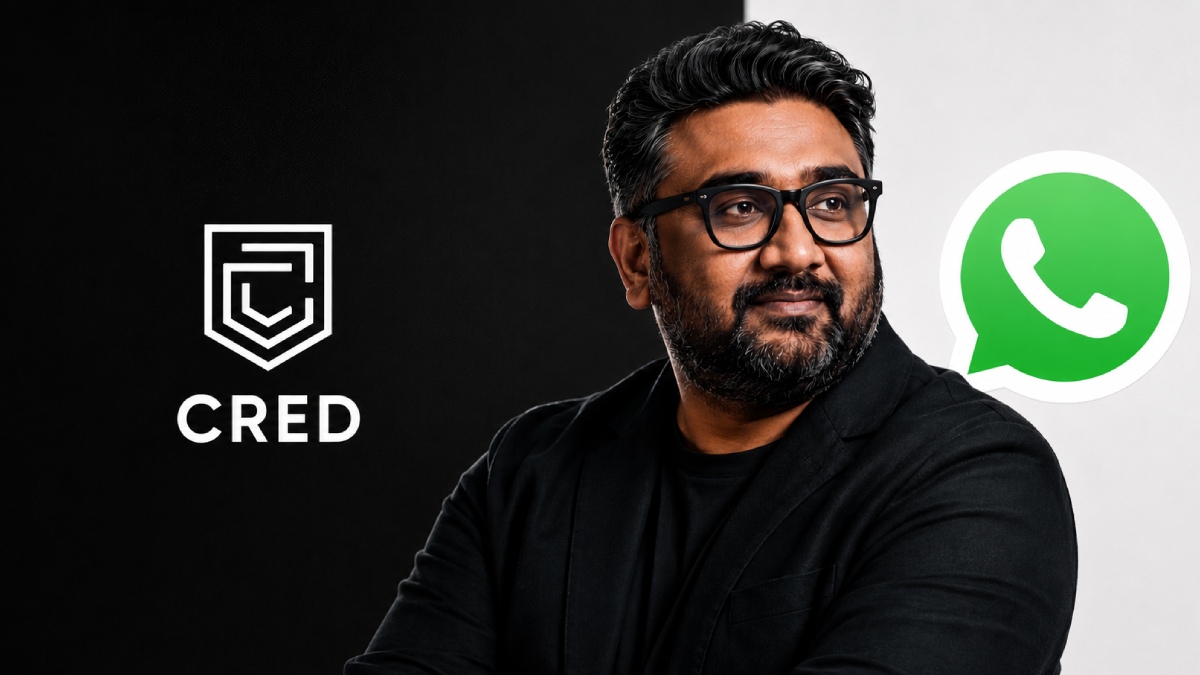
Kunal Shah’s rise to the top of WhatsApp is one of the most consequential leadership stories to emerge from India’s startup economy in 2026. Meta and CRED announced on 22 June 2026 that Shah would transition to Meta’s global leadership team and lead WhatsApp globally, while Meta committed to invest ₹8,550 crore (about US$900 million) in CRED at a post-money valuation of about US$4.5 billion. Meta said it would be a minority investor in CRED and would not receive access to customer information. Reuters reported the same leadership move, noting that Shah would succeed Will Cathcart, who stepped down after seven years at the helm of WhatsApp.
The appointment matters because it brings a founder known for behavioural insight, product intuition, and long-range thinking into one of the world’s most important communication platforms. Shah built FreeCharge into a major Indian consumer payments business before its sale to Snapdeal in 2015, then founded CRED in 2018 and turned it into a premium fintech platform with 17 million monthly members, more than 40% of India’s credit card bill-payment volume, and about ₹3,200 crore in revenue, according to CRED. Reuters also noted that CRED had become profitable.
For WhatsApp, the move signals a strategic push beyond messaging toward payments, business services, and more sophisticated consumer monetisation, especially in India, where Reuters says WhatsApp has more than 500 million users. For Meta, it is a bet that the future of consumer platforms will be shaped by leaders who understand trust, habit formation, and financial behaviour as deeply as they understand software. For India’s startup ecosystem, it is a landmark signal that a founder built in India can be tapped to run a platform used by billions.

Table of Contents
Your Leadership Story Deserves the Spotlight
Get featured on TheAshNow — the editorial platform trusted by founders, CEOs & executives worldwide for Google visibility, LinkedIn authority & global recognition.
Apply for Featured Profile →Quick Facts
- Name: Kunal Shah.
- Current role: Meta announced Shah as the global head of WhatsApp and said he would transition to Meta’s global leadership team.
- Best known for: Co-founding FreeCharge and founding CRED.
- Education: Shah studied philosophy at Wilson College in Mumbai and later dropped out of a management course at NMIMS, Reuters reported.
- FreeCharge: Co-founded in 2010; acquired by Snapdeal in 2015 for about US$400 million.
- CRED: Founded in 2018; serves 17 million monthly members and processes more than 40% of India’s credit card bill payments.
- CRED economics: The company said it has around ₹3,200 crore in revenue and profitability. Reuters also reported CRED had revenue of about US$313 million in FY2024–25 and a loss of ₹2.9 billion, reflecting that its financial profile has been in transition.
- WhatsApp significance: India is WhatsApp’s largest market, with more than 500 million users.
Career Timeline
2010 — FreeCharge begins
Shah co-founded FreeCharge with Sandeep Tandon in August 2010, building a mobile recharge and bill-payment business that quickly became one of the best-known consumer internet companies in India. Startup Grind’s event bio and Reuters both describe the platform as a major early success in Shah’s career.
2015 — Snapdeal acquires FreeCharge
Snapdeal acquired FreeCharge in 2015 in a transaction Reuters and Startup Grind describe as worth about US$400 million. The deal became one of the largest Indian startup exits of its era and established Shah as a founder who could build, scale, and exit a consumer product with real market adoption.
2018 — CRED is founded
Shah launched CRED in 2018 with a sharp and unusual premise: creditworthiness should be rewarded. CRED’s own newsroom says the company was built to enable financial progress for creditworthy Indians, with products spanning payments, lending, insurance, wealth, and lifestyle.
2020–2026 — CRED expands into a broad financial platform
CRED’s newsroom says the platform serves 17 million members every month, processes more than 40% of India’s credit card bill payments, and has expanded into multiple financial categories. CRED also said it had become profitable and had built a full stack of licences.
2024 — Product philosophy becomes widely discussed
By 2024, Shah’s product thinking had become a subject of public interest well beyond Indian fintech. Lenny’s Newsletter framed him as one of India’s most admired product leaders and focused on his views on second-order thinking, startup philosophy, and what it takes to win in India.
2025–2026 — AI becomes central to CRED’s operating model
CRED launched an AI-powered credit coach and an internal AI acceleration system called CRED codelens, which the company described as a living intelligence layer backed by 400+ specialised agents. The company said the AI coach offers personalised guidance without storing or retaining member data from those conversations.
22 June 2026 — Meta announces the WhatsApp transition
Meta and CRED announced that Shah would transition to Meta’s global leadership team and lead WhatsApp globally. CRED said Meta would invest ₹8,550 crore in the company at about a US$4.5 billion valuation, while Meta would not get access to CRED customer information. Reuters reported that Shah would replace Will Cathcart, who stepped down after seven years.
Detailed Biography
Kunal Shah’s story does not fit the standard template of Indian tech leadership. He is not the archetype of an engineering-first founder from an elite technical institute. Reuters says he studied philosophy at Wilson College in Mumbai and later dropped out of a management course at NMIMS. That background matters because his career has been shaped less by credentialism and more by an unusually sharp instinct for how people behave, what they value, and which products they return to again and again.
His first major company, FreeCharge, showed that instinct in action. Co-founded in 2010, FreeCharge solved a simple but recurring consumer problem: how to make mobile recharges and bill payments easier, faster, and more rewarding. In an era when Indian internet businesses were still defining themselves, FreeCharge succeeded by reducing friction and adding incentives. The eventual Snapdeal acquisition in 2015 turned that success into one of the defining exits in Indian startup history.
What followed was even more revealing. Many founders, after a large exit, retreat into investing or advisory work. Shah did both of those things, but he also started again. In 2018, he founded CRED, a company that took one of the most boring consumer tasks in finance — paying a credit card bill — and recast it as a premium, reward-based habit. CRED’s own description is explicit: the company exists to catalyse financial progress for creditworthy Indians. It built a membership model around trust, exclusivity, and behavioural reinforcement.
BUILD YOUR LEGACY IN PRINT
Editorial features for founders, CEOs & executives — engineered for search visibility, LinkedIn credibility & industry authority.
APPLY NOW →That founding thesis became the base on which CRED expanded. The company moved into payments, lending, insurance, wealth, and lifestyle, while maintaining a premium positioning. Its newsroom says it now serves 17 million members every month and processes more than 40% of India’s credit card bill payments. Reuters added that CRED had revenue of about US$313 million in FY2024–25 and a loss of ₹2.9 billion, while CRED’s own June 2026 announcement said the business had reached about ₹3,200 crore in revenue and profitability. Taken together, those figures show a company that has moved from category creation to economic scale.
The June 2026 Meta deal crystallised Shah’s trajectory. CRED said Shah would step back from day-to-day operations and transition to Meta’s global leadership team. Reuters reported that Meta was investing US$900 million in CRED and tapping Shah to head WhatsApp globally. That is more than a career change; it is a transfer of founder energy from a fintech platform to one of the world’s largest communication networks.
The significance is amplified by what WhatsApp represents. Reuters noted that India is WhatsApp’s largest market, with more than 500 million users, and that the platform is expanding beyond messaging into payments and business services. That means the leadership transition is not about managing a mature social product in a static state. It is about steering a platform that sits at the intersection of communication, commerce, and financial behaviour in some of the world’s most important markets.
Leadership Analysis
Shah’s leadership style is best understood as product philosophy under pressure. He does not appear to build for novelty alone. He builds for durable behavioural change. Public discussions of his work repeatedly return to the same themes: second-order thinking, category design, trust, incentives, and products that are meaningfully better than the alternatives. Lenny’s Newsletter described him as a leader known for second-order thinking and startup philosophy, while Seed To Scale documented his “Delta 4” framework — the idea that a product must be significantly better than what people already use if it is to break habit and earn adoption.
That framework matters because it explains why Shah’s companies have often looked less like feature factories and more like behaviour machines. FreeCharge did not merely make recharging possible online; it made the act faster and more rewarding. CRED did not merely accept bill payments; it turned payment discipline into status, rewards, and repeated engagement. This is not gimmickry. It is product psychology applied with commercial discipline.
The June 2026 AI work at CRED deepens that reading. The AI coach gives members personalised, real-time guidance on credit health and explicitly says member data is neither stored nor retained in those conversations. CRED codelens, meanwhile, is an internal intelligence layer designed to give engineers and other teams instant context, better decision-making, and faster shipping. CRED says the tool orchestrates more than 400 specialised agents and has helped engineers ship features and resolve bugs four times faster. In other words, Shah’s AI orientation is not just about consumer-facing wow-factor. It is about making systems smarter, employees more effective, and customer experiences more actionable.
That combination is especially relevant for WhatsApp. Meta and Reuters both frame the move in part through business services and payments. If Shah is bringing his worldview to WhatsApp, the most plausible interpretation — based on the public record — is that he will treat AI as infrastructure for usefulness, not as decoration. That means more intelligent support, better business tooling, tighter relevance in commerce, and a stronger bridge between user intent and product action. This is an inference from his public CRED work and Meta’s stated WhatsApp direction, not a claim about unreleased plans.
His privacy philosophy also appears more concrete than rhetorical. CRED said Meta would not receive access to CRED customer information. CRED’s AI coach says member data is not stored or retained in those conversations. WhatsApp itself is built around end-to-end encryption; WhatsApp’s own privacy pages say personal messages, calls, photos, and videos are secured with end-to-end encryption so only the sender and recipient can access them. For a leader now stepping into WhatsApp, that alignment between product trust and business growth is not incidental — it is foundational.
Shah also seems unusually comfortable with long-term compounding. CRED’s 2026 announcement says the company is being prepared for an eventual IPO, with leadership structure being set for the next stage. That language matters. It suggests a founder who thinks in institutions, not just launches. In business-history terms, this is the transition from venture-style creation to durable operating architecture.
Why This Appointment Matters for WhatsApp, Meta, and India
For WhatsApp, Shah’s appointment is significant because the platform’s next chapter is likely to be defined less by simple messaging growth and more by deepening utility. Reuters says WhatsApp is expanding beyond messaging into payments and business services in India. The company already has scale; the challenge is to turn scale into depth without undermining the trust that made the product indispensable in the first place. Shah’s record suggests he understands that tension better than most founders.
For Meta, the move is a strategic statement. The company is not simply promoting a manager; it is importing a founder who has spent his career thinking about consumer habit, trust, and financial behaviour. The Reuters report says Meta’s investment in CRED is one of its largest into India’s financial technology sector in recent years, and that it will take a minority stake without access to customer data. That structure suggests deliberate separation of capital, data, and leadership — the kind of institutional design a global platform needs when it wants to expand into sensitive, regulated products.
For India’s startup ecosystem, Shah’s rise is symbolic in a way that goes beyond personal success. India has already produced many founders and operators; what is rarer is seeing one move from building consumer-finance infrastructure in India to leading a global communications product used by billions. Reuters says WhatsApp has more than 500 million users in India alone. A founder from India taking charge of that platform sends a strong signal about where product leadership talent is being recognised and how Indian consumer insight now matters to global tech strategy.
It also matters for the future of digital communication. The most important messaging platforms are no longer just messaging platforms. They are becoming venues for payments, businesses, support, discovery, and eventually AI-mediated actions. WhatsApp’s evolution into a more utility-rich platform will require leaders who understand both user trust and economic incentives. Shah’s background in fintech gives him a rare advantage here because money is often the sharpest test of trust.
Major Achievements
Shah’s achievements are best measured not only by company valuations but by category creation. FreeCharge gave Indian consumers an easier and more rewarding way to recharge phones and pay bills, and its 2015 acquisition by Snapdeal validated the business at scale. CRED then took a seemingly narrow financial task and turned it into a premium platform with daily and monthly engagement. Few founders manage to build two separate consumer businesses that each define a clear chapter in India’s internet history.
Another major achievement is his ability to attract trust from investors, partners, and users over multiple cycles. CRED’s latest fundraising announcement says the company has a full stack of licences, profitability, and a strong brand, while its member base continues to grow. Reuters says the company is expanding into payments, lending, insurance, and wealth, and has already become a major force in card bill payments. This is what category leadership looks like: not a single successful product, but an expanding system of complementary products.
His public thinking is also an achievement in itself. Lenny’s Newsletter highlighted his ideas on second-order effects, while Seed To Scale documented his Delta 4 framework. In an ecosystem often dominated by metrics and hype, Shah’s contribution has been to articulate a vocabulary for product usefulness, behavioural shift, and compounding advantage. Founders often copy tactics; fewer build conceptual tools that others use to reason about products.
The AI work at CRED adds another layer. The AI coach shows a willingness to bring intelligence directly into the consumer workflow, while codelens shows a willingness to use AI to improve the internal machinery of the company. That combination is noteworthy because it treats AI as both a user value proposition and an operational capability. It is a serious, institution-building approach rather than a superficial trend chase.
Challenges Ahead
The WhatsApp role is powerful, but it is not easy. Reuters notes that WhatsApp faces regulatory scrutiny in India, and a July 2026 Reuters report said India had instructed WhatsApp to halt the rollout of a username feature pending consultations, citing concerns about anonymity and fraud. For any leader, that is a reminder that the platform sits inside a dense regulatory and social environment. Product decisions are never purely product decisions at WhatsApp.
Competition is another issue. Reuters says WhatsApp’s expansion into payments and business services places it in a field where rivals such as Google Pay and PhonePe are already established. The challenge is not merely feature parity. It is adoption, trust, merchant usefulness, and regulatory durability. Shah’s fintech background is relevant here, but the scale is different. He is moving from building a premium Indian consumer-fintech business to steering one of the world’s most ubiquitous communication networks.
Privacy will remain a balancing act. WhatsApp’s own privacy materials emphasise end-to-end encryption and private communication, while Meta’s push toward broader commerce and AI functionality will inevitably intensify scrutiny. Shah’s advantage is that he has already built in a trust-sensitive domain, and CRED’s public insistence on data separation suggests he understands the reputational cost of getting privacy wrong. Even so, the operational and political stakes at WhatsApp are far higher.
Finally, there is the challenge of expectation. When a founder of Shah’s reputation moves into a platform as large as WhatsApp, observers expect transformation, not continuity. Yet the best leadership at scale is often disciplined continuity with selective reinvention. The real test will be whether WhatsApp becomes more useful, more trusted, and more economically valuable without becoming cluttered, extractive, or less private. That balance will define the Shah era.
Conclusion
Kunal Shah’s journey is unusual even by startup standards. He did not begin with an engineering pedigree or a conventional corporate ladder. He began with a sharp understanding of people, products, incentives, and trust. FreeCharge proved he could build a consumer business that solved an everyday pain point. CRED proved he could turn a boring financial behaviour into a category with brand, economics, and cultural resonance. Meta’s decision to bring him in to lead WhatsApp globally suggests that the next phase of digital communication will require exactly those capabilities.
What makes Shah’s appointment important is not only that an Indian founder is leading one of the world’s largest messaging platforms. It is that he arrives with a worldview shaped by trust-sensitive products, behavioural design, and long-term platform thinking. WhatsApp’s future will be written at the intersection of communication, AI, commerce, privacy, and regulation. Shah’s record suggests he is unusually well prepared for that intersection.
For Meta, this is a leadership decision. For India, it is an ecosystem milestone. For WhatsApp, it is a bet on a founder who has spent his career turning human behaviour into product advantage. And for the global tech industry, it is a reminder that the most important leaders are increasingly those who can build with equal fluency across trust, technology, and economic design.

FAQs on Kunal Shah
Why did Meta choose Kunal Shah for WhatsApp?
Because Shah has spent years building products around consumer behaviour, payments, trust, and retention. Reuters said the appointment signals Meta’s push into digital payments and broader business services on WhatsApp, while Shah’s record at FreeCharge and CRED makes him a strong fit for that direction.
What will Kunal Shah do at WhatsApp?
The public record supports one clear answer: he will lead WhatsApp globally, and Meta appears to want a stronger push into payments, commerce, and business services. Reuters says WhatsApp is already expanding beyond messaging, especially in India, which is its largest market. Any more specific product roadmap would be speculation unless Meta announces it.
Why is Kunal Shah’s WhatsApp appointment important for India?
India is WhatsApp’s largest market, with more than 500 million users, so an Indian founder leading the platform is symbolically and strategically significant. It shows that Indian consumer-tech leadership is now shaping a platform used at global scale.
What is Kunal Shah’s leadership style?
Publicly, Shah is known for second-order thinking, strong product intuition, and designing incentives that change behaviour. Commentary and interviews around him describe a founder who thinks about how products become habits, not just how they launch. His work at FreeCharge and CRED reflects that style.
How does Kunal Shah think about AI?
At CRED, AI has been positioned as both a consumer feature and an internal operating layer. The company launched an AI credit coach and also described CRED codelens as an internal intelligence system designed to help teams move faster. That suggests Shah sees AI as infrastructure, not just marketing.
What is Kunal Shah’s privacy philosophy?
The strongest public evidence is that CRED said Meta would not get access to customer information as part of the investment, and CRED’s AI coach says member data is not stored or retained in those conversations. That aligns with WhatsApp’s own privacy-first positioning around end-to-end encryption.
How successful was FreeCharge?
FreeCharge became one of India’s best-known consumer payment products and was acquired by Snapdeal in 2015 for about US$400 million. That exit established Shah as a founder who could build and scale a consumer product successfully.
What is CRED’s business model?
CRED started as a credit-card bill payment platform for creditworthy users and expanded into payments, lending, insurance, wealth, and lifestyle services. CRED’s own newsroom says it now serves 17 million members monthly and processes over 40% of India’s credit card bill payments.
Does Kunal Shah hold a stake in CRED after moving to WhatsApp?
Reuters reported that he will retain about a 20% stake in CRED while stepping away from the executive role. That means he is not severing ties with the company even as he moves to WhatsApp.
Who replaces Kunal Shah at CRED?
CRED said Miten Sampat would serve as interim CEO after Shah transitions to Meta’s global leadership team. Reuters reported the same arrangement.
Is WhatsApp trying to become more than a messaging app?
Yes. Reuters said WhatsApp is expanding beyond messaging into payments and business services, particularly in India and other major emerging markets. That is the broader strategic backdrop for Shah’s appointment.
What challenges will Kunal Shah face at WhatsApp?
The main challenges are regulatory scrutiny, privacy expectations, competition in payments, and the difficulty of monetising a massive user base without harming trust. Reuters reported that WhatsApp has already faced pressure in India over product rollouts and that rivals such as Google Pay and PhonePe are deeply established.
Why is Kunal Shah seen as a strong product leader?
Because he has repeatedly built products that address real consumer friction and then turned them into habit-forming platforms. FreeCharge solved simple payments friction; CRED made bill payment feel premium and rewarding; WhatsApp is now the next much larger canvas. That pattern is why he is viewed as a product strategist, not just a founder.
What does Kunal Shah’s appointment mean for Meta?
It suggests Meta wants a leader who understands consumer economics in India, especially as the company looks to deepen commerce and financial services on WhatsApp. Reuters and Breakingviews both framed the deal as a strategic bet on payments and platform expansion.
What is the most accurate one-line bio of Kunal Shah right now?
Kunal Shah is an Indian entrepreneur, founder of CRED and co-founder of FreeCharge, who was announced in June 2026 as the global leader of WhatsApp at Meta.
What is Kunal Shah’s net worth?
Kunal Shah’s exact net worth is not officially disclosed in any public filing or company statement I checked. Media estimates vary widely, and that is exactly why readers should treat any single number with caution. One recent report said estimates range from more than $500 million to over ₹15,000 crore, but it also stressed that these are media estimates, not verified disclosures.
What did Kunal Shah study, and is he linked to the University of Mumbai?
Kunal Shah studied philosophy at Wilson College in Mumbai and later dropped out of a management course at Narsee Monjee Institute of Management Studies (NMIMS). Reuters specifically identifies Wilson College as his college, and Wilson College’s own documents describe it as affiliated to the University of Mumbai. So the most accurate wording is: he studied at Wilson College, Mumbai, which is affiliated with the University of Mumbai.
Was Kunal Shah’s business profitable or loss-making?
Both have been true at different points, depending on the period and the source. CRED’s own 22 June 2026 announcement said the company had reached about ₹3,200 crore in revenue and had become profitable. Reuters, in a separate report, said CRED reported around ₹313 million in revenue for FY2024–25 and a ₹2.9 billion loss. The safest way to write this is that CRED has scaled strongly, but its profitability picture has been reported differently across sources and time periods.
Did Kunal Shah invest in Helium?
Yes, but this refers to Helium, the proptech startup, not the element. A Reuters-reported story said Bengaluru-based Helium raised ₹5 crore in its first funding round from several startup founders, including Kunal Shah and Albinder Dhindsa.
Did Kunal Shah work at Deloitte?
I could not verify any credible public source showing that CRED founder Kunal Shah worked at Deloitte. Search results did turn up a different person named Kunal Shah with Deloitte roles, including an official Deloitte Consulting profile, but that is not evidence about the CRED founder. For a publication piece, it is better to avoid attributing a Deloitte background to him unless you have a direct primary source.
What is Kunal Shah’s salary?
In a 2023 interview-style answer reported by ETHRWorld, Shah said his salary at CRED was ₹15,000 per month, and that he did not believe he should take a large salary until the company became profitable. That figure was widely reported as his CRED salary, not a verified salary disclosure for WhatsApp or Meta.
Is Kunal Shah officially the Head of WhatsApp?
Yes. Meta and CRED announced on 22 June 2026 that Shah would transition to Meta’s global leadership team and lead WhatsApp globally. Reuters reported the same move, saying he would replace Will Cathcart.
References
- Meta’s WhatsApp to Be Led by Indian Startup Founder Kunal Shah (Reuters)
- WhatsApp’s Pick of Indian Fintech Founder Signals Payment Ambitions (Reuters)
- CRED Announces Meta Investment and Kunal Shah’s Transition to WhatsApp Leadership
- WhatsApp Privacy & Security (Official)
- Kunal Shah to Lead WhatsApp – The Indian Express
- CRED Founder Kunal Shah to Lead WhatsApp – NDTV
Disclaimer: This article is an independent editorial profile published by TheAshNow for informational and educational purposes. It is based on publicly available information, official company announcements, and reports from reputable news organizations available at the time of publication. While every effort has been made to ensure factual accuracy, information may change over time as new developments emerge. The views presented are editorial analysis and should not be interpreted as official statements from Meta, WhatsApp, CRED, or Kunal Shah unless explicitly attributed to those organizations or individuals. Readers are encouraged to refer to official company announcements for the latest updates.



[…] Kunal Shah: How the FreeCharge and CRED Founder Came to Lead WhatsApp Globally […]
[…] Kunal Shah: How the FreeCharge and CRED Founder Came to Lead WhatsApp Globally […]
[…] Kunal Shah: How the FreeCharge and CRED Founder Came to Lead WhatsApp Globally […]