
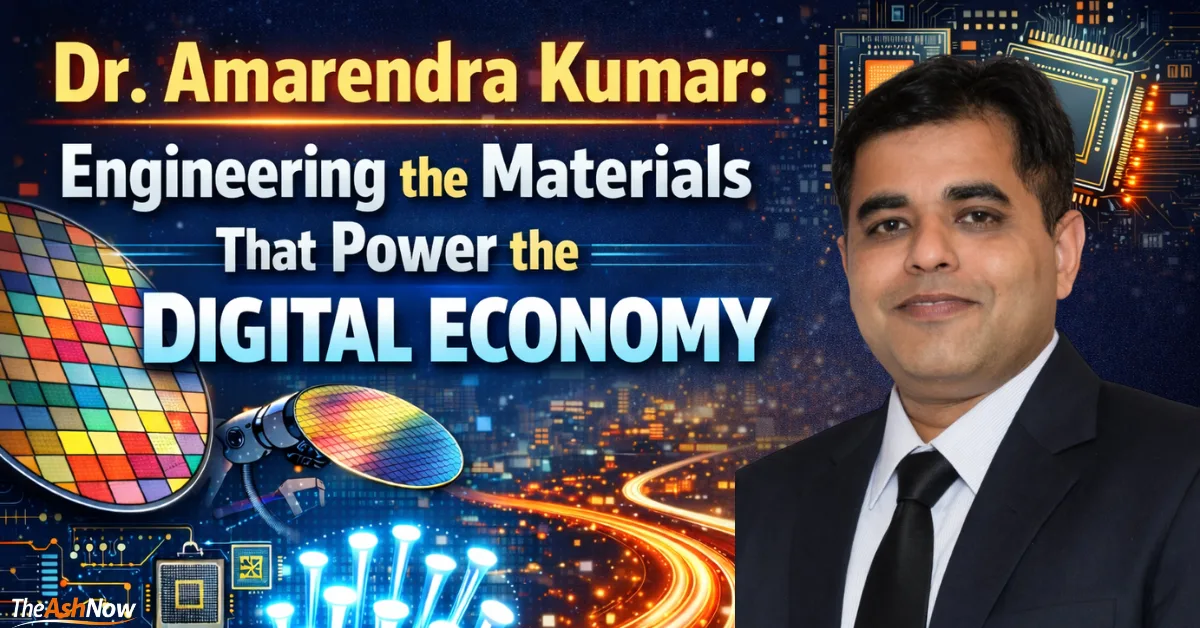
In an era where digital transformation is often described in terms of software, data, and algorithms, the deeper reality is that the digital world still rests on physical systems: materials, devices, and manufacturing processes that make computation, connectivity, and energy efficiency possible. The professionals who shape those foundations rarely attract public attention, yet their work determines the limits of what technology can do.
Amarendra Kumar belongs to this quieter but decisive group. With a career spanning industrial R&D, academic research, and advanced semiconductor manufacturing across India, Taiwan, Singapore, and Austria, his work sits at the intersection of materials science, device engineering, and applied industrial research. His professional trajectory reflects how modern technological progress is built — not by isolated breakthroughs, but through sustained, methodical engineering across borders, disciplines, and institutions.
His work matters not because it is visible, but because it is infrastructural. The devices, materials, and processes he contributes to become part of the invisible architecture of modern life: power electronics, lighting systems, semiconductor components, and the physical substrates that allow digital technologies to function reliably, efficiently, and at scale.
Table of Contents
Who He Is and What He Does
Amarendra Kumar holds a Ph.D. in Nanotechnology and is currently a Senior Staff Engineer at Infineon Technologies in Austria, where he works on the development of enhancement-mode discrete Gallium Nitride (GaN) high-electron-mobility transistors, known commercially as CoolGaN™, for highly efficient power conversion systems and medium-voltage applications.
Your Leadership Story Deserves the Spotlight
Get featured on TheAshNow — the editorial platform trusted by founders, CEOs & executives worldwide for Google visibility, LinkedIn authority & global recognition.
Apply for Featured Profile →His role is technical, research-driven, and product-oriented. It sits within the highly specialized field of semiconductor device development, where physics, materials engineering, manufacturing constraints, and system-level requirements converge. The work involves not only understanding materials at the nanoscale, but also integrating them into processes that can be manufactured reliably and deployed commercially.
Before joining Infineon, he served as a Technical Project Lead at Philips Lumileds in Singapore, and earlier as a Senior Technical Engineer at Epistar in Taiwan, one of the major global LED and optoelectronics manufacturers. His career also includes academic research at National Tsing Hua University in Taiwan, both as a doctoral researcher and as a postdoctoral researcher, as well as early industry experience as a Project Engineer with Wipro Technologies in collaboration with Texas Instruments in India.
Across these roles, his professional identity is consistent: a semiconductor and nanotechnology specialist working on the physical engineering challenges that enable modern electronics.
- Anmol Jaiswal – The Story Behind Indian Backpacker and India’s Most Adventurous Travel Creator
 Few Indian travel creators have built a reputation quite like…
 - Joshua Freedman: Emotional Intelligence Leader & CEOIn a world defined by rapid technological change, workplace uncertainty,…
- Alex Hormozi: The Entrepreneur Who Turned Business Growth Into a $100M PlaybookThere is a particular kind of entrepreneur who becomes famous…
- Alakh Pandey: The Founder of Physics Wallah Who Turned Affordable Education Into a National EdTech MovementAlakh Pandey is an Indian educator, entrepreneur, teacher, and the…
- Kunal Shah: How the FreeCharge and CRED Founder Came to Lead WhatsApp GloballyKunal Shah’s rise to the top of WhatsApp is one…





Career Journey and Progression
Amarendra Kumar’s professional path began in India, where he worked from 2007 to 2010 as a Project Engineer with Wipro Technologies and Texas Instruments. In that role, he focused on system-on-chip verification, leading verification activities across synthesis, formal verification, simulation, and analog mixed simulation. He worked on processor architectures such as ARM and Cortex-M3 and on protocols including AXI, AHB, APB, SPI, and CAN. This early experience grounded him in system-level reliability, quality assurance, and the discipline of delivering robust engineering outcomes within industrial constraints.
He then moved into advanced academic research at National Tsing Hua University in Taiwan, where he completed a Master’s degree in Nanoengineering and Microsystems, followed by a Ph.D. in Nanotechnology. His doctoral work and subsequent postdoctoral research focused on semiconductor processes, thin films, nanostructures, and surface engineering. During this period, his work explored how nanoscale modifications to materials such as silicon, silicon oxide, and sapphire could enhance their optical, mechanical, and electrical properties, with applications across solar cells, integrated circuits, LEDs, MEMS, and packaging technologies.
From academia, he transitioned into industrial R&D in Taiwan at Epistar, where he worked as a Senior Technical Engineer from 2017 to 2022. There, his focus shifted from fundamental research toward large-scale semiconductor fabrication, LED and optoelectronic device integration, and manufacturing-relevant process development. This phase marked the translation of laboratory-scale understanding into industrial production environments.
In 2022, he joined Philips Lumileds in Singapore as a Technical Project Lead. In that role, he not only contributed technically but also led cross-functional teams, managing complex projects involving micro-LEDs, thin films, device integration, and process optimization. His responsibilities included project coordination, statistical process control, failure analysis, design of experiments, and root-cause investigations across manufacturing and R&D teams.
Since 2024, he has been at Infineon Technologies in Austria as a Senior Staff Engineer, working on Gallium Nitride power devices. This represents a shift toward next-generation power electronics — technologies that are increasingly critical for electric vehicles, renewable energy systems, data centers, and energy-efficient infrastructure.
His career shows a steady progression: from verification engineering, to academic research, to industrial R&D, to technical leadership, and now to advanced device development at the frontier of power semiconductor technology.
- Digital Detox Strategies the World Needs Right Now
- Benefits of Digital Detox in a Hyper-Connected World
- Inside a Digital Detox Retreat — Life Without Screens
- Best Digital Detox Apps to Beat Phone Addiction in 2026
- The Digital Detox Book for a Calmer Mind





Core Expertise and Professional Distinction
What distinguishes Amarendra Kumar professionally is not a single specialization, but the continuity across scales and domains. He operates across the full spectrum from nanoscale materials science to system-level semiconductor device performance.
BUILD YOUR LEGACY IN PRINT
Editorial features for founders, CEOs & executives — engineered for search visibility, LinkedIn credibility & industry authority.
APPLY NOW →His expertise spans thin-film deposition techniques such as physical vapor deposition and plasma-enhanced chemical vapor deposition, nanofabrication, surface engineering, and reactive ion etching. At the same time, he has worked on device integration, packaging, failure analysis, statistical process control, and manufacturing process development.
This combination allows him to bridge a gap that often separates research from production. Many engineers understand either laboratory physics or industrial manufacturing; fewer are deeply fluent in both. His background allows him to move between understanding why a phenomenon occurs at the material level and how it can be stabilized, scaled, and controlled in an industrial environment.
This is particularly important in fields like Gallium Nitride power electronics, where performance gains are tightly coupled with manufacturing challenges. GaN devices promise higher efficiency and power density than traditional silicon, but they also introduce new reliability, integration, and process-control complexities. Work in this area requires not only theoretical understanding but also engineering pragmatism.
Real-World Impact and Relevance
The technologies Amarendra Kumar works on are not consumer-facing, but they are deeply embedded in modern infrastructure. Power semiconductors affect how efficiently energy is converted and managed in electric vehicles, charging systems, renewable energy grids, data centers, and industrial automation. Improvements in these devices translate directly into reduced energy loss, lower heat generation, smaller form factors, and more sustainable systems.
Similarly, his earlier work in LEDs, micro-LEDs, and optoelectronics contributed to lighting, display technologies, and optical components that shape how information is visualized and how environments are illuminated.
Even his academic work on nanostructured surfaces and material strengthening has implications for manufacturing yield, material durability, and device performance. These are not abstract contributions; they influence cost structures, environmental efficiency, and the physical feasibility of new products.
His impact is therefore indirect but systemic. It resides in the reliability of devices, the efficiency of energy conversion, the scalability of manufacturing processes, and the physical integrity of materials used across industries.
Why This Work Matters Now
The relevance of this domain is growing, not shrinking. The global push toward electrification, renewable energy, and high-performance computing places increasing pressure on power electronics and semiconductor infrastructure. Data centers consume massive amounts of energy. Electric vehicles demand efficient and reliable power conversion. Renewable energy systems require robust power management to integrate variable energy sources into stable grids.
Gallium Nitride and other wide-bandgap semiconductors are central to meeting these demands. They offer higher switching speeds, lower losses, and improved efficiency, but they also require new manufacturing methods, new reliability standards, and new integration strategies.
Professionals working at this level are shaping the technical limits of what is possible in sustainable technology. Their work influences not only product performance but also environmental impact and energy consumption at a planetary scale.
- Why FIFA World Cup 2026 Is the Biggest World Cup in History?
- The Most Expensive Play in NFL History
- Lakers–Trail Blazers: Latest Score, Key Moments, and Game-Changing Plays
- World Cup 2026: Latest Standings and What It Means for Every Team
- Thunder vs Warriors: What Really Happened in Last Night’s Shocking NBA Clash





What His Journey Represents
Amarendra Kumar’s career reflects a broader reality of modern engineering: progress is international, interdisciplinary, and cumulative. His work spans four countries, multiple institutions, and both academic and industrial environments. It shows how technological development today is not confined to a single lab, company, or nation, but emerges from global networks of expertise.
It also reflects a professional model grounded in continuity rather than disruption. His contributions are not framed as radical breakthroughs, but as careful, sustained improvements in materials, devices, and processes. This kind of work rarely makes headlines, but it is what allows technologies to mature, stabilize, and become reliable parts of everyday life.
For other professionals, his path illustrates the value of depth, patience, and cross-domain fluency. It suggests that long-term relevance comes not from chasing trends, but from building robust expertise that remains valuable as technologies evolve.
Conclusion
Amarendra Kumar’s work does not seek attention, but it earns significance through quiet influence. His career demonstrates how the foundations of the digital and energy transitions are built by engineers who operate far from the public eye, yet whose decisions shape the physical reality of modern technology.
From verification engineering to nanotechnology research, from LED manufacturing to Gallium Nitride power devices, his professional journey reflects the layered, interconnected nature of technological progress. It is a reminder that innovation is not only about new ideas, but about turning those ideas into reliable, scalable, and efficient systems that the world can depend on.
In that sense, his contribution is not a single achievement, but a sustained commitment to building the physical infrastructure on which modern life increasingly relies.
- Government Constitutes High-Powered Task Force on Examination Reforms Under Nandan Nilekani
- Dr. Ashwini Kumar Ashraf: A Life That Refused to Remain in the Dark
- How Vladimir Putin Is Quietly Reshaping the Global Power in 2026?
- How YouTubers Like Dhruv Rathee Are Reshaping Political Awareness in India
- Jensen Huang — The Man Quietly Powering the AI World






Top Related FAQs
1. What does Dr. Amarendra Kumar work on at Infineon Technologies?
Dr. Amarendra Kumar works on the development of enhancement-mode Gallium Nitride (GaN) power transistors for high-efficiency power conversion and medium-voltage electronic systems.
2. What is Dr. Amarendra Kumar’s academic background?
He holds a Ph.D. in Nanotechnology and an M.S. in Nanoengineering and Microsystems from National Tsing Hua University, along with a B.Tech in Electronics.
3. Why is Gallium Nitride (GaN) important in modern electronics?
GaN enables faster switching, higher efficiency, and lower energy losses than traditional silicon, making it critical for electric vehicles, renewable energy systems, and data centers.
4. What industries are influenced by the kind of work Dr. Amarendra Kumar does?
His work impacts power electronics, renewable energy, electric mobility, data infrastructure, semiconductor manufacturing, lighting systems, and advanced electronic packaging.
5. What does Dr. Amarendra Kumar’s career path represent for young engineers?
It represents a model of combining deep academic research with applied industrial engineering across global institutions, showing how technical expertise can translate into long-term professional relevance.

Disclaimer: This editorial profile is based exclusively on publicly available professional information and is intended for informational and recognition purposes. It does not imply endorsement, sponsorship, or affiliation, nor does it represent the views of the individual or any organizations referenced.







[…] Dr. Amarendra Kumar: Engineering the Materials That Power the Digital Economy […]
[…] Dr. Amarendra Kumar: Engineering the Materials That Power the Digital Economy […]