
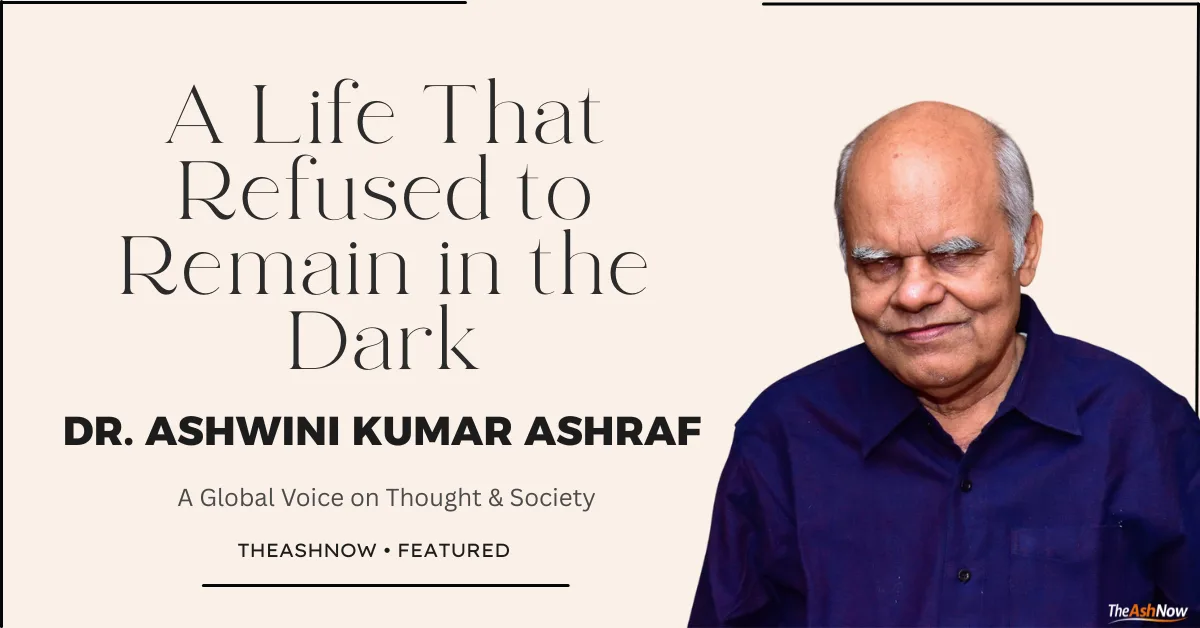
When a Life Becomes Its Own Light
Some lives shine because they are placed in the spotlight.
Others shine because they generate their own light.
Dr. Ashwini Kumar Ashraf belongs to the second kind.
His story is not merely about achievement, recognition, or success. It is about a human being who transformed inward clarity into outward influence, who turned reflection into relevance, and who proved that vision is not a function of the eyes, but of the mind.
Blind from childhood, Dr. Ashraf did not experience the world visually. Instead, he experienced it intellectually, emotionally, and linguistically. Where others looked, he listened. Where others reacted, he reflected. Where others hurried, he deepened.
Your Leadership Story Deserves the Spotlight
Get featured on TheAshNow — the editorial platform trusted by founders, CEOs & executives worldwide for Google visibility, LinkedIn authority & global recognition.
Apply for Featured Profile →This inward orientation shaped an extraordinary life — as a scholar, a philosopher, a poet, a teacher, and a public intellectual whose work continues to shape minds across classrooms, cultures, and continents.
This is the story of that life.
Table of Contents
Early Years — Learning the World Through Meaning
From a young age, Dr. Ashraf’s relationship with the world was different. Without sight, he developed an unusually refined awareness of sound, language, tone, and emotion. Words were not just tools of communication; they were instruments of discovery.
He did not learn by watching examples. He learned by understanding principles. He did not memorize patterns. He grasped structures.
This made him exceptionally attentive and intellectually curious. He did not seek quick answers. He pursued foundational questions: What is truth? What is justice? What is a meaningful life?
These questions were not abstract for him. They were personal. They were necessary.
His academic excellence was not driven by competition, but by compulsion — the compulsion to understand.
The Scholar’s Path — Philosophy as Practice
Dr. Ashraf pursued higher education with distinction, ultimately earning his PhD from B. R. Ambedkar Bihar University (BRABU), Muzaffarpur. He later served as a professor across multiple colleges within the same university system, shaping generations of students.
But for him, philosophy was never just a subject. It was a discipline of integrity.
He did not teach students what to think. He taught them how to think — how to examine assumptions, hold contradictions, and resist easy conclusions.
BUILD YOUR LEGACY IN PRINT
Editorial features for founders, CEOs & executives — engineered for search visibility, LinkedIn credibility & industry authority.
APPLY NOW →His classroom was not a stage. It was a workshop of the mind.
Students often recall that his greatest gift was not information, but perspective. He made ideas feel alive. He made complexity feel navigable. He made thinking feel human.
The Emergence of the Poet — When Thought Found Rhythm
Parallel to his academic journey, another expression took shape — poetry.
Dr. Ashraf’s literary work is not ornamental. It is essential.
His book Raushani exists in both Hindi and Urdu, not as translations, but as distinct creative works. Each language version carries different compositions, different emotional registers, and different rhythms of reflection.
This is not bilingual writing. It is bicultural thinking.
In his poetry, light is not a physical phenomenon. It is moral clarity. It is awareness. It is the courage to remain sensitive in a hard world and honest in a complex one.
His poetry does not shout. It stays.
The Digital Voice — Depth in an Age of Noise
With over 200 high-quality videos on his YouTube channel, Dr. Ashraf has created a digital archive of reflection — lectures, meditations, poetic recitations, and philosophical conversations.
He has not adapted his voice to the internet. He has invited the internet to slow down to his voice.
On social platforms, his presence attracts those who are not looking for entertainment but for nourishment. His audience is not large in volume, but deep in engagement.
In a world driven by speed, his work is an act of resistance.
Cultural Recognition and Public Life
Ad
- Anmol Jaiswal – The Story Behind Indian Backpacker and India’s Most Adventurous Travel Creator

- Why Sugar Prices Are Rising in India: Is Ethanol Behind the Price Surge?
- Joshua Freedman: Emotional Intelligence Leader & CEO
- Alex Hormozi: The Entrepreneur Who Turned Business Growth Into a $100M Playbook
- Alakh Pandey: The Founder of Physics Wallah Who Turned Affordable Education Into a National EdTech Movement





Dr. Ashraf’s work has been recognized by major cultural institutions and national platforms.
He has been invited multiple times to present at the Khuda Bakhsh Oriental Public Library in Patna. His programs and conversations have been broadcast on All India Radio, DD Bihar, DD News, and ETV Bihar.
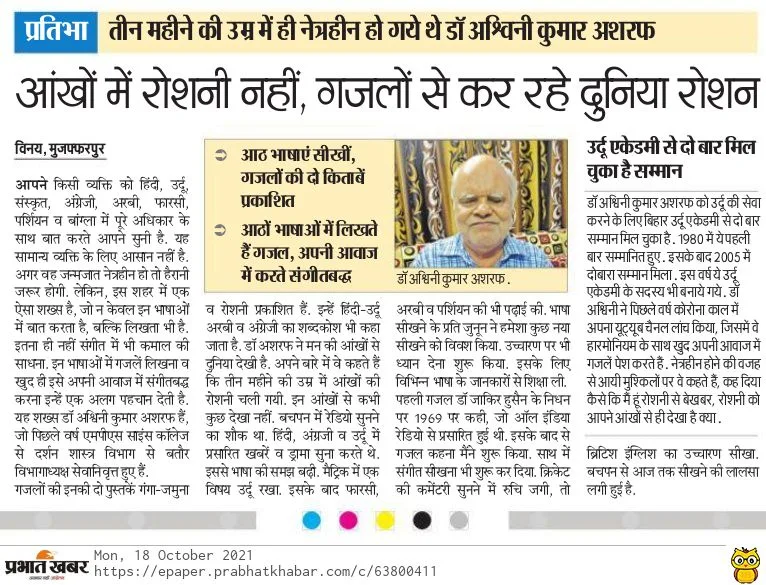
His work and life have been featured in major newspapers such as Dainik Jagran, Dainik Bhaskar, and Prabhat Khabar.
He has received honors from the Governor and the Chief Minister in recognition of his contributions to education, literature, and culture.
These recognitions reflect not only achievement, but trust — trust in his voice as a cultural and intellectual presence.
A Philosophy of Dignity
What distinguishes Dr. Ashraf is not what he has achieved, but how he has achieved it.
He does not perform his struggle.
He does not market his limitation.
He does not dramatize his identity.
He carries his life with dignity — quiet, steady, and grounded.
His influence comes not from volume, but from clarity. Not from assertion, but from alignment. Not from ambition, but from authenticity.
Global Relevance — A Universal Voice
Though rooted in Indian academic and literary traditions, Dr. Ashraf’s relevance is universal.
He speaks to questions that cross cultures:
How do we remain thoughtful in a distracted age?
How do we stay ethical in competitive systems?
How do we preserve inner life in an external world?
His work is not topical. It is timeless.
Legacy — The Light He Leaves Behind
Dr. Ashwini Kumar Ashraf is not a figure of spectacle. He is a figure of substance.
He is remembered not for moments, but for influence. Not for declarations, but for transformations.
His life teaches us that light is not something we receive. It is something we cultivate.
And that the most enduring forms of illumination are not visual — they are ethical, intellectual, and human.
Closing Reflection — A Life That Refused to Remain in the Dark
In an era defined by speed, noise, and surface, Dr. Ashwini Kumar Ashraf stands as a reminder that depth still matters, that thinking still matters, and that dignity still matters.
His life is not just a biography.
It is a philosophy.
A philosophy that teaches us that darkness is not the absence of sight, but the absence of awareness.
And that a life devoted to awareness can never remain in the dark.
Find Dr. Ashwini Kumar Ashraf Online
Top Searched FAQs Related To Dr. Ashwini Kumar Ashraf
1. Who is Dr. Ashwini Kumar Ashraf?
Dr. Ashwini Kumar Ashraf is an Indian philosopher, poet, and academic known for his work in philosophy, Hindi–Urdu literature, and public intellectual discourse. He has taught at B. R. Ambedkar Bihar University and is recognized for blending deep thinking with poetic expression.
2. What is Dr. Ashwini Kumar Ashraf famous for?
He is known for his philosophical teaching, his bilingual literary work Raushani in Hindi and Urdu, his public talks, and his digital presence through lectures and reflections that reach a wide audience.
3. What is the book Raushani by Dr. Ashwini Kumar Ashraf about?
Raushani is a collection of philosophical and poetic writings that explore themes of awareness, dignity, truth, identity, and inner clarity, written separately in Hindi and Urdu with different compositions in each language.
4. Where did Dr. Ashwini Kumar Ashraf study?
He completed his PhD at B. R. Ambedkar Bihar University (BRABU), Muzaffarpur, and later taught philosophy across several colleges within the same university system.
5. What subjects does Dr. Ashwini Kumar Ashraf teach?
His primary academic focus is philosophy, including ethics, social thought, and the relationship between human values and modern society.
6. Is Dr. Ashwini Kumar Ashraf a philosopher or a poet?
He is both. His work bridges philosophy and poetry, using each as a different language for exploring the same human questions.
7. Does Dr. Ashwini Kumar Ashraf have a YouTube channel?
Yes. He runs a YouTube channel with over 200 videos featuring philosophical talks, literary discussions, and poetic recitations.
8. Has Dr. Ashwini Kumar Ashraf appeared on television or radio?
Yes. His programs and interviews have been broadcast on All India Radio, DD Bihar, DD News, and ETV Bihar.
9. Has Dr. Ashwini Kumar Ashraf received any awards?
Yes. He has been honored multiple times by state authorities, including recognitions from the Governor and the Chief Minister for his contributions to education and culture.
10. What makes Dr. Ashwini Kumar Ashraf’s work unique?
His work is unique because it combines academic rigor with emotional depth, intellectual honesty with poetic sensitivity, and public influence with personal humility.
11. Why do people find Dr. Ashwini Kumar Ashraf inspiring?
Because his life reflects discipline, dignity, and depth — showing that influence can be built through thought, integrity, and quiet consistency rather than publicity or power.
12. Is Raushani available in English?
Currently, it is primarily available in Hindi and Urdu, with each version containing unique compositions.
13. Does Dr. Ashwini Kumar Ashraf speak at public events?
Yes. He regularly participates in cultural, academic, and literary events, including programs at heritage institutions like the Khuda Bakhsh Oriental Public Library.
14. How has Dr. Ashwini Kumar Ashraf influenced young people?
Through teaching, mentoring, public talks, and online content that encourage critical thinking, self-awareness, and ethical reflection.
15. How many languages does Dr. Ashwini Kumar Ashraf know?
Based on his public talks and content on YouTube, Dr. Ashwini Kumar Ashraf appears to be comfortable in multiple languages, including Hindi, Urdu, Bangla, Bhojpuri, and often references ideas, texts, and expressions across linguistic traditions. While he has not publicly listed all the languages he knows, his work reflects a strong multilingual and cross-cultural intellectual engagement.
16. Why did TheAshNow feature Dr. Ashwini Kumar Ashraf?
TheAshNow featured Dr. Ashwini Kumar Ashraf because his life and work represent the kind of thoughtful, ethical, and quietly influential leadership that deserves wider recognition. In a world driven by speed and noise, Dr. Ashraf’s commitment to depth, reflection, education, and cultural dialogue aligns closely with TheAshNow’s mission to highlight people and ideas that shape the future in meaningful ways. This feature is part of TheAshNow’s effort to bring such voices to a broader global audience.
Disclaimer: This biography is a narrative and editorial profile based on publicly available information, interviews, broadcasts, published materials, and the subject’s own public content. While every effort has been made to ensure accuracy, this article is not intended as an official or authorized biography.
Some interpretations, descriptions, and reflections are presented in a journalistic and literary context to provide readers with a deeper understanding of Dr. Ashwini Kumar Ashraf’s life, work, and influence.
If any factual detail is inaccurate or requires correction, readers are encouraged to treat this article as a living document open to updates and refinement.
This content is intended for informational, educational, and cultural purposes only.
Sources & Reference Basis: This article is based on the following categories of publicly available and verifiable sources:
• Dr. Ashwini Kumar Ashraf’s public lectures, talks, and videos shared on his official YouTube channel
• Broadcast appearances on All India Radio (AIR), DD Bihar, DD News, and ETV Bihar
• Public programs and invitations at Khuda Bakhsh Oriental Public Library, Patna
• Coverage and features in Indian newspapers, including Dainik Jagran, Dainik Bhaskar, and Prabhat Khabar
• Academic affiliation and teaching history within B. R. Ambedkar Bihar University (BRABU), Muzaffarpur
• His published literary work Raushani in Hindi and Urdu
• Public cultural recognitions and honors reported by state-level institutions
• Public statements, interviews, and event recordings accessible in the public domain
In addition, narrative interpretation and contextual analysis have been used to frame the biography in a long-form editorial format suitable for a global readership.




This blog is definitely rather handy since I’m at the moment creating an internet floral website – although I am only starting out therefore it’s really fairly small, nothing like this site. Can link to a few of the posts here as they are quite. Thanks much. Zoey Olsen
I keep listening to the news update lecture about receiving boundless online grant applications so I have been looking around for the most excellent site to get one. Could you advise me please, where could i find some?
[…] Dr. Ashwini Kumar Ashraf: A Life That Refused to Remain in the Dark […]