
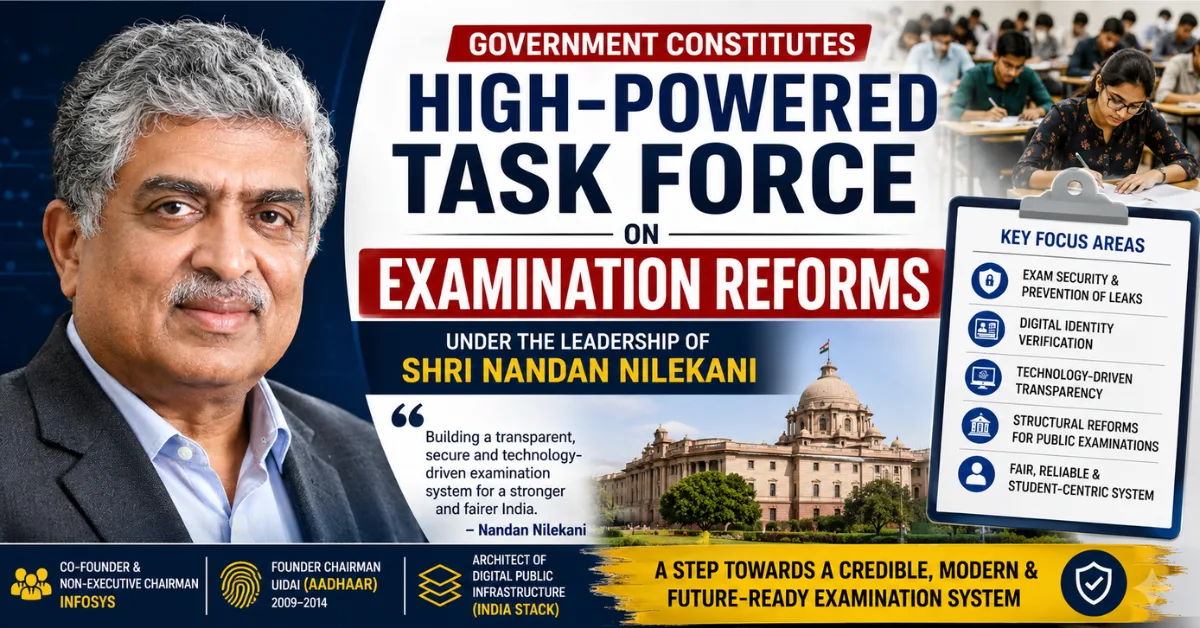
Latest Appointment: Head of High-Powered Task Force on Examination Reforms (2026)
On 26 July 2026, Prime Minister Narendra Modi announced the constitution of a High-Powered Task Force on Examination Reforms under the leadership of Nandan Nilekani. The decision comes as part of the Government of India’s broader effort to restore trust in the country’s examination system and strengthen the integrity of public examinations.
According to the Prime Minister, the task force has been entrusted with recommending reforms that will make India’s examination system:
- More transparent
- Technology-driven
- Secure against paper leaks and malpractice
- Reliable for students and educational institutions
- Better equipped with modern digital infrastructure and identity verification systems
The government has stated that it intends to act promptly on the committee’s recommendations to build a more credible and future-ready examination ecosystem.
Why Nandan Nilekani?
Nandan Nilekani’s appointment reflects his extensive experience in leading large-scale technology initiatives. As the founding Chairman of UIDAI, he oversaw the implementation of Aadhaar, one of the world’s largest digital identity systems. His expertise in digital public infrastructure, governance, and scalable technology solutions is expected to help modernise India’s examination framework and improve transparency through technology.
Your Leadership Story Deserves the Spotlight
Get featured on TheAshNow — the editorial platform trusted by founders, CEOs & executives worldwide for Google visibility, LinkedIn authority & global recognition.
Apply for Featured Profile →Key Objective of the Task Force
The High-Powered Task Force is expected to recommend measures related to:
- Technology-enabled examination security
- Digital identity verification
- Prevention of paper leaks and impersonation
- Transparent and efficient examination processes
- Long-term structural reforms for public examinations
This appointment marks one of the most significant public policy roles undertaken by Nandan Nilekani since his leadership of the Aadhaar programme. Further, it reinforces his position as one of India’s foremost technology and governance experts.
Nandan Nilekani at a Glance
| Field | Details |
|---|---|
| Full Name | Nandan Mohanrao Nilekani |
| Date of Birth | 2 June 1955 |
| Birthplace | Bengaluru (then Bangalore), Karnataka, India |
| Nationality | Indian |
| Profession | Entrepreneur, Business Leader, Technologist, Public Policy Expert |
| Education | B.Tech in Electrical Engineering, IIT Bombay |
| Known For | Co-founding Infosys, Leading Aadhaar (UIDAI), Digital Public Infrastructure |
| Current Role | Non-Executive Chairman, Infosys |
| Awards | Padma Bhushan (2006) |
Few individuals have shaped India’s technology landscape as profoundly as Nandan Nilekani. A visionary entrepreneur, public policy reformer, and digital transformation advocate, Nilekani is best known for co-founding Infosys and leading the development of Aadhaar, the world’s largest digital identity programme.
His work extends far beyond corporate success. Through his contributions to digital governance, financial inclusion, and public technology infrastructure, Nilekani has played a central role in redefining how millions of Indians access government services, banking, healthcare, and digital payments.
Today, he remains one of India’s most respected voices on technology, innovation, artificial intelligence, and digital public infrastructure.
Table of Contents
Early Life and Education
Nandan Mohanrao Nilekani was born on 2 June 1955 in Bengaluru, Karnataka.
He spent much of his childhood in different parts of India because of his father’s career in the textile industry. His early education instilled curiosity and analytical thinking that later became defining characteristics of his leadership style.
He pursued Electrical Engineering at the prestigious Indian Institute of Technology (IIT) Bombay, graduating in 1978.
At IIT Bombay, Nilekani met many future leaders who would shape India’s technology revolution.
BUILD YOUR LEGACY IN PRINT
Editorial features for founders, CEOs & executives — engineered for search visibility, LinkedIn credibility & industry authority.
APPLY NOW →Beginning His Career
After graduation, Nilekani joined Patni Computer Systems, one of India’s early software companies.
It was here that he met N. R. Narayana Murthy, who would later become his business partner.
Their shared vision was simple but ambitious:
Build a world-class technology company from India.
At a time when India’s software industry was still in its infancy, this goal seemed nearly impossible.
Co-Founding Infosys
In 1981, Nandan Nilekani became one of the seven founders of Infosys, alongside:
- N. R. Narayana Murthy
- Kris Gopalakrishnan
- S. Gopalakrishnan
- S. D. Shibulal
- K. Dinesh
- N. S. Raghavan
- Ashok Arora
The company started with limited financial resources but immense ambition.
Infosys focused on:
- Software development
- IT consulting
- Global outsourcing
- Enterprise solutions
Over the next few decades, Infosys became one of India’s largest multinational IT companies and helped establish India as a global software powerhouse.
Becoming CEO
Nilekani became the Chief Executive Officer (CEO) of Infosys in 2002.
Under his leadership:
- Revenue grew substantially.
- Global expansion accelerated.
- Thousands of new jobs were created.
- Infosys strengthened its reputation for corporate governance.
- The company became one of the world’s leading IT service providers.
His leadership combined innovation with ethical business practices.
Leading India’s Aadhaar Mission
Perhaps Nilekani’s most transformative contribution came in 2009, when he was appointed the founding Chairman of the Unique Identification Authority of India (UIDAI).
His mission was to create a unique digital identity for every Indian resident.
The result was Aadhaar.
What is Aadhaar?
Aadhaar is a 12-digit unique identity number linked to biometric and demographic information.
Its objectives include:
- Preventing identity fraud
- Improving welfare delivery
- Enabling digital verification
- Supporting financial inclusion
- Making government services more accessible
Today, Aadhaar has become one of the world’s largest digital identity systems, covering over a billion residents and supporting numerous public and private services.
India Stack
Nilekani also became closely associated with the development of India Stack, an open digital infrastructure that enables secure and scalable digital services.
Key components include:
- Aadhaar Authentication
- e-KYC
- Digital Signatures
- DigiLocker integration
- Consent-based data sharing
- Payment infrastructure that supports innovations such as UPI
India Stack has significantly reduced the cost and complexity of delivering digital services, enabling rapid growth in fintech and digital governance.
Financial Inclusion
One of Nilekani’s long-term goals has been making financial services accessible to everyone.
Digital identity has enabled:
- Faster bank account opening
- Digital payments
- Direct Benefit Transfers (DBT)
- Reduced paperwork
- Simplified KYC processes
These developments have expanded access to formal financial services for millions of people.
Return to Infosys
In 2017, Nandan Nilekani returned to Infosys as Non-Executive Chairman during a period of organisational transition.
His leadership helped restore investor confidence and strengthened the company’s strategic direction.
He has continued to guide Infosys while advocating for responsible technology and innovation.
Books Written by Nandan Nilekani
1. Imagining India (2008)
This book explores:
- India’s economic future
- Demographics
- Education
- Governance
- Urbanisation
- Technology
It remains widely cited in discussions about India’s long-term development.
2. Rebooting India (2015)
Co-authored with Viral Shah, this book focuses on how technology can improve governance and public service delivery.
Leadership Style
Nilekani is known for:
- Data-driven decision making
- Long-term strategic thinking
- Collaborative leadership
- Innovation
- Ethical governance
- Public-private collaboration
Rather than pursuing publicity, he has often emphasised institution-building and scalable technology.
Awards and Recognition
Some of his major honours include:
- Padma Bhushan (2006), India’s third-highest civilian award
- Multiple business leadership recognitions
- Featured among influential global technology leaders
- Honoured by several academic and industry organisations

Philanthropy
Along with his wife Rohini Nilekani, he supports initiatives in:
- Education
- Climate and sustainability
- Water conservation
- Public health
- Governance
- Civic technology
- Social innovation
The couple has committed substantial resources to philanthropic causes through grants and institutional support.
Views on Artificial Intelligence
Nilekani has consistently argued that AI should:
- Enhance human productivity rather than simply replace jobs.
- Be built responsibly and transparently.
- Be accessible beyond large corporations.
- Complement strong digital public infrastructure.
He believes India’s digital foundation provides an opportunity to develop AI solutions that are inclusive and scalable.
Role in India’s Examination Reforms
In July 2026, the Government of India appointed Nandan Nilekani to head a high-powered task force focused on strengthening the country’s public examination system.
The initiative aims to improve:
- Examination security
- Digital infrastructure
- Identity verification
- Transparency
- Technology adoption
- Trust in competitive examinations
The appointment reflects the government’s confidence in his experience leading large-scale technology and governance projects.

Legacy
Nandan Nilekani’s career represents a rare combination of entrepreneurship and public service.
His work has influenced:
- India’s IT industry
- Digital identity
- Public digital infrastructure
- Financial inclusion
- E-governance
- Technology policy
Whether through Infosys or Aadhaar, his contributions have had a lasting impact on India’s digital transformation.
Frequently Asked Questions (FAQs)
Who is Nandan Nilekani?
Nandan Nilekani is an Indian entrepreneur, co-founder and Non-Executive Chairman of Infosys, and the founding Chairman of UIDAI, where he led the Aadhaar digital identity programme.
Why is Nandan Nilekani famous?
He is best known for co-founding Infosys and leading the creation of Aadhaar, which became the world’s largest biometric digital identity system.
What is Nandan Nilekani’s educational background?
He earned a B.Tech in Electrical Engineering from the Indian Institute of Technology (IIT) Bombay.
Which books has Nandan Nilekani written?
His notable books include Imagining India and Rebooting India (co-authored with Viral Shah).
What is Nandan Nilekani’s role at Infosys?
He currently serves as the Non-Executive Chairman of Infosys.
Conclusion
Nandan Nilekani’s journey from an IIT graduate to a globally recognised technology leader illustrates the power of innovation, institution-building, and public service. By helping establish Infosys as a global IT leader and spearheading Aadhaar and broader digital public infrastructure, he has left an enduring mark on India’s economic and technological development. As India continues to embrace digital transformation and emerging technologies such as artificial intelligence, Nilekani remains one of the country’s most influential voices shaping the future of technology and governance.




[…] Subscribe FreeBREAKING Assam Floods 2026: When the Brahmaputra Turns Into a Sea◆Government Constitutes High-Powered Task Force on Examination Reforms Under Nandan Nilekani◆The Truth About Wife Swapping: History, Facts, Laws, Psychology, and Global […]