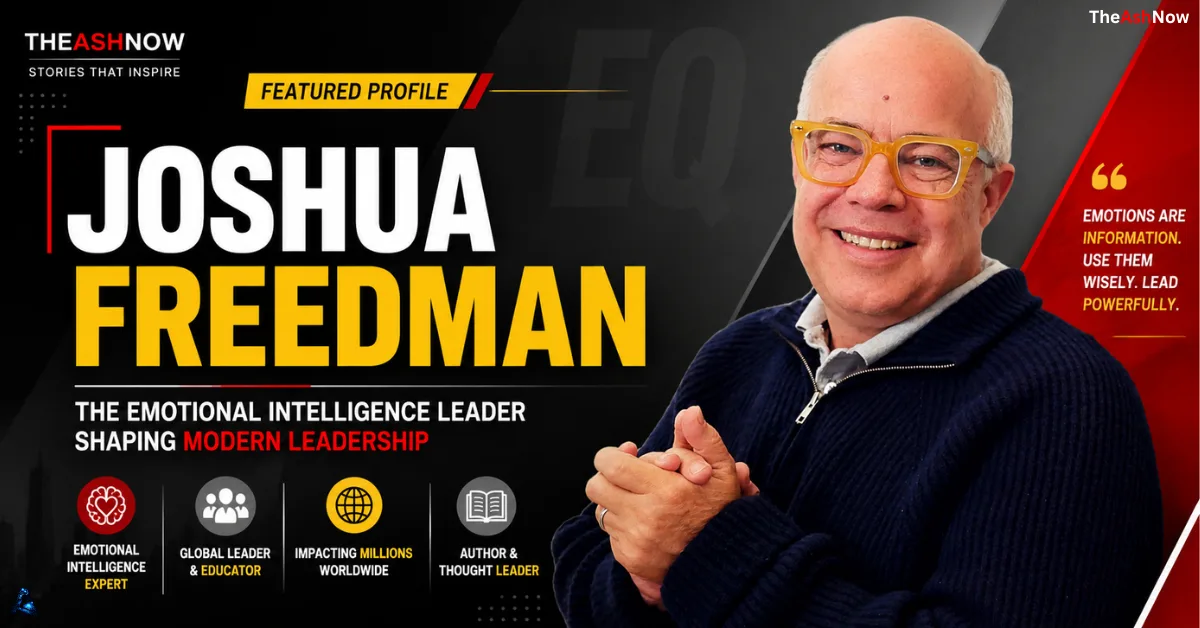
In a world defined by rapid technological change, workplace uncertainty, complex relationships, and increasing pressure on leaders, emotional intelligence has become more than a personal development concept. It is increasingly viewed as a practical leadership capability—one that influences decision-making, communication, culture, collaboration, and organizational performance.
Few professionals have spent as much time translating emotional intelligence into practical tools for leaders and organizations as Joshua Freedman, CEO and cofounder of Six Seconds, a global organization dedicated to helping people develop and practice emotional intelligence.
Freedman’s career sits at the intersection of leadership, education, neuroscience, organizational development, coaching, and social impact. Through Six Seconds, his work has reached people across countries and industries, while his research and writing have helped make emotional intelligence more measurable and actionable.
His central idea is straightforward but consequential: emotions are not obstacles to effective leadership. They are information that can help people make better decisions, build stronger relationships, and act with greater purpose.
Your Leadership Story Deserves the Spotlight
Get featured on TheAshNow — the editorial platform trusted by founders, CEOs & executives worldwide for Google visibility, LinkedIn authority & global recognition.
Apply for Featured Profile →Table of Contents

From Education to Emotional Intelligence
Joshua Freedman’s interest in emotional intelligence developed through education rather than traditional corporate leadership.
He grew up in Berkeley, California, and worked as a middle school teacher and administrator at the Nueva School. During that period, he encountered the emerging field of emotional intelligence and became interested in the possibility of teaching people practical skills for understanding themselves and interacting more effectively with others.
His early professional experience was diverse. Before focusing his career on Six Seconds, Freedman started multiple businesses, became a licensed building contractor, and worked in theater as a stage manager and technical director.
That combination of experiences would eventually contribute to his approach to leadership. Rather than treating emotional intelligence as an abstract psychological theory, Freedman became interested in how emotional skills could be practiced in real environments—classrooms, workplaces, leadership teams, families, and communities.
His work with Six Seconds grew from that philosophy.
Social Media Presence
| Platform | Official/Public Handle | Followers* | Status |
|---|---|---|---|
| @freedman | 49.5K+ | Joshua Freedman’s professional profile | |
| @joshmfreedman | 1000+ | Publicly associated account | |
| X / Twitter | @eqjosh | 20k+ | Publicly associated account |
| Six Seconds | 90k+ | Six Seconds official page | |
| YouTube | Six Seconds | 32k+ | Six Seconds official channel |
Building a Global Emotional Intelligence Movement
Six Seconds was founded around the idea that emotional intelligence should be something people actively practice rather than simply understand intellectually.
As a cofounder, Freedman has played a major role in expanding the organization from an educational initiative into a global network focused on emotional intelligence development.
According to Six Seconds, Freedman has led emotional intelligence programs in more than 50 countries and helped build a community that has engaged millions of people in learning and practicing EQ. The organization describes itself as a global community of changemakers working toward a world in which emotional intelligence is practiced by a billion people.
His work has also moved beyond individual development. Six Seconds has partnered with organizations and leaders to apply emotional intelligence to management, organizational culture, employee engagement, leadership development, education, and social impact.
BUILD YOUR LEGACY IN PRINT
Editorial features for founders, CEOs & executives — engineered for search visibility, LinkedIn credibility & industry authority.
APPLY NOW →Organizations cited by Six Seconds in connection with its EQ work include FedEx, the U.S. Navy, HSBC, Intel, Amazon, and the United Nations.
That breadth is important because Freedman’s approach does not position emotional intelligence simply as a “soft skill.” Instead, it connects human behavior with measurable organizational outcomes.

What Makes Joshua Freedman’s Approach Different?
A major theme in Freedman’s work is the idea that emotions should not simply be suppressed or ignored.
Traditional management thinking has sometimes encouraged professionals to separate emotions from business decisions. Freedman challenges that assumption.
The reasoning is practical: people make decisions while experiencing emotions, build relationships through emotional signals, respond to uncertainty emotionally, and interpret workplace situations through both cognitive and emotional processes.
Six Seconds describes emotional intelligence as the ability to combine thinking and feeling to create better outcomes for ourselves and others. Its model emphasizes using emotional information alongside thoughtful analysis rather than treating the two as competing forces.
This perspective changes the leadership question.
Instead of asking, “How do I eliminate emotion from this decision?” a leader can ask, “What is this emotion telling me, and how can I use that information wisely?”
That shift is at the heart of Freedman’s philosophy.
The Six Seconds Model of Emotional Intelligence
Freedman is closely associated with the Six Seconds Model of Emotional Intelligence, a framework designed to make EQ practical.
The model focuses on three broad areas: Know Yourself, Choose Yourself, and Give Yourself.
“Know Yourself” involves recognizing emotions, patterns, thoughts, and reactions. Leaders need awareness before they can effectively change their behavior.
“Choose Yourself” focuses on creating space between an emotional reaction and a response. Instead of automatically acting on an impulse, a person can examine what is happening and consider different options.
“Give Yourself” connects emotional intelligence with purpose, vision, and intentional action. It asks people to consider what they want to contribute and how their behavior aligns with their deeper goals.
The framework reflects Freedman’s broader belief that emotional intelligence is not simply about becoming calmer or more agreeable. It is about becoming more conscious and intentional.
That distinction matters in leadership.
A leader who understands their own emotional patterns can potentially communicate more effectively, navigate conflict more constructively, and make decisions with a broader perspective.

Making Emotions a Strategic Resource
Freedman’s work increasingly connects emotional intelligence with business performance.
In Six Seconds’ research and organizational work, emotions are treated as a source of information about people, relationships, culture, motivation, trust, and organizational conditions.
The organization’s business case for emotional intelligence argues that emotions influence decisions, creativity, relationships, and workplace behavior. It also identifies potential organizational costs associated with poor emotional intelligence, including turnover, absenteeism, errors, and customer dissatisfaction.
This is particularly relevant for modern organizations.
Companies can invest heavily in technology, infrastructure, artificial intelligence, data, and operational systems. Yet the success of those investments still depends heavily on people.
Employees have to collaborate. Managers have to communicate. Teams have to adapt. Customers have to trust companies. Leaders have to make decisions under uncertainty.
In each of these situations, emotional intelligence can influence how effectively people respond.
Freedman’s contribution has been to help organizations treat that human dimension as something that can be developed, assessed, and incorporated into organizational strategy.
The State of the Heart Research
One of Freedman’s most significant areas of work is the State of the Heart study, a long-running global analysis of emotional intelligence.
The research uses emotional intelligence assessments to examine trends across countries, regions, demographics, and organizational contexts.
Six Seconds describes the research as a longitudinal effort tracking global emotional intelligence trends. Freedman’s current author profile describes the research as involving more than a million assessments across more than 150 countries.
One of the concepts emerging from this work is what Freedman and Six Seconds describe as an “Emotional Recession”—a sustained decline in emotional and relational capacities with implications for wellbeing, engagement, and organizational resilience.
The concept is particularly relevant in an era characterized by workplace disruption, digital overload, social fragmentation, rapid technological change, and uncertainty.
For Freedman, the answer is not to retreat from change. It is to strengthen the human capabilities required to navigate it.
Leadership in an Age of AI and Rapid Change
The rise of artificial intelligence has intensified conversations about the future of work.
Automation can increasingly perform analytical, administrative, and repetitive tasks. Generative AI can assist with writing, research, coding, design, customer service, and knowledge work.
But technological capability does not eliminate the need for human leadership.
If anything, it creates new questions about trust, judgment, communication, ethics, collaboration, adaptability, and purpose.
Freedman’s work provides a useful framework for thinking about those challenges.
As machines become increasingly capable of processing information, humans still have to determine how technology should be used, how teams should respond to change, and what outcomes organizations ultimately want to achieve.
Emotional intelligence therefore becomes relevant not because technology makes people less important, but because technology makes distinctly human capabilities increasingly valuable.
Author and Thought Leader
Freedman has also built a substantial body of written work around emotional intelligence.
His books have addressed leadership, organizational change, workplace performance, parenting, and practical emotional intelligence. His earlier works include At the Heart of Leadership, Inside Change, The Vital Organization, Whole-Hearted Parenting, and The EQ Gym Workbook.
In 2026, Freedman expanded his work with Emotion Rules: The Science and Practice of Emotional Wisdom, a book focused on understanding emotions and using them more effectively in everyday life and leadership. Six Seconds describes the book as an extension of Freedman’s work, translating emotional intelligence research into practical emotional wisdom.
His writing reflects a consistent theme: emotional intelligence should be usable.
Rather than presenting EQ solely as an academic concept, Freedman’s work focuses on what people can actually do differently in conversations, decisions, relationships, leadership situations, and moments of pressure.
Emotional Intelligence Beyond the Workplace
Although much of Freedman’s work has organizational applications, his vision extends beyond business.
Six Seconds has collaborated with UNICEF World Children’s Day on the POP-UP Festival, an initiative designed to make emotional intelligence resources available to children and young people around the world. The organization says the program connects emotional intelligence with wellbeing and the United Nations Sustainable Development Goals.
This reflects another important element of Freedman’s philosophy: emotional intelligence is not exclusively a corporate competency.
It can influence how children learn, how parents communicate, how educators support students, how communities handle challenges, and how individuals develop healthier relationships.
That broader perspective helps explain why his work has attracted interest across education, business, leadership development, coaching, and social impact.

A Philosophy Built Around Choice
Perhaps the most distinctive aspect of Joshua Freedman’s work is his emphasis on choice.
Emotions can be powerful. People can experience anger, fear, frustration, excitement, disappointment, anxiety, enthusiasm, or uncertainty before they have consciously decided how to respond.
Freedman’s framework encourages people to create a moment of awareness between emotional stimulus and action.
That principle can be remarkably powerful in leadership.
A difficult email arrives. A colleague challenges a proposal. A customer becomes angry. A team misses an important target. A major organizational change creates uncertainty.
The immediate emotional reaction may be automatic.
The response does not have to be.
Freedman’s practical approach encourages people to notice what they are experiencing, examine the information contained within the emotion, consider their options, and then act intentionally.
His public work frequently describes this process as moving from reaction toward more conscious response.
A Global Perspective on Human-Centered Leadership
Freedman’s career demonstrates how a concept that once occupied a relatively specialized space in psychology and education can become relevant to global leadership.
His work connects emotional intelligence with organizational performance, education, coaching, personal development, workplace culture, and social impact.
The geographic scale of Six Seconds’ network is equally significant. The organization currently describes its work as reaching more than 10 million people across 150-plus countries, while its global community continues to develop EQ programs and resources.
For an increasingly interconnected world, that international perspective matters.
Leadership challenges may look different in Silicon Valley, London, Singapore, Mumbai, São Paulo, Nairobi, or Sydney, but fundamental human dynamics—trust, communication, motivation, conflict, uncertainty, purpose, and connection—remain relevant across borders.
The Legacy Joshua Freedman Is Building
Joshua Freedman’s professional journey is ultimately about changing how people think about the relationship between emotions and performance.
His work argues that emotional intelligence is not the opposite of analytical thinking. It is a complementary capability.
It is not about avoiding difficult emotions. It is about understanding them.
It is not about becoming passive or endlessly accommodating. It is about becoming more intentional.
And it is not limited to executive coaching or corporate training. It can be applied in classrooms, families, communities, organizations, and everyday decisions.
Through Six Seconds, global research, books, assessments, leadership programs, and educational initiatives, Freedman has helped move emotional intelligence from an interesting idea toward a practical discipline for human development and organizational leadership.
In an era when businesses are being transformed by artificial intelligence, globalization, and constant technological disruption, his message remains especially relevant: the future of performance is still deeply connected to the quality of human relationships and the wisdom with which people use their emotions.
That may be Joshua Freedman’s most enduring contribution to modern leadership—the reminder that understanding people is not separate from achieving results.
It is part of how results are achieved.

Frequently Asked Questions About Joshua Freedman
Who is Joshua Freedman?
Joshua Freedman is an emotional intelligence expert, author, coach, and the CEO and cofounder of Six Seconds, a global organization focused on helping people develop and practice emotional intelligence. His work connects EQ with leadership, organizational performance, education, coaching, and social impact.
What is Joshua Freedman known for?
Joshua Freedman is best known for his work in emotional intelligence and for helping develop practical frameworks that allow individuals and organizations to apply EQ in everyday decisions, relationships, leadership, and workplace environments. He is also known for his leadership at Six Seconds and his research and writing on emotional intelligence.
What is Joshua Freedman’s connection to Six Seconds?
Joshua Freedman is a cofounder and CEO of Six Seconds, a global emotional intelligence network. His work with the organization has included developing EQ programs, assessments, research, and leadership initiatives for organizations and communities around the world.
What does Joshua Freedman teach about emotional intelligence?
Freedman’s approach emphasizes using emotions as useful information rather than simply trying to suppress them. The Six Seconds Model focuses on three broad pursuits: Know Yourself, Choose Yourself, and Give Yourself—helping people become more aware, intentional, and purposeful in their actions.
What books has Joshua Freedman written?
Joshua Freedman has written several books and resources related to emotional intelligence, leadership, organizational development, and personal growth. His published work includes At the Heart of Leadership, while his more recent book is Emotion Rules: The Science and Practice of Emotional Wisdom.
6. What is At the Heart of Leadership by Joshua Freedman about?
At the Heart of Leadership explores how emotional intelligence can be applied to leadership and organizational performance. The book presents emotional intelligence as a practical capability that can help leaders improve how they make decisions, communicate, build relationships, and achieve results.
Why is Joshua Freedman’s work important for modern leadership?
Joshua Freedman’s work is relevant to modern leadership because organizations increasingly need leaders who can navigate uncertainty, change, collaboration, trust, communication, and human relationships alongside technological and business challenges. His approach positions emotional intelligence as a practical capability that can complement analytical and strategic thinking.

Sources
- Joshua Freedman — Six Seconds Official Profile
His role as CEO/cofounder, EQ programs, books, assessments, global work, and organizational partnerships. (6seconds.org)
Joshua Freedman — Six Seconds Official Profile - Joshua Freedman — Emotion Rules Author Profile
Information about his work in emotional intelligence, State of the Heart research, and Emotion Rules. (6seconds.org)
Joshua Freedman — Emotion Rules / Six Seconds - Emotion Rules — Official Book Page
Official information about Joshua Freedman’s latest book and its emotional intelligence framework. (6seconds.org)
Emotion Rules — Six Seconds - Emotion Rules — What’s in the Book
Details about the book’s 12 Emotion Rules, leadership applications, emotional intelligence, and emotional wisdom. (6seconds.org)
Emotion Rules — What’s in the Book - At the Heart of Leadership — Google Books
Bibliographic and descriptive information about Joshua Freedman’s At the Heart of Leadership: How to Get Results with Emotional Intelligence. (Google Books)
At the Heart of Leadership — Google Books - At the Heart of Leadership — Open Library
Publication information for the 2007 edition, including publisher, language, pages, and subject classification. (Open Library)
At the Heart of Leadership — Open Library - Joshua Freedman — Official Website Biography
Additional biographical information, professional background, books, assessments, and global EQ work. (Joshua Freedman)
Joshua Freedman — Official Biography - Joshua Freedman — Official Books Page
Lists his books, including At the Heart of Leadership, Inside Change, The Vital Organization, The EQ Gym, and Emotion Rules. (Joshua Freedman)
Joshua Freedman — Books
Disclaimer: This Featured Profile is an independent editorial and informational article published by TheAshNow. It is intended for general informational purposes and is not an official biography, endorsement, sponsorship, or representation of Joshua Freedman or Six Seconds unless explicitly stated. Information has been compiled from publicly available sources and may change over time. TheAshNow does not claim to speak on behalf of Joshua Freedman, Six Seconds, or any organization mentioned in the article. Readers should refer to official sources for the most current and authoritative information. Any opinions or interpretations presented in the article are editorial in nature and should not be treated as statements made by the featured individual.