
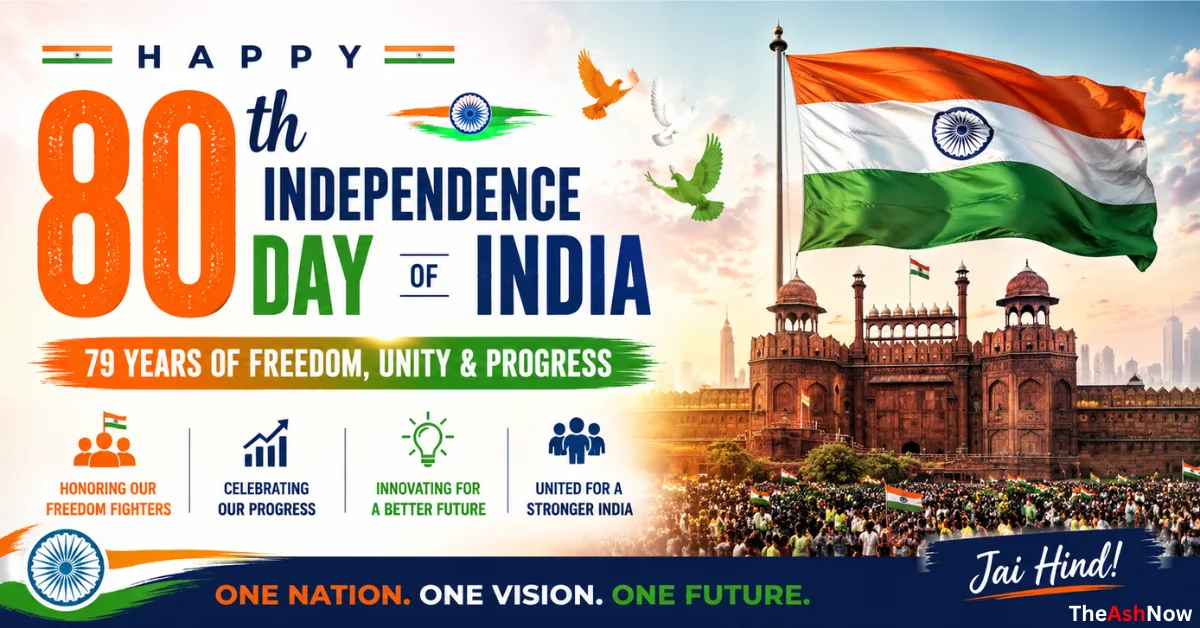
Every year on 15 August, India proudly celebrates its Independence Day—a moment that reminds every citizen of the sacrifices, courage, and determination that made freedom possible. 15 August 2026 marks India’s 80th Independence Day, commemorating 79 years of independence since 1947 and honoring the generations who fought for a free and democratic nation.
From the historic tricolor hoisting at the Red Fort to celebrations in schools, colleges, offices, villages, and cities, Independence Day is more than a national holiday. It is a day to remember the past, celebrate the present, and commit ourselves to building a stronger future.
As India continues to emerge as one of the world’s fastest-growing economies, the 80th Independence Day is a reminder that freedom is not only about political independence but also about innovation, education, equality, opportunity, and national progress.

Table of Contents
Your Leadership Story Deserves the Spotlight
Get featured on TheAshNow — the editorial platform trusted by founders, CEOs & executives worldwide for Google visibility, LinkedIn authority & global recognition.
Apply for Featured Profile →The Historic Journey to Independence
For nearly two centuries, India remained under British colonial rule. Millions of Indians participated in the struggle for freedom through peaceful protests, civil disobedience, revolutionary movements, and countless acts of courage.
Visionary leaders inspired the nation to dream of an independent India where every citizen could live with dignity and freedom. Alongside these well-known figures, countless unsung heroes, women, farmers, workers, students, soldiers, and ordinary citizens sacrificed their lives and livelihoods for the nation’s future.
Finally, on 15 August 1947, India achieved independence, beginning a new chapter in its history as a sovereign democratic nation.
Why the 80th Independence Day Is Special
The 80th Independence Day represents an important milestone in India’s modern history.
It reflects:
- Nearly eight decades of democratic governance.
- Remarkable economic transformation.
- Rapid technological innovation.
- Significant achievements in education, healthcare, infrastructure, and digital connectivity.
- India’s growing influence on global affairs.
The occasion also encourages citizens to reflect on how far the country has come while recognizing the work that still lies ahead.
India’s Progress Since Independence
Since 1947, India has transformed across multiple sectors.
Economic Growth
India has evolved into one of the world’s largest economies. Manufacturing, services, agriculture, startups, digital commerce, and innovation continue to drive economic development while creating new opportunities for millions.
Digital Revolution
Digital India has changed the way people communicate, learn, work, pay, and access public services. Internet connectivity, digital payments, online education, and e-governance have made technology an essential part of everyday life.
Space and Science
India’s achievements in space exploration have earned international recognition. Scientific research, satellite technology, planetary missions, and innovation continue to strengthen the country’s global reputation.
BUILD YOUR LEGACY IN PRINT
Editorial features for founders, CEOs & executives — engineered for search visibility, LinkedIn credibility & industry authority.
APPLY NOW →Infrastructure Development
Modern highways, expressways, airports, metro systems, railway modernization, renewable energy projects, and smart city initiatives are reshaping the nation’s infrastructure.
Education and Innovation
India has become a global hub for engineering, medicine, research, entrepreneurship, and information technology. Young innovators and startups are contributing to solutions with global impact.
The Meaning of Freedom Today
Freedom today extends beyond independence from colonial rule.
It also represents:
- Equal opportunities for every citizen.
- Access to quality education.
- Freedom of expression within constitutional values.
- Innovation and entrepreneurship.
- Gender equality.
- Social justice.
- Environmental responsibility.
- Digital inclusion.
Every generation has a responsibility to protect these values and strengthen India’s democratic institutions.
The Role of India’s Youth
More than half of India’s population is young, making youth one of the country’s greatest strengths.
The future of India depends on young people who choose to:
- Learn continuously.
- Build new businesses.
- Develop technology.
- Create employment.
- Support local communities.
- Protect the environment.
- Respect diversity.
- Participate responsibly in democracy.
The dreams of today’s youth will shape India’s next chapter.
Unity in Diversity: India’s Greatest Strength
- India is home to hundreds of languages, multiple religions, countless traditions, and diverse cultures.
- Despite these differences, the country continues to celebrate the principle of “Unity in Diversity.”
- From Kashmir to Kanyakumari and from Gujarat to Arunachal Pradesh, every region contributes to India’s cultural richness.
- This diversity has always been one of India’s greatest strengths and continues to inspire the world.
Honoring Our Armed Forces
- Independence is protected every day by the dedication and sacrifice of the Indian Armed Forces, paramilitary personnel, police forces, disaster response teams, and countless public servants.
- Their commitment ensures the nation’s security, sovereignty, and peace.
- On Independence Day, millions of Indians express gratitude to everyone serving the country with courage and integrity.
Building the India of Tomorrow
The journey of nation-building never truly ends.
Every citizen can contribute by:
- Following the Constitution.
- Respecting laws.
- Paying taxes honestly.
- Supporting education.
- Keeping public spaces clean.
- Promoting innovation.
- Encouraging sustainable development.
- Fighting misinformation with verified facts.
- Helping those in need.
- Working with honesty and integrity.
Small actions taken by millions of citizens create meaningful national progress.
Independence Day Celebrations Across India
The day begins with the Prime Minister hoisting the national flag at the Red Fort in New Delhi, followed by the national anthem and an address to the nation.
Across India, schools, colleges, offices, government institutions, and communities organize:
- Flag hoisting ceremonies.
- Cultural performances.
- Patriotic songs.
- Speeches.
- Parade events.
- Community service activities.
- Tree plantation drives.
- Educational programs.
- Tribute ceremonies honoring freedom fighters.
The tricolor becomes a symbol of unity, pride, and hope in every corner of the country.
Conclusion
- India’s 80th Independence Day is not only a celebration of freedom but also a celebration of resilience, democracy, diversity, and progress.
- As the nation honors 79 years of independence, this historic milestone reminds every citizen that the future of India depends on collective responsibility, innovation, compassion, and national unity.
- The sacrifices of the past have given us the freedom to dream, create, and build. It is now our responsibility to ensure that future generations inherit an India that is stronger, more inclusive, more sustainable, and more prosperous than ever before.
Happy 80th Independence Day, India!
May the Tiranga continue to inspire every Indian to work with pride, integrity, and hope for a brighter tomorrow.
FAQs
1. Is 2026 India’s 80th Independence Day or 79th?
Yes, 15 August 2026 marks India’s 80th Independence Day. India has completed 79 years of independence since 15 August 1947, making the 2026 celebration the 80th Independence Day.
2. Why is the 80th Independence Day celebrated in 2026?
India became independent on 15 August 1947. Since the first Independence Day was celebrated in 1947, the celebration on 15 August 2026 is counted as the 80th Independence Day, while the nation completes 79 years of freedom.
3. What is the significance of India’s 80th Independence Day?
India’s 80th Independence Day celebrates nearly eight decades of democracy, unity, national development, and the sacrifices of freedom fighters. It is also an opportunity to reflect on the country’s achievements and its vision for the future.
4. How is Independence Day celebrated in India?
Independence Day is celebrated with the Prime Minister’s flag hoisting ceremony at the Red Fort, patriotic speeches, cultural programs, parades, school events, community celebrations, and the display of the Indian national flag across the country.
5. What is the theme of India’s 80th Independence Day in 2026?
The Government of India may announce an official theme closer to 15 August 2026. Until then, there is no officially declared national theme for the 80th Independence Day.

- Disclaimer: This article is published for educational, informational, and awareness purposes only. While every effort has been made to ensure the accuracy of the information, historical facts, dates, themes, government announcements, and official details may be updated over time.
- Any references to national events, official ceremonies, or future announcements are based on publicly available information at the time of publication. Readers are encouraged to verify official announcements through the Government of India or other authorized sources when necessary.
- The views expressed in this article are intended solely to celebrate India’s independence, honor the sacrifices of freedom fighters, and promote national unity, constitutional values, and civic awareness. No part of this content is intended to offend, misrepresent, or promote political bias.




This writeup provided practical information I can use today and I look forward to reading more from you
Cảm ơn thông tin bổ ích. Nếu bạn quan tâm du học Hàn Quốc, Letco chuyên tư vấn lộ trình, chọn trường và xin visa với tỷ lệ đậu cao. Xem chi tiết tại letco.vn.