
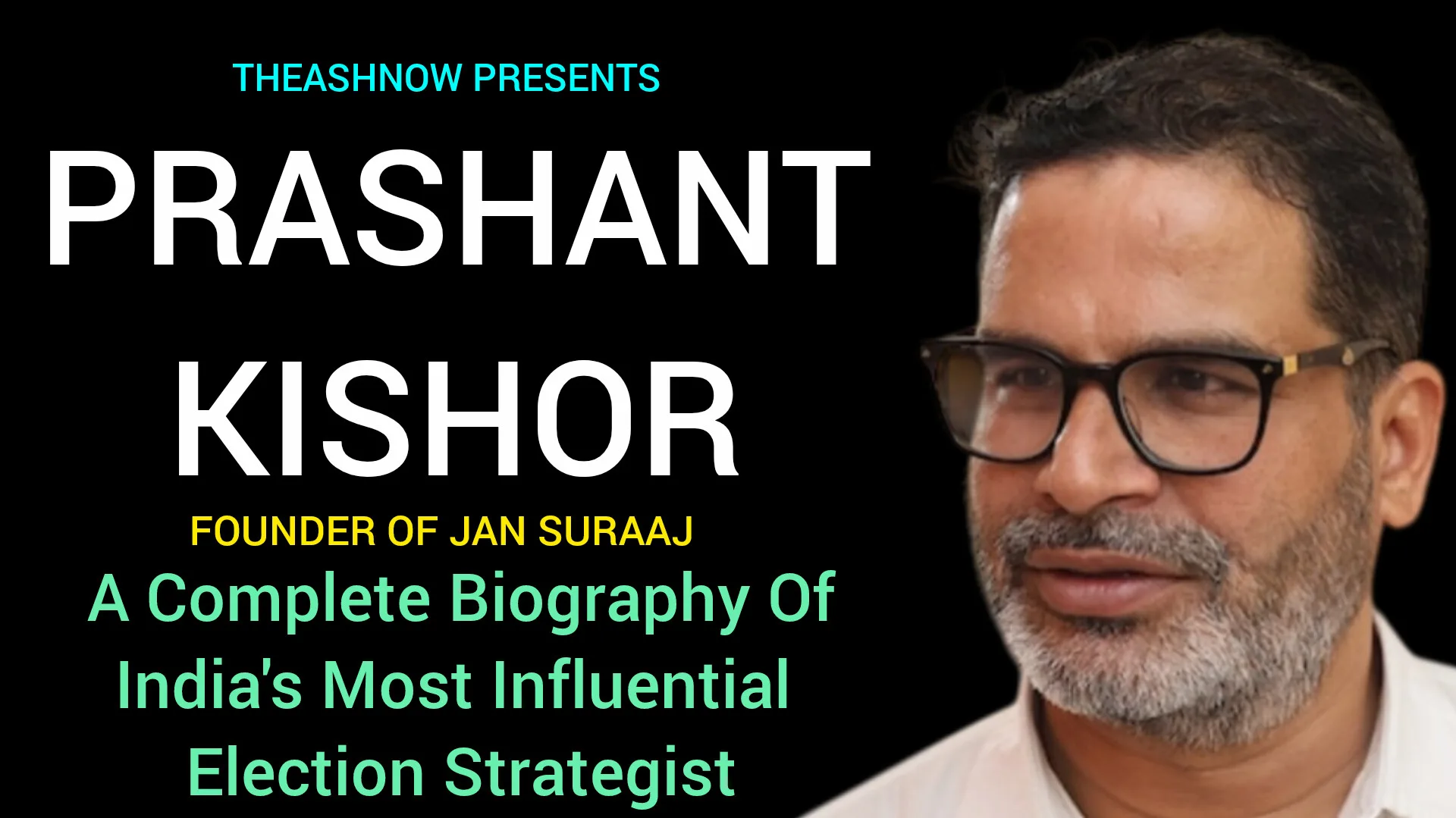
Modern Indian politics is full of towering personalities—leaders, ideologues, mass mobilizers, and strategists who have shaped the national narrative. Among them, one figure stands out not for fiery speeches or decades of political lineage, but for something rare: the ability to transform electoral politics through data, technology, communication, and grassroots engineering. This figure is Prashant Kishor, widely known as PK.
Born in a small village in Bihar, Kishor rose from a public health expert in Africa to become one of the most powerful behind-the-scenes forces in Indian democracy. His strategies helped determine the outcomes of some of the biggest elections of the past decade—Lok Sabha 2014, Bihar 2015, Punjab 2017, West Bengal 2021, Delhi 2020, and more. His work changed how campaigns are designed, executed, and analyzed.
But his story doesn’t end there. After mastering election strategy, he walked away from the consulting world to start a political movement that aims to transform Bihar: Jan Suraaj.
This biography explores the complete life of Prashant Kishor—his origins, influences, failures, victories, philosophies, controversies, and his attempt to reshape Bihar’s political future.
Your Leadership Story Deserves the Spotlight
Get featured on TheAshNow — the editorial platform trusted by founders, CEOs & executives worldwide for Google visibility, LinkedIn authority & global recognition.
Apply for Featured Profile →Table of Contents
Chapter 1: Early Life and Rural Roots
Every extraordinary journey begins with an ordinary setting.
Prashant Kishor was born on 20 March 1977 in Konar, a small village in the Rohtas district of Bihar. His father, Dr. Shrikant Pandey, was a doctor who served in government hospitals. His mother, Sushila Devi, managed the household. The family lived a simple, middle-class life, rooted in the values of discipline, education, and service.
Growing up in rural Bihar in the 1980s and early 1990s was far from easy. Electricity was unreliable, roads were poor, and opportunities were limited. Yet, for a young boy who observed social inequalities, administrative failures, and lack of development on a daily basis, these experiences planted the seeds of future ambition.
The contrast between what he saw in his village and what he believed was possible stayed with him. He often mentions in conversations that the real India lives outside big cities, and this belief deeply shaped his politics later.
After completing his schooling in Buxar, he pursued engineering. But even during his early education, Kishor showed an unusual ability to analyze systems, understand patterns, and think beyond traditional expectations.
Chapter 2: A Career in Public Health — From Bihar to Africa
Before politics entered his life, Prashant Kishor built a strong, meaningful career in public health, working with international institutions.
He spent around eight years working on health systems, nutrition, development models, and social policy. His work was largely associated with the United Nations and its allied agencies.
UNICEF in Chad
One of the most important chapters of his early career was his role as the Chief of Social Policy and Planning at UNICEF in the African nation of Chad. This region, affected by poverty, malnutrition, and political instability, gave Kishor exposure to the complexities of development work at the ground level.
Here, he learned:
BUILD YOUR LEGACY IN PRINT
Editorial features for founders, CEOs & executives — engineered for search visibility, LinkedIn credibility & industry authority.
APPLY NOW →- How government systems function
- How policies fail and succeed
- How social behavior influences public programs
- How data can guide decision-making
His analytical reports during this period gained recognition, and one of his papers on economic development models caught the interest of influential Indian policymakers.
This would eventually open the door to his political journey.
Chapter 3: The Leap Into Politics — A Quiet Revolution Begins
Around 2011, while India was witnessing a wave of political awakening triggered by the anti-corruption movement, Kishor left his UN role and returned to India. He was looking for a bigger challenge.
A few conversations with political leaders—particularly with those close to the Gujarat government at the time—marked the beginning of a historic partnership.
In 2013, Kishor founded a young, motivated, tech-driven team called:
Citizens for Accountable Governance (CAG)
CAG consisted of students from IITs, IIMs, medical colleges, global universities, and communication backgrounds. They brought professionalism, digital skills, and analytical thinking to Indian elections—something the country had never seen before.
They weren’t traditional political workers. They were strategists, data scientists, filmmakers, designers, and field managers.
With this team, Kishor set in motion what would become one of the most groundbreaking political campaigns in Indian history.
Chapter 4: Modi 2014 — A Campaign That Changed Everything
The 2014 Lok Sabha election was a defining moment for India and for Prashant Kishor.
He became the principal architect of Narendra Modi’s high-voltage, tech-savvy, multi-platform election campaign.
Some of the innovations he introduced became iconic:
Chai Pe Charcha
A mass engagement initiative that connected Modi to people across India via live, satellite-linked tea-shop discussions.
3D Hologram Rallies
Modi addressed dozens of locations simultaneously using holographic projections—a first in Indian politics.
Mission 272+ Data Strategy
CAG designed meticulous booth-level data models, micro-segmentation analyses, and targeted communication for specific voter groups.
Massive Volunteer Mobilization
Youth played a central role in organizing events, door-to-door outreach, and digital promotions.
The campaign broke all previous records in scale, professionalism, and media presence.
When BJP won a historic mandate with a full majority, Prashant Kishor became a national figure—though he still maintained a low public profile.
But one thing was clear:
Indian elections would never be the same again.
Chapter 5: The Rise of I-PAC — A New Era in Election Strategy
After the 2014 success, CAG was transformed into the Indian Political Action Committee (I-PAC)—a new kind of political consultancy in India.
I-PAC was different from anything that existed earlier:
- It functioned like a corporate organization.
- It mixed analytics with ground surveys.
- It deployed thousands of field workers.
- It used digital media as a powerful weapon.
- It crafted narratives through branding and storytelling.
Under Kishor’s leadership, I-PAC soon became the most influential political consulting group in Asia.
Chapter 6: The Bihar Masterstroke (2015)
In 2015, Kishor engineered the strategy for the Mahagathbandhan—a grand alliance of JD(U), RJD, and Congress—against BJP in Bihar.
This was one of the toughest battles of the decade.
Kishor:
- Rebranded Nitish Kumar as “Bihari ke Putra”
- Designed a strong volunteer network
- Ran targeted campaigns on governance vs. identity
- Created ground-level programs like Har Ghar Dastak
Despite a massive wave for BJP nationally, the Grand Alliance won decisively.
This victory established Kishor as India’s foremost election strategist.
Chapter 7: The Architect of Multiple Historic Wins
Over the next several years, Kishor and his team played a central role in major elections across the country.
Punjab 2017 — Congress returns to power
Kishor built the campaign that delivered a huge victory to Captain Amarinder Singh.
Andhra Pradesh 2019 — YSRCP landslide
He helped Y. S. Jagan Mohan Reddy sweep the state.
West Bengal 2021 — TMC’s dramatic comeback
Perhaps his biggest achievement after 2014, this campaign helped Mamata Banerjee stop aggressive national opposition efforts and win a third term.
Delhi 2020 — AAP supermajority
Arvind Kejriwal’s victory was powered by I-PAC’s grassroots and digital work.
Tamil Nadu 2021 — DMK returns to power
Kishor guided M. K. Stalin’s campaign to a sweeping victory.
During this period, his image evolved into that of a “kingmaker.”
His successes reshaped regional politics and repositioned election strategy as a professional discipline.
Chapter 8: A Rare Failure — Uttar Pradesh 2017
Not all campaigns succeeded.
His strategy for Congress in the UP 2017 election did not produce results. The party performed poorly, and BJP swept the state.
However, PK has often mentioned that failures teach more than victories, and this setback strengthened his analytical approach for later campaigns.
Chapter 9: A Shift — From Strategist to Politician
After years of advising leaders across ideological lines, Kishor felt he needed to move from consultancy to active politics.
In 2018, he joined Janata Dal (United) and was appointed National Vice-President.
But his tenure was short-lived. Kishor often challenged the party’s decisions—particularly on issues of ideology and alliances.
This friction led to his exit in 2020.
And then came his biggest transition yet.
Chapter 10: The Birth of Jan Suraaj
After leaving JD(U), Kishor did something unusual.
He didn’t launch a party immediately.
He didn’t start campaigning.
He didn’t form alliances.
Instead, he started walking.
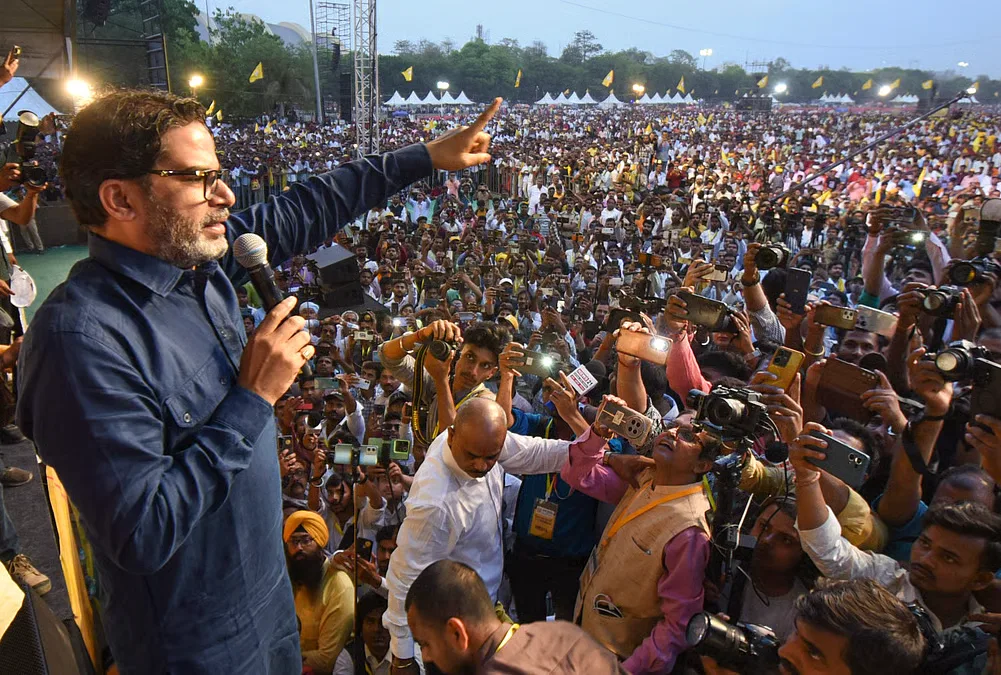
The Jan Suraaj Padyatra
A massive foot march across Bihar—covering thousands of kilometers, hundreds of blocks, and countless villages.
This padyatra allowed him to:
- Understand local problems
- Build direct connections
- Listen to ground realities
- Observe governance challenges firsthand
Out of this journey grew a movement called Jan Suraaj, which later became a full-fledged political party in October 2024.
Chapter 11: Vision and Ideology of Jan Suraaj
Jan Suraaj is built around one central philosophy:
“Good governance is the first condition of a developed society.”
Its core principles are:
- Data-based governance
- Meritocracy
- Ending caste-dominated politics
- Empowering youth
- Modernizing Bihar
- Transparency in leadership
- Quality education and healthcare
- Rural development with long-term planning
Kishor’s speeches emphasize that Bihar lags behind not because its people are weak, but because governance has failed for decades.
He believes that real development comes not from caste alliances but from administrative efficiency.
Chapter 12: Governance Model Proposed by Kishor
Kishor’s vision includes:
1. Strong education reforms
Better schools, teacher accountability, and a modern curriculum.
2. Healthcare overhaul
Primary health centers, district hospitals, and rural nutrition.
3. Economic growth
Agriculture modernization, SME support, and skill development.
4. Migration reversal
Creating enough jobs in Bihar so that youth don’t have to leave the state.
5. Transparent recruitment
Ending corruption in government jobs.
6. Village-level governance
Empowering panchayats with funds and accountability tools.
This model draws heavily from his experience in public health planning and development science.
Chapter 13: Criticism and Controversies
Kishor’s rising popularity also brought criticism:
- Some accuse him of working with opposite ideologies for commercial gain.
- Critics say professional election firms make politics expensive.
- Rival parties filed defamation cases against him in Bihar.
- Skeptics doubt whether a strategist can become a mass leader.
- Others argue that Bihar’s caste politics is too deeply rooted to be changed.
Despite this, Kishor remains one of the boldest voices in Indian political reform.
Chapter 14: Personal Life
Prashant Kishor is married to Dr. Jahnavi Das, a medical professional from Assam.
They reportedly met during their overseas work in public health programs.
The couple has one son.
Kishor’s mother passed away in 2018, a loss he rarely speaks about publicly. He is extremely private about his family and avoids using them in political publicity.
Chapter 15: The Man Behind the Strategist
While PK is known for his election strategies, those who have worked with him describe him as:
- Highly disciplined
- Data-obsessed
- Extremely detail-oriented
- A perfectionist
- A relentless worker
- Someone who can operate without sleep during campaigns
- A sharp communicator
He believes in “science over slogans”, a rare perspective in Indian politics.
Chapter 16: Legacy and Impact
Even before entering full-time politics, Kishor had already reshaped India’s political landscape.
His legacy includes:
- Professionalizing election campaigns
- Making data analytics central to political decision-making
- Using technology, digital media, and behavioral science in politics
- Creating career opportunities for youth in political consulting
- Influencing major elections across multiple states
- Inspiring new-age political activism
- Showing India that politics can be modern, strategic, and scientific
Chapter 17: The Road Ahead
Whether Prashant Kishor becomes a major political leader or not, one thing is clear:
He has already changed the rules of Indian politics.
Jan Suraaj represents his long-term vision, not just an election bid.
His padyatras, ground engagement, and governance-first approach indicate that he is aiming for structural change.
The coming years will determine:
- Can Jan Suraaj break caste equations?
- Can PK convert strategy into votes?
- Will Bihar accept a new political model?
- Will he become a major contender for the Chief Minister’s post?
The future remains open, but the journey is undeniably historic.
Conclusion
Prashant Kishor’s biography is not just the story of one man—it is the story of how ideas, ambition, and courage can reshape a nation’s political consciousness.
From a village in Bihar to the halls of the United Nations, from shaping national elections to forming his own political movement, Kishor’s life is unlike any other in Indian public life.
He is not just a strategist; he is a thinker, reformer, and now a political challenger seeking to redesign the future of Bihar.
And his story is still unfolding.
Frequently Asked Questions (FAQs) About Prashant Kishor
Why is Prashant Kishor famous?
He became famous after leading the strategic planning for the 2014 Lok Sabha campaign and later for helping several regional parties win state elections. His use of data, technology, and grassroots surveys revolutionized political campaigning in India.
What is Jan Suraaj?
Jan Suraaj is a political movement and later a political party launched by Prashant Kishor. It focuses on good governance, education, health, youth empowerment, and reducing caste-based politics in Bihar.
Did Prashant Kishor win the 2025 Bihar election?
No. In the 2025 Bihar Assembly elections, the Jan Suraaj Party contested about 238 seats but did not win a single seat. The vote share remained around 3–4%.
Why did Jan Suraaj fail in the election?
Analysts cite multiple reasons: lack of local leadership, absence of caste-based mobilization, weak organizational base, limited resources, and voter preference for traditional parties. Jan Suraaj acted as a vote splitter in several seats rather than a strong challenger.
Which political parties has Prashant Kishor worked with?
He has worked with BJP, JD(U), Congress, AAP, YSRCP, TMC, and DMK, among others — helping many win major elections.
Is Prashant Kishor still a political strategist?
No. He has repeatedly stated that he has left political consultancy to focus completely on building Jan Suraaj and working directly with people on the ground.
What is Prashant Kishor’s long-term goal?
His long-term aim is to transform governance in Bihar, uplift education and health systems, reduce migration, and introduce a modern, merit-based political culture independent of caste equations.
Will Jan Suraaj continue after the 2025 defeat?
As of now, PK has indicated that Jan Suraaj will restructure and continue working. The party may focus on stronger grassroots organization before contesting future elections.




When I originally commented I clicked the -Notify me when new comments are added- checkbox and now each time a comment is added I get four emails with the same comment. Is there any way you can remove me from that service? Thanks!
[…] Prashant Kishor: A Complete Biography of India’s Most Influential Election Strategist […]