USA in 2050: The United States has dominated the global economy for over a century, but as we approach 2050, the question of whether America will maintain its economic supremacy has become increasingly complex. While the nation faces unprecedented challenges from rising competitors like China and India, the U.S. possesses enduring advantages that could help it retain significant global economic influence, even if not outright dominance.
Table of Contents
USA in 2050: The Shifting Economic Landscape
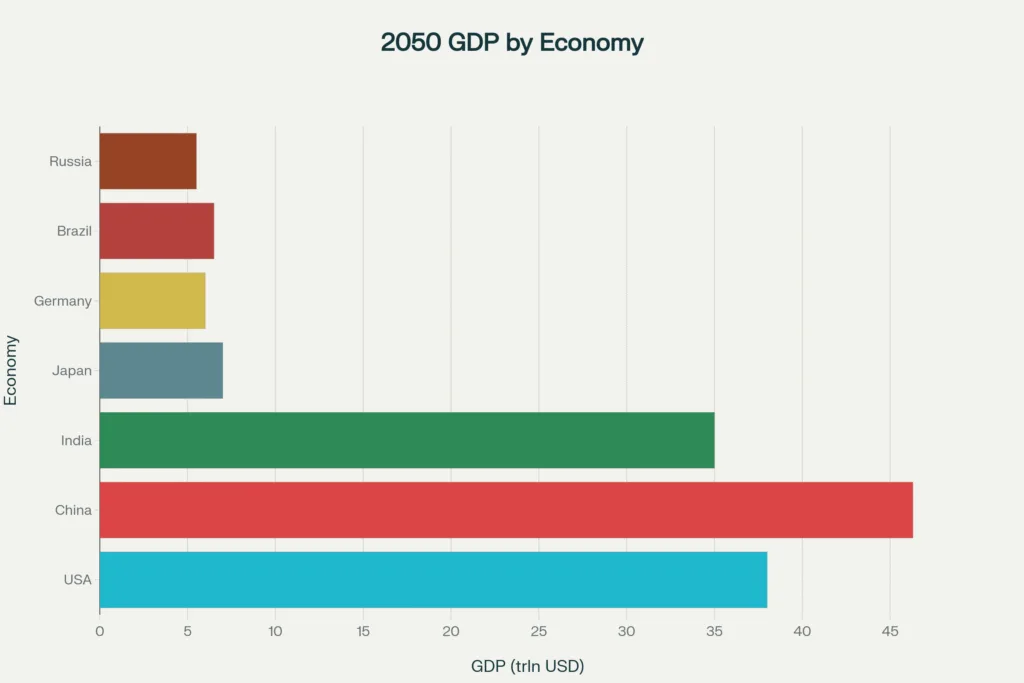
Economic projections paint a dramatically different picture of 2050. Goldman Sachs and other leading financial institutions forecast that China’s economy will reach approximately $46.3 trillion by 2050, compared to America’s projected $38 trillion. This would mark the end of nearly a century of American economic dominance, with China claiming the top spot sometime in the 2030s.
India emerges as another formidable player, with projections showing its GDP could reach $30-35 trillion by 2050. The rapid growth of Asian economies means that Asia (excluding developed markets) will represent 40% of global GDP by 2050, compared to just 36% for all developed markets combined.
However, these projections come with significant caveats. Recent analyses: Frequently Asked Questions: USA’s Economic Future in 2050
gest that China’s long-term growth prospects face substantial headwinds. The country confronts a rapidly aging population, with those over 65 expected to reach 37.8% of the total population by 2050. Additionally, China’s property sector slowdown and increasing global pushback against its economic practices could constrain future growth.
Your Leadership Story Deserves the Spotlight
Get featured on TheAshNow — the editorial platform trusted by founders, CEOs & executives worldwide for Google visibility, LinkedIn authority & global recognition.
Apply for Featured Profile →America’s Enduring Strengths
Despite facing intensified competition, the United States maintains several structural advantages that could help preserve its economic leadership:
Technological Innovation and AI Dominance
- America continues to lead in cutting-edge technologies, particularly artificial intelligence. The Trump administration’s AI Action Plan emphasizes that “whoever has the largest AI ecosystem will set global AI standards and reap broad economic and military benefits”. The U.S. maintains superiority in AI development, with American companies like OpenAI, Google, and Microsoft leading breakthrough innovations.
- Military and technological leaders warn that nations leading in AI will dominate global technology by 2050. Frank Kendall, former Secretary of the Air Force, emphasized that “victory or defeat in the air or in space at the human scale is likely to be determined by which combatant has fielded the most advanced AI technology”.
Demographics and Immigration
- While America is aging, its demographic outlook remains more favorable than major competitors. By 2050, 22% of Americans will be over 65, compared to China’s projected 37.8%. The U.S. population is expected to grow from 331 million in 2020 to 371 million by 2050, driven largely by continued immigration.
- America’s diversity advantage is expanding: by 2050, immigrants and their children will account for 34% of the U.S. population, up from 26% today. This demographic dynamism contrasts sharply with the population decline expected in many developed competitors.
Financial Market Dominance
- The United States maintains an enormous advantage in global finance. American stock and bond markets totaled $79 trillion in 2024, eight times larger than Japan’s markets. Goldman Sachs has increased its allocation to U.S. stocks to 79%, a 12-percentage-point overweight relative to global indices.
- The dollar’s reserve currency status remains largely unchallenged, despite efforts by BRICS nations to develop alternatives. While emerging economies push for de-dollarization, no viable alternative has emerged to match the dollar’s liquidity and stability.
Significant Challenges Ahead
Fiscal Sustainability Crisis
- Perhaps America’s greatest vulnerability lies in its unsustainable fiscal trajectory. The national debt is projected to reach 150-195% of GDP by 2050, potentially doubling from current levels. The Congressional Budget Office warns this could trigger “a fiscal crisis where investors lose confidence in the U.S. government’s ability to service debt”.
- Rising debt service costs already consume as much federal spending as national defense or Medicare. By 2050, this burden could significantly constrain government investment in critical areas like infrastructure, education, and research.
Infrastructure Investment Gap
- The American Society of Civil Engineers gives U.S. infrastructure a C grade, with a $3.7 trillion investment gap needed to bring infrastructure to good repair. This represents a significant competitive disadvantage as China spends ten times more on infrastructure as a percentage of GDP.
- Poor infrastructure costs the U.S. approximately $1 trillion annually in forgone economic growth, hampering business competitiveness and productivity growth essential for maintaining economic leadership.
Manufacturing and Supply Chain Resilience
- While reshoring efforts are underway, challenges remain substantial. Only 2% of companies have fully completed their reshoring plans despite 81% expressing intentions to bring supply chains closer to home. Manufacturing currently represents just 12% of U.S. GDP, though reshoring could increase this to 15-20% by 2050.
| Factor | Current Status (2025) | 2050 Projection | Competitive Assessment |
|---|---|---|---|
| GDP Size (Projected) | $29 trillion (#1 globally) | $38 trillion (#2-3 globally) | May lose #1 position to China |
| GDP Per Capita | $80,000+ (Top 10) | $90,000+ (Top 5) | Remains competitive globally |
| Population Growth | 0.4% annually | 0.3% annually | Slower than emerging economies |
| Technological Leadership | Leading in AI, semiconductors | Strong but challenged by China | Intense competition with China |
| Innovation Ecosystem | Silicon Valley, strong VC | Maintained but competition increases | Strong foundation, global talent attraction |
| Military Strength | Dominant military power | Likely remains #1 | Maintains global military leadership |
| Financial Markets | $79 trillion market cap | Expected to maintain dominance | Deep, liquid markets advantage |
| Higher Education | World’s top universities | Continued global leadership | Brain drain mitigation through immigration |
| Demographics | Aging but immigration helps | 22% over 65, diverse population | Better than China/Europe demographics |
| Infrastructure Quality | C grade (ASCE rating) | Improved with recent investments | $3.7T investment gap to address |
| Energy Independence | Net energy exporter since 2019 | Maintained energy security | Advantage over import-dependent rivals |
| Debt-to-GDP Ratio | 120% of GDP | 150-195% of GDP (risk) | Major fiscal challenge ahead |
| Manufacturing Share | 12% of GDP | 15-20% with reshoring efforts | Maintained, but competition increases |
The U.S. faces policy uncertainty, labor shortages, and cost challenges that complicate manufacturing renaissance efforts. However, legislation like the CHIPS Act and the Inflation Reduction Act provides significant incentives for domestic production.

The Multipolar Reality
- Rather than a simple binary outcome, 2050 will likely feature a multipolar economic world with multiple centers of power. The U.S., China, and India are projected to form a “New Triad” of economic superpowers, collectively representing enormous global influence.
- BRICS nations already represent almost 40% of global GDP, challenging traditional Western economic dominance. However, internal divisions and the lack of institutional coherence limit their ability to present a unified alternative to the American-led economic order.
Strategic Imperatives for Continued Leadership
- For America to maintain significant economic influence through 2050, several strategic priorities emerge:
- Productivity and Innovation Investment: Maintaining technological leadership requires continued investment in R&D, education, and emerging technologies like AI and quantum computing.
- Fiscal Responsibility: Addressing the debt crisis through politically difficult reforms to spending and taxation will be essential to maintain economic stability and investor confidence.
- Infrastructure Modernization: Closing the $3.7 trillion infrastructure gap through targeted federal investment and private partnerships could restore competitive advantages.
- Immigration and Demographics: Maintaining America’s demographic dynamism through continued immigration will be crucial for economic growth as other developed nations face population decline.
Conclusion: Adaptation Rather Than Abdication
- Will America still rule the world economy in 2050? The answer is nuanced. While the U.S. may lose its position as the single largest economy to China, it will likely remain a dominant global economic power with unmatched influence in key sectors.
- America’s technological leadership, financial market depth, military strength, and demographic advantages provide a foundation for continued prominence even in a more competitive global environment. The U.S. economy’s resilience, innovation capacity, and institutional strength have repeatedly enabled it to adapt to changing global conditions.
- The more likely scenario for 2050 is American leadership within a multipolar economic system rather than outright dominance. Success will depend on how effectively the nation addresses its fiscal challenges, invests in infrastructure and innovation, and adapts to intensified global competition.
- As Goldman Sachs analysts note, the U.S. remains “the largest, most diverse, innovative, and resilient economy in the world”. While the days of unchallenged American economic hegemony may be ending, the foundation exists for continued leadership in the global economy of 2050—provided the nation makes the necessary strategic investments and reforms today.
Frequently Asked Questions: USA’s Economic Future in 2050?
1. When will China overtake the USA as the world’s largest economy?
Most projections suggest China will surpass US GDP sometime between 2030-2037, with the exact timing depending on growth rates and exchange rates. However, recent analyses question whether this will happen at all due to China’s structural challenges, including an aging population, a property sector crisis, and slowing growth.
2. What will be the ranking of the top economies by 2050?
By 2050, the consensus ranking is: 1) China ($46.3 trillion), 2) USA ($38 trillion), 3) India ($35 trillion), 4) Japan (~$7 trillion), 5) Germany (~$6 trillion). However, this represents nominal GDP – the US will likely maintain higher per-capita income and living standards.
3. Will the USA lose its economic dominance completely by 2050?
No, the USA will not lose economic dominance completely. While it may rank #2-3 in total GDP, America will likely retain leadership in financial markets, technology innovation, military power, and global influence. The scenario is multipolar leadership rather than total displacement.
4. How will demographic changes affect US economic power?
By 2050, 22% of Americans will be over 65, but this is better than in China (37.8%) and most developed nations. Immigration will help – immigrants and their children will represent 34% of the US population by 2050, providing demographic dynamism that competitors lack.
5. What role will technology play in maintaining US leadership?
Technology, especially AI, will be crucial. The US leads in AI development through companies like OpenAI, Google, and Microsoft. Military experts predict that nations leading in AI will dominate global technology by 2050, giving America a potential decisive advantage.
6. Can the US dollar maintain its global reserve currency status?
Despite challenges from BRICS and de-dollarization efforts, no viable alternative to the dollar has emerged. The dollar comprises 87% of foreign exchange reserves, and US financial markets ($79 trillion) are eight times larger than competitors. Reserve status will likely be maintained.
7. What are the biggest economic challenges facing America by 2050?
The biggest challenges are: 1) National debt reaching 150-195% of GDP, 2) $3.7 trillion infrastructure investment gap, 3) Fiscal sustainability crisis, 4) Manufacturing competitiveness, 5) Rising healthcare costs, and 6) Political polarization affecting policy consistency.
8. How will AI and innovation impact US competitiveness?
AI will be transformational. Trump’s AI Action Plan emphasizes that “whoever has the largest AI ecosystem will set global AI standards”. The US maintains advantages in the innovation ecosystem, venture capital, top universities, and tech talent attraction that should preserve leadership.
BUILD YOUR LEGACY IN PRINT
Editorial features for founders, CEOs & executives — engineered for search visibility, LinkedIn credibility & industry authority.
APPLY NOW →9. What happens if China’s economy grows faster than expected?
If China grows faster than expected, it could become significantly larger than the US by 2050. Fitch Solutions projects China’s economy could be “quite a bit larger” than America’s by 2050. However, China faces major structural headwinds that make sustained rapid growth unlikely.
10. Will manufacturing reshoring save American economic leadership?
Manufacturing reshoring is happening, but faces challenges. Currently, 12% of GDP, manufacturing could reach 15-20% by 2050 with government incentives like the CHIPS Act. However, cost challenges, labor shortages, and global competition limit the impact on overall economic leadership.
11. How does US debt threaten future economic dominance?
US debt is projected to reach 150-195% of GDP by 2050, potentially triggering a fiscal crisis if investors lose confidence. This could constrain government investment in infrastructure, education, and research – critical areas for maintaining competitiveness.
12. What about India’s economic rise – will it challenge both the US and China?
India is projected to have the world’s fastest growth (3.1% annually through the 2050s) and could become the third-largest economy. With better demographics than China and the US, India represents a major challenge to both superpowers, creating a “New Triad” of economic powers.
13. Can BRICS countries create an alternative to the US-led economic order?
BRICS already represents 40% of global GDP, but internal divisions and a lack of institutional coherence limit their effectiveness. While they challenge the US-led order, creating a truly alternative system remains difficult without addressing fundamental coordination problems.
14. Will a US recession derail America’s economic prospects?
Economists currently place recession odds at 40-45% by the end of 2025. While recessions create short-term disruption, the US economy’s resilience and structural advantages suggest it would recover. Long-term competitiveness depends more on addressing debt, infrastructure, and innovation challenges.
15. How do trade wars and tariffs affect long-term US competitiveness?
Tariffs and trade wars create short-term costs but may have mixed long-term effects. They can encourage domestic manufacturing (reshoring) but also increase costs for consumers and businesses. Success depends on whether trade policy supports a broader competitiveness strategy rather than pure protectionism.