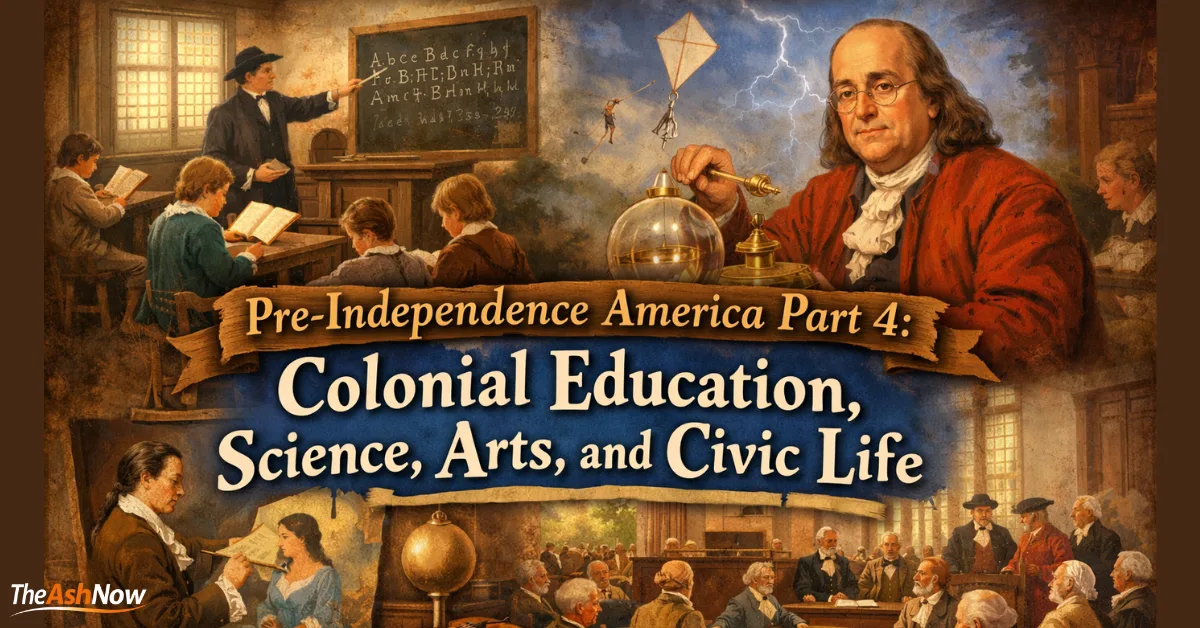
Pre-Independence America Part 4: As America grew economically and politically, its intellectual and cultural life blossomed. Education became more accessible (for some), science took root, the arts flourished modestly, and civic institutions started forming. These elements didn’t just enrich colonial life—they built the philosophical foundation for revolution and democracy.
Table of Contents
1. Colonial Education: Classrooms, Colleges, and Literacy
1.1 Purpose of Education
The primary goals of early education were:
- Teaching reading for religious purposes (especially in Puritan colonies)
- Training ministers and civic leaders
- Promoting moral discipline and civic responsibility
Ad
Your Leadership Story Deserves the Spotlight
Get featured on TheAshNow — the editorial platform trusted by founders, CEOs & executives worldwide for Google visibility, LinkedIn authority & global recognition.
Apply for Featured Profile →- Why Sugar Prices Are Rising in India: Is Ethanol Behind the Price Surge?

- Colombia Earthquake: A 7.4-Magnitude Disaster Exposes the Human Cost of Seismic Risk Across Western Colombia
- Bankipur By-Election Result 2026 LIVE: Counting Updates, Vote Margin & Latest Trends
- Assam Floods 2026: When the Brahmaputra Turns Into a Sea
- Pralhad Joshi Takes Charge as India’s New Education Minister




1.2 Regional Differences in Schooling
| Region | Characteristics |
|---|---|
| New England | Education for the elite only; tutors for plantation children; widespread illiteracy among poor whites and slaves |
| Middle Colonies | Moderate literacy; religious diversity led to varied schooling (Quakers, Lutherans, etc.) |
| Southern Colonies | Education for elite only; tutors for plantation children; widespread illiteracy among poor whites and slaves |
1.3 Notable Institutions
- Harvard College (1636) – Oldest U.S. college, trained Puritan ministers
- College of William & Mary (1693) – Anglican institution in Virginia
- Yale University (1701) – Founded due to Harvard’s growing liberalism
- Princeton, Columbia, Penn – Founded during the Enlightenment to expand secular education
1.4 Women and Education
- Girls were often educated at home or in “dame schools.”
- Education focused on religion, sewing, and domestic skills
- Literate women were rare, but not absent—Mercy Otis Warren and Abigail Adams were notable thinkers
2. Enlightenment and Scientific Curiosity
2.1 The American Enlightenment
Inspired by European philosophers like John Locke, Voltaire, and Rousseau, the American Enlightenment emphasized:
- Reason over tradition
- Empirical evidence
- Human rights
- Political reform
2.2 Benjamin Franklin – America’s Enlightenment Icon
- Scientist, inventor, philosopher, and diplomat
- Created bifocals, a lightning rod, Franklin stove
- Founded:
- Library Company of Philadelphia
- American Philosophical Society
- University of Pennsylvania
- His experiments with electricity earned international fame
Ad
- Anmol Jaiswal – The Story Behind Indian Backpacker and India’s Most Adventurous Travel Creator
- Joshua Freedman: Emotional Intelligence Leader & CEO
- Alex Hormozi: The Entrepreneur Who Turned Business Growth Into a $100M Playbook
- Alakh Pandey: The Founder of Physics Wallah Who Turned Affordable Education Into a National EdTech Movement
- Kunal Shah: How the FreeCharge and CRED Founder Came to Lead WhatsApp Globally





2.3 Scientific Exploration
- Colonists studied:
- Astronomy (for navigation)
- Agricultural science (crop rotation, fertilization)
- Natural history (animals, plants, minerals)
- Almanacs like Poor Richard’s Almanack included science, weather forecasts, and moral proverbs
3. Print Culture and the Rise of Newspapers
3.1 Growth of the Printing Press
- Printing expanded rapidly in the 1700s—Boston, Philadelphia, and New York became publishing hubs
- By 1775, over 30 newspapers were in print across the colonies
3.2 Popular Publications
- Pamphlets, sermons, almanacs, essays
- Political tracts became popular during pre-revolution debates (e.g., Common Sense by Thomas Paine)
3.3 Spread of Literacy
- Literacy rates in New England reached 90% (white males)
- Reading was both a personal and civic act—essential for understanding scripture and revolutionary ideas
4. Arts, Music, and Literature
4.1 Painting and Visual Art
- Most artists were self-taught portraitists
- Art served to:
- Record family history
- Showcase wealth
- Decorate churches
Famous colonial artists:
- John Singleton Copley
- Charles Willson Peale
- Gilbert Stuart (later painted George Washington’s iconic portrait)
4.2 Music and Theater
- Music was used in worship, celebrations, and taverns
- Instruments included fiddles, drums, flutes, and harpsichords
- Popular genres:
- Psalms and hymns
- Folk songs
- African rhythms among slaves
Theater was limited in New England (seen as sinful), but more popular in the South and Middle Colonies.
4.3 Literature and Poetry
- Early writings were religious or didactic
- Prominent writers:
- Anne Bradstreet – First published female poet in America
- Phillis Wheatley – Enslaved African-American poet published in the 1770s
- Jonathan Edwards – Preacher and theologian (“Sinners in the Hands of an Angry God”)
5. Civic Life and Public Institutions
5.1 Town Meetings and Assemblies
- New England town meetings were among the first experiments in direct democracy
- Elected officials debated taxes, laws, and local issues
- Civic engagement was limited to property-owning white men
5.2 Voluntary Associations
- Book clubs, Masonic lodges, debating societies, and churches became centers of public discourse
- These gatherings built a sense of community and political identity
5.3 Libraries and Public Knowledge
- Subscription libraries grew—Franklin’s Library Company of Philadelphia was the first
- Libraries stocked:
- Classical texts
- Enlightenment works
- Scientific manuals
- Religious literature
6. Intellectual Movements and Revolutionary Thought
6.1 Spread of Revolutionary Philosophy
- Colonial thinkers began questioning:
- Monarchy
- Church authority
- Taxation without representation
Influential writings included:
- John Locke’s Two Treatises of Government
- Montesquieu’s The Spirit of Laws
- Thomas Paine’s Common Sense (sold over 100,000 copies in months)
6.2 Universities as Intellectual Incubators
- Colleges became spaces for political and philosophical debate
- Many Founding Fathers were alumni of colonial institutions
- Young minds trained in rhetoric, history, logic, and ethics—critical for future leadership
7. The Role of Religion in Cultural Life
7.1 The Great Awakening’s Cultural Impact
- Fostered religious pluralism and tolerance
- Encouraged individual emotional expression
- Created new denominations (Methodists, Baptists)
7.2 Religion as a Civic Force
- Churches acted as:
- Meeting places
- Charity centers
- Education hubs
- Ministers were often community leaders and political influencers
Conclusion of Part 4
Even before declaring independence, the colonies were mentally and culturally ready for it. Schools, libraries, debating clubs, and newspapers created an informed, literate public. Enlightenment ideas empowered individuals to question authority, while religion, science, and the arts gave them a moral and intellectual vocabulary for revolution.
The cultural soil had been tilled—and soon, the seeds of revolution would sprout.
Ad
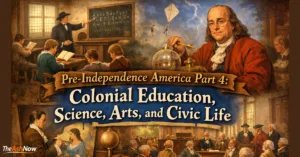
- Pre-Independence America Part 4: Colonial Education, Science, Arts, and Civic Life
- USA in 2050: Will It Still Rule the World Economy?

- The Real Motives Behind US Tariffs on Its Own Allies?
- No Deal in Alaska: Trump-Putin Summit Ends With Tense Optimism, No Ukraine Ceasefire
- Israel–Iran: Direct Warfare Erupts in the Middle East🚨





FAQs Related To Pre-Independence America
1. What was education like in colonial America before independence?
Education in colonial America was limited, locally organized, and focused mainly on religion, basic literacy, and moral instruction, especially for boys.
2. Who had access to education in pre-independence America?
Formal education was mostly available to white males from wealthy or middle-class families, while women, enslaved people, and Native Americans had very limited access.
BUILD YOUR LEGACY IN PRINT
Editorial features for founders, CEOs & executives — engineered for search visibility, LinkedIn credibility & industry authority.
APPLY NOW →3. What subjects were taught in colonial schools?
Common subjects included reading, writing, arithmetic, Latin, Bible studies, and classical texts, depending on region and social class.
4. How did science develop in colonial America?
Science advanced through practical experimentation, astronomy, medicine, and natural philosophy, often inspired by Enlightenment ideas from Europe.
Coming up in Part 5:
“Law, Governance, and Early Democratic Institutions in Colonial America” – a complete breakdown of courts, law codes, charters, governors, assemblies, and how these early frameworks evolved into the roots of American democracy.