
Pre-Independence America: A Deep Dive into Life Before 1776
Chapters:👇
1. Religion in Colonial America
1.1 The Importance of Religion
- In New England, especially Massachusetts, Puritanism shaped laws and daily life.
- Middle Colonies (like Pennsylvania) were more religiously diverse—Quakers, Catholics, Lutherans, Jews, and others lived side by side.
- Southern Colonies had the Anglican Church as the dominant faith, though religious practice was less strictly enforced.
1.2 Religious Freedom and Conflict
- Maryland Toleration Act (1649) was one of the first attempts at religious liberty, though it applied only to Christians.
- Roger Williams founded Rhode Island after being banished from Massachusetts for advocating religious tolerance.
- Despite early movements toward freedom of worship, religious dissenters were often persecuted, fined, or exiled.
1.3 The Great Awakening (1730s–1740s)
This religious revival:
- Encouraged personal connection with God over institutional authority.
- Created emotional, charismatic preaching (e.g., George Whitefield).
- Unified colonies spiritually and sowed seeds for future democratic ideals.
2. Family Structure and Domestic Life
2.1 Patriarchal Family Model
- Families were male-dominated. The father was head of household and decision-maker.
- Women were expected to be obedient wives, mothers, and homemakers.
- Large families (6–10 children) were common due to high infant mortality and labor needs.
2.2 Women’s Lives
- Women had limited legal rights—they could not vote, own property (unless widowed), or sue in court.
- In New England, widows and unmarried women sometimes managed estates.
- Most women were domestic workers, handling cooking, spinning, weaving, and child-rearing.
2.3 Marriage and Courtship
- Marriage was often practical rather than romantic.
- Courtship was overseen by parents or community elders.
- Divorce was rare and legally complex.
Advertisment










3. Slavery and Indentured Servitude
3.1 Rise of African Slavery
- Slavery became central to colonial life, especially in the South.
- By 1776, over 500,000 enslaved Africans lived in the colonies.
- Slaves were used on plantations, in households, shipyards, mines, and cities.
3.2 Life for Enslaved People
- Enslaved people faced brutal conditions: long hours, beatings, poor housing, no legal protection.
- Family separations were common.
- Despite the oppression, African-American culture began to form—language, music, spirituality (blending Christianity and African traditions).
3.3 Indentured Servitude
- Many poor Europeans (especially Irish, German, and English) came as indentured servants.
- They signed contracts (4–7 years) in exchange for passage, food, and housing.
- After release, some became landowners, but most stayed poor.
4. Gender Roles and Social Expectations
4.1 Expectations of Men
- Men were expected to:
- Provide for the family.
- Be involved in politics (if eligible).
- Uphold religious and moral values.
- Male education was prioritized.
4.2 Women in Society
- Social norms confined women to the private, domestic sphere.
- Public roles were frowned upon (with a few exceptions in Quaker and indigenous societies).
- Some women (e.g., Anne Hutchinson) challenged these norms and faced exile or persecution.
4.3 Children and Youth
- Children were taught to be obedient, religious, and industrious.
- Childhood was short—by age 10, many worked or trained in a trade.
5. Intellectual Life and Cultural Awakening
5.1 The Enlightenment in America
The 18th century saw the rise of rational thought, science, and individual liberty—imported from Europe’s Enlightenment.
Your Leadership Story Deserves the Spotlight
Get featured on TheAshNow — the editorial platform trusted by founders, CEOs & executives worldwide for Google visibility, LinkedIn authority & global recognition.
Apply for Featured Profile →Key American Enlightenment thinkers:
- Benjamin Franklin: Science, diplomacy, and civic planning.
- Thomas Jefferson: Liberty, reason, and education.
- Thomas Paine: Radical political philosophy (“Common Sense”).
Ideas emphasized:
- Natural rights (life, liberty, property)
- Government by consent
- Skepticism of monarchy and the Church
5.2 Print Culture and Literacy
- By 1770, literacy rates in New England were over 90% among white males.
- Printing presses flourished in cities like Boston and Philadelphia.
- Newspapers, pamphlets, and books allowed rapid spread of political and scientific ideas.
5.3 Arts and Music
- Art was mostly religious or portraiture.
- Music included hymns, folk songs, and African rhythms among enslaved communities.
- Colonial Americans celebrated harvests, holidays, and weddings with dance and music.
6. Class Divisions and Mobility
6.1 The Elite Class
- Wealthy merchants, landowners, and political leaders formed a colonial aristocracy.
- They held most of the political power and lived in large homes, often with slaves or servants.
6.2 The Middle Class
- Artisans, shopkeepers, small farmers.
- Increasingly active in local politics and protest movements.
6.3 The Poor and Landless
- Tenant farmers, laborers, indentured servants, and urban poor lived on the edge of survival.
- Class tensions occasionally led to uprisings (e.g., Bacon’s Rebellion, 1676).
7. Relations with Native Americans
7.1 Shifting Alliances and Warfare
- Colonists and Native tribes engaged in:
- Trade alliances
- Territorial disputes
- Military conflicts (e.g., King Philip’s War, 1675–76)
7.2 Land Displacement
- Europeans believed in private property and expanded westward.
- Native Americans were pushed off land through treaties, war, and force.
7.3 Cultural Exchange
- Some blending occurred: food, clothing, agricultural practices.
- However, cultural erasure and violence defined most colonial-Native relations.
Conclusion of Part 2
Colonial society was a world of contradictions—liberty vs slavery, education vs inequality, religion vs repression, and hope vs hierarchy. It was a world fermenting with change. As ideas of personal freedom and rebellion took root, colonial Americans began imagining a future where they ruled themselves.
💡 Coming Up in Part 3: Colonial Economy and Commerce – Agriculture, Trade, Industry, Currency, and the Rise of Capitalism
✔️Pre-Published Parts:👇
✅Pre-Independence America – Part 1: Setting the Stage (1500s–1776)
✅Pre-Independence America – Part 2: Inside Colonial Society – Religion, Family, Slavery, Gender Roles, and Intellectual Life
Read More:
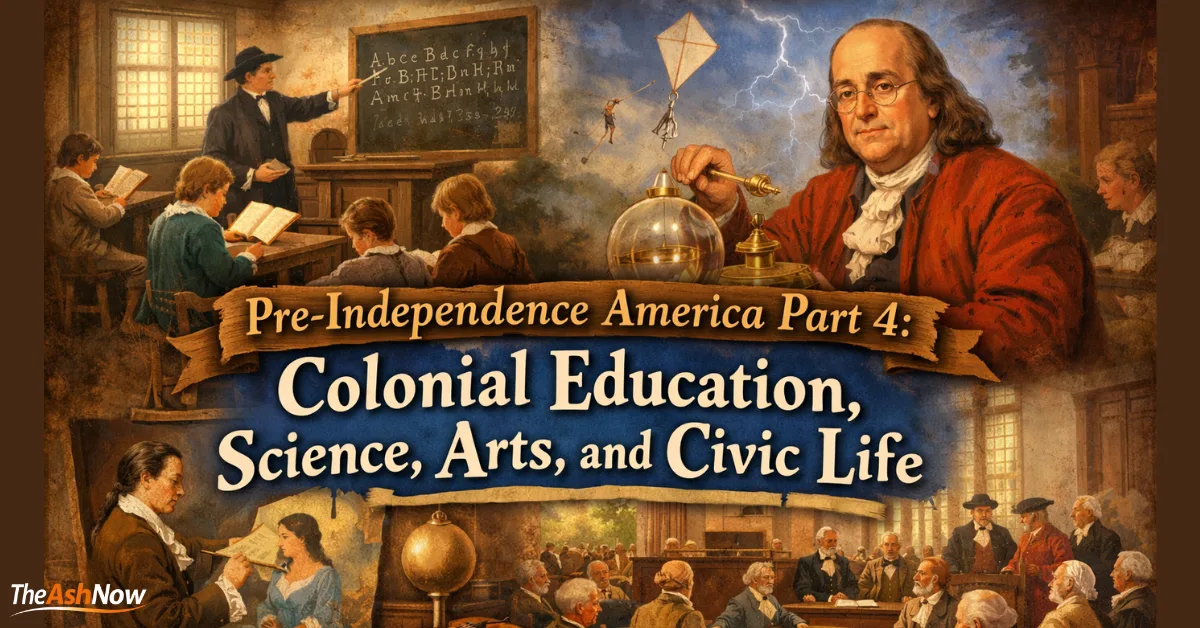
- Pre-Independence America Part 4: Colonial Education, Science, Arts, and Civic Life

- USA in 2050: Will It Still Rule the World Economy?

- The Real Motives Behind US Tariffs on Its Own Allies?
- No Deal in Alaska: Trump-Putin Summit Ends With Tense Optimism, No Ukraine Ceasefire
- Israel–Iran: Direct Warfare Erupts in the Middle East🚨

- American History Timeline Part 3: Colonial Economy and Commerce – Agriculture, Trade, Industry, Currency, and the Rise of Capitalism








[…] 👉 यहाँ क्लिक करें […]
[…] Life Before 1776: Pre-Independence America – Part 1: Setting the Stage (1500s–1776) Pre-Independence America – Part 2: Inside Colonial Society – Religion, Family, Slavery, Gender R… […]
Thank you for your sharing. I am worried that I lack creative ideas. It is your article that makes me full of hope. Thank you. But, I have a question, can you help me?