
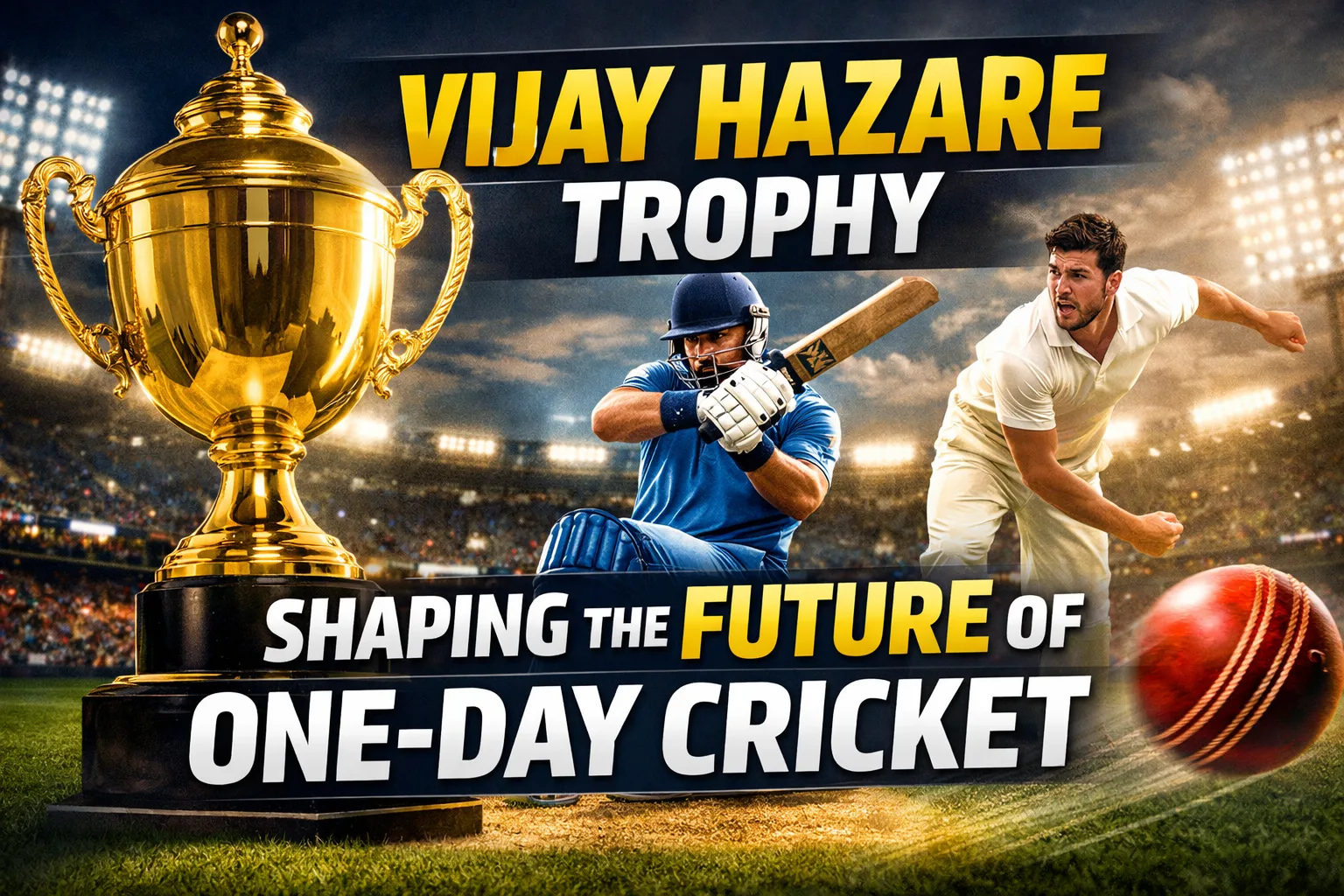
For a long time, one-day cricket felt like a format looking for its future.
Caught between the raw spectacle of T20 and the tradition of Test matches, the 50-over game has often seemed squeezed, uncertain of its identity, and increasingly sidelined.
Yet quietly, away from the global glare of billion-dollar leagues and World Cup finals, something important has been happening.
A domestic competition — methodical, data-rich, competitive, and ruthless in its meritocracy — has been reshaping how one-day cricket is played, coached, selected, and understood.
That competition is the Vijay Hazare Trophy.
And its influence is now extending far beyond its original borders.
This article explains what the Vijay Hazare Trophy is, why it matters now, how it works, what opportunities and risks it creates, and how it is shaping the next generation of one-day cricket globally — in playing style, talent development, analytics, and governance.
Table of Contents
What Is the Vijay Hazare Trophy?
The Vijay Hazare Trophy is a domestic List A (50-over) cricket tournament. In practical terms, that means it mirrors the rules, structure, and tempo of international one-day cricket: limited overs, colored clothing, white ball, fielding restrictions, and a heavy emphasis on scoring rates, death-over execution, and tactical adaptability.
What distinguishes it is not the format itself, but the environment it creates:
Your Leadership Story Deserves the Spotlight
Get featured on TheAshNow — the editorial platform trusted by founders, CEOs & executives worldwide for Google visibility, LinkedIn authority & global recognition.
Apply for Featured Profile →- High-volume data from a large pool of competitive players
- A compressed season that rewards consistency over flash
- Strong incentives for national selection are tied directly to performance
- A professionalized structure that blends traditional coaching with modern analytics
Unlike franchise leagues that optimize for entertainment and star power, this competition is optimized for development, evaluation, and scalability. It functions more like a laboratory than a show.
For selectors, analysts, and coaches, it is a controlled environment that allows them to observe how players respond to real match pressure without the distortions created by celebrity, branding, or commercial narratives.
In other words, it is a performance system — not just a tournament.

Why It Matters Now
One-day cricket is at a crossroads.
Globally, the format faces three converging pressures:
- Audience attention is fragmenting toward shorter formats and on-demand entertainment.
- Player skill profiles are changing, with many athletes growing up in T20-first ecosystems.
- Broadcasters and sponsors are demanding clearer narratives, faster games, and predictable outcomes.
The risk is that 50-over cricket becomes an awkward middle ground — too long for casual viewers, too short for purists.
The Vijay Hazare Trophy matters because it has unintentionally become the most stable proving ground for what modern one-day cricket should look like:
- It shows how 50-over cricket can remain tactically rich without becoming slow.
- It demonstrates how players can be trained for sustained performance, not just explosive moments.
- It provides selectors with a data-dense environment for fair evaluation.
At a time when many competitions are drifting toward entertainment optimization, this one is drifting toward performance optimization. That distinction is crucial.
For global cricket, it offers a model: a way to keep one-day cricket relevant, rigorous, and credible.
How It Works
Tournament Structure
Teams represent regional or state associations rather than franchises. This preserves continuity, accountability, and developmental pipelines.
BUILD YOUR LEGACY IN PRINT
Editorial features for founders, CEOs & executives — engineered for search visibility, LinkedIn credibility & industry authority.
APPLY NOW →The competition is typically structured as:
- Group stages with round-robin matches
- Followed by knockout rounds for the top teams
- All matches played under standard 50-over rules
This structure rewards consistency, squad depth, and adaptability to conditions.
Player Incentives
Unlike franchise leagues, where contracts are often secured before performance, here:
- Selection is earned, not marketed
- Poor form has real consequences
- Young players can displace seniors based on merit
This creates a performance culture that closely resembles international selection pressure.
Tactical Environment
Teams are encouraged — and often forced — to:
- Rotate strike effectively across long innings
- Build innings rather than only exploding
- Manage bowling resources across 50 overs
- Use part-time bowlers tactically
- Adapt to pitch and weather variability
These are precisely the skills that international one-day cricket requires and that T20 alone does not sufficiently develop.

Benefits and Opportunities
1. It Rebuilds the 50-Over Skill Set
Players emerging from this system are better trained in:
- Long-form batting under pressure
- Bowling with old balls and flat pitches
- Fielding endurance, positioning, and discipline
- Game management over multiple phases
This directly strengthens international teams’ ability to compete in World Cups and bilateral series.
2. It Creates Data-Driven Selection
Because the tournament produces large volumes of standardized match data, selectors can evaluate:
- Performance trends over time
- Impact under different conditions
- Consistency rather than highlight moments
This reduces bias and reputation-based selection, increasing fairness and credibility.
3. It Encourages Tactical Innovation
Coaches experiment with:
- Flexible batting orders
- Role-based selection (anchors, finishers, enforcers)
- New fielding shapes
- Bowling rotations optimized for matchups
Successful experiments spread quickly through coaching networks and into international play.
4. It Strengthens the Talent Pipeline
Young players learn early what sustained professionalism looks like — not just how to hit sixes, but how to manage a 50-over career.
That creates athletes who are mentally durable, tactically literate, and physically conditioned for long careers.
Risks, Limitations, and Practical Concerns
1. Overemphasis on Domestic Metrics
Domestic dominance does not always translate internationally. Pitch conditions, crowd pressure, travel fatigue, and opposition quality vary widely.
There is a risk of over-trusting domestic data without adjusting for contextual differences.
2. Potential for Conservative Play
Because consistency is rewarded, some players may avoid risk excessively, producing safe but low-impact cricket.
That can reduce innovation if not balanced with incentives for initiative.
3. Viewer Engagement Challenges
The competition is not designed primarily for broadcast spectacle. This limits its global visibility and commercial leverage.
Without careful storytelling and presentation, its strategic importance remains invisible to fans.
4. Talent Drain to Shorter Formats
As T20 leagues offer higher pay and fame, some top talent may prioritize them over developmental competitions, weakening the system unless incentives remain aligned.
Real-World Scenarios
Scenario 1: The Anchor Reborn
A technically sound but underappreciated batter consistently scores 80–100 in difficult conditions, building innings and enabling others to attack.
In a franchise league, that player might be overlooked. In this system, that player becomes indispensable — and later proves invaluable in international tournaments where stability matters.
Scenario 2: The Death Bowler Tested
A fast bowler consistently defends low totals in the final 10 overs, showing control, variation, and psychological resilience.
Selectors gain confidence that the skill will translate to international pressure, not just domestic dominance.
Scenario 3: The Tactical Captain
A young captain experiments with batting order flexibility, using floaters and matchups.
The success of this approach spreads into higher levels, shaping how teams think about leadership and in-game strategy.
Future Outlook: The Next 1–3 Years
The influence of the Vijay Hazare Trophy is likely to expand in three ways:
1. As a Selection Benchmark
More weight will be given to sustained domestic performance when selecting international squads, especially for major tournaments.
2. As a Tactical Incubator
Coaching philosophies developed here will increasingly inform national team strategies, especially around powerplay usage, middle-over acceleration, and bowling rotations.
3. As a Governance Model
Other cricketing systems may replicate its structure: development-first, merit-driven, data-rich competitions that balance professionalism with accessibility.
In a world where sport is often pulled toward spectacle, this model quietly protects substance.

Frequently Asked Questions
Is the Vijay Hazare Trophy the same as a franchise league?
No. It is a domestic representative competition focused on development and evaluation, not entertainment or branding.
Why is it influential outside its home system?
Because the tactical ideas, player profiles, and selection practices it produces are adopted by international teams.
Does it replace the need for international exposure?
No. It complements it by preparing players more thoroughly before they reach the international stage.
Is it better than T20 for player development?
It develops different skills. Together, they create more complete players.
Does it slow the game down?
When managed well, it enhances strategic depth without sacrificing competitiveness.
Will it remain relevant as attention shifts to shorter formats?
Its relevance lies in performance integrity, not popularity, which gives it long-term value.
Summary
The future of one-day cricket will not be shaped by spectacle alone. It will be shaped by systems that reward consistency, intelligence, adaptability, and resilience.
The Vijay Hazare Trophy matters because it quietly preserves and modernizes those values.
It does not chase attention. It earns credibility.
It does not manufacture stars. It develops professionals.
It does not predict the future of cricket — it trains it.
In doing so, it is not merely sustaining the 50-over format. It is redefining what excellence in that format looks like, and why it still deserves a place at the center of the global game.






Whats up this is kind of of off topic but I was wondering if blogs use WYSIWYG editors or if you have to manually code with HTML. I’m starting a blog soon but have no coding experience so I wanted to get advice from someone with experience. Any help would be greatly appreciated!