
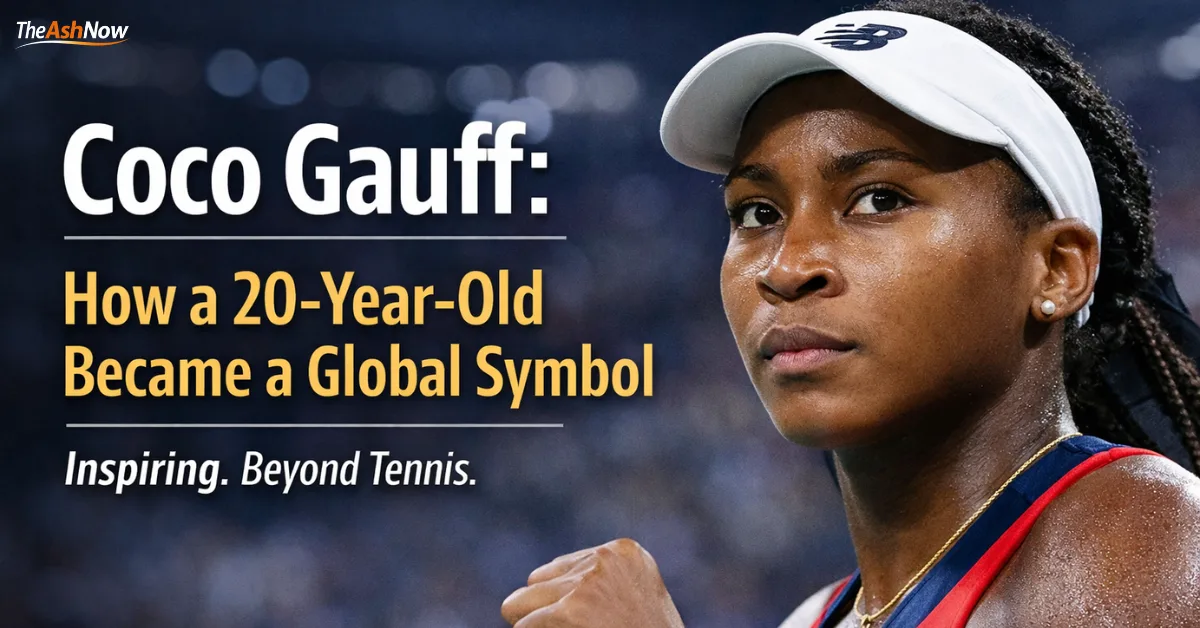
At just 20 years old, Coco Gauff occupies a position in global culture that few athletes, regardless of age, ever reach. She is a Grand Slam champion, one of the most recognizable faces in world sport, and a commercial powerhouse. But her significance goes far beyond rankings, trophies, or endorsements. Gauff has become a symbol of generational change, of disciplined ambition, of a new relationship between youth, influence, and responsibility in the modern world.
Her rise is not just a sports story. It is a cultural story about how leadership, identity, and public trust are being reshaped in a digital, hyper-visible era.
Table of Contents
Who Coco Gauff Is
Cori Dionne “Coco” Gauff was born in 2004 in Delray Beach, Florida, into a family deeply rooted in athletics. Her father, Corey Gauff, played college basketball. Her mother, Candi, was a collegiate track athlete. From the beginning, sport was not simply an activity in her life — it was a discipline, a structure, and a language through which excellence was understood.
Gauff turned professional at 14. By 15, she had defeated Venus Williams on the main stage at Wimbledon, announcing herself not as a novelty, but as a serious competitor. That early moment was not a peak — it was a starting point. Over the following years, she developed into one of the most technically complete and mentally resilient players of her generation.
Your Leadership Story Deserves the Spotlight
Get featured on TheAshNow — the editorial platform trusted by founders, CEOs & executives worldwide for Google visibility, LinkedIn authority & global recognition.
Apply for Featured Profile →In 2023, she won the US Open singles title, confirming her place among the elite. By 20, she had established herself not only as a champion but as a consistent top-tier presence in women’s tennis.
- Why FIFA World Cup 2026 Is the Biggest World Cup in History?

- The Most Expensive Play in NFL History
- Lakers–Trail Blazers: Latest Score, Key Moments, and Game-Changing Plays
- World Cup 2026: Latest Standings and What It Means for Every Team
- Thunder vs Warriors: What Really Happened in Last Night’s Shocking NBA Clash





From Prodigy to Global Figure
Sports history is filled with prodigies who rise quickly and fade just as fast. What separates Gauff from that pattern is not just her performance, but her evolution.
She did not remain frozen in the identity of a “teenage sensation.” She matured — tactically, psychologically, and publicly. Her game became more aggressive, more stable, more strategically intelligent. Her public voice became more measured, more thoughtful, more intentional.
She learned how to exist in three worlds at once:
- The intensely competitive world of elite sport
- The commercial world of global brands and sponsorships
- The social world of fans, media, and cultural expectations
Managing any one of these is difficult. Managing all three at 20 requires unusual discipline.
Gauff never positioned herself as an influencer who happens to play tennis. She positioned herself as an athlete first — and allowed influence to grow as a consequence of credibility.
That distinction is crucial. It is why she is trusted.

Why Her Influence Extends Beyond Tennis
Coco Gauff’s cultural relevance does not come from controversy, spectacle, or provocation. It comes from contrast.
In a digital culture driven by outrage, speed, and performance for attention, she represents something else:
- Consistency instead of chaos
- Discipline instead of impulsiveness
- Seriousness instead of performative personality
This makes her stand out not only among athletes but among public figures in general.
BUILD YOUR LEGACY IN PRINT
Editorial features for founders, CEOs & executives — engineered for search visibility, LinkedIn credibility & industry authority.
APPLY NOW →She speaks carefully. She chooses her moments. When she engages in social or political conversations, she does so without theatrics, without moral grandstanding, and without seeking viral attention. This restraint is rare — especially in a generation often stereotyped as loud, reactive, or constantly online.
As a result, her voice carries weight.
For young audiences, she represents a model of ambition without toxicity. For institutions and brands, she represents reliability without blandness. For global media, she represents relevance without scandal.
That combination is what transforms visibility into symbolic power.
- Anmol Jaiswal – The Story Behind Indian Backpacker and India’s Most Adventurous Travel Creator
- Joshua Freedman: Emotional Intelligence Leader & CEO
- Alex Hormozi: The Entrepreneur Who Turned Business Growth Into a $100M Playbook
- Alakh Pandey: The Founder of Physics Wallah Who Turned Affordable Education Into a National EdTech Movement
- Kunal Shah: How the FreeCharge and CRED Founder Came to Lead WhatsApp Globally





What Makes Her Different From Past Sports Icons
Every generation has its icons. What distinguishes Gauff is not that she is famous, but how she is famous.
Past sports icons often followed one of two paths:
- The unreachable hero, distant and mythologized
- The chaotic star, driven by drama as much as by achievement
Gauff represents a third model: the visible professional.
She is not remote, but she is not exposed.
She is not silent, but she is not noisy.
She is not manufactured, but she is not unfiltered.
She maintains boundaries — personal, emotional, and communicative — in a world that increasingly rewards boundarylessness. That self-regulation is itself a form of leadership.
In that sense, she is not just performing excellence. She is modeling how excellence can coexist with mental health, dignity, and self-control.
This is why parents trust her.
This is why institutions invest in her.
This is why young people see her not just as successful, but as sustainable.

The Cultural Moment She Represents
Coco Gauff’s rise coincides with a broader cultural shift.
Younger generations are increasingly skeptical of:
- Loud authority
- Performative activism
- Empty branding
- Artificial personas
They gravitate toward figures who feel real, composed, competent, and grounded.
Gauff fits that moment precisely.
She does not try to be a symbol — but she becomes one because her behavior aligns with what people are searching for: credibility, stability, and quiet strength.
She represents a generation that wants to succeed without burning out, influence without corruption, and ambition without losing itself.
In this sense, she is not just a sports icon. She is a cultural response to a world that feels overstimulated, polarized, and unstable.
She becomes a symbol not because she declares herself to be one, but because people project meaning onto her.
That is how symbols are made.
- Government Constitutes High-Powered Task Force on Examination Reforms Under Nandan Nilekani
- Dr. Ashwini Kumar Ashraf: A Life That Refused to Remain in the Dark
- How Vladimir Putin Is Quietly Reshaping the Global Power in 2026?
- How YouTubers Like Dhruv Rathee Are Reshaping Political Awareness in India
- Jensen Huang — The Man Quietly Powering the AI World





What Her Journey Signals for the Next Generation
Coco Gauff’s story signals that the future of influence is shifting.
It is moving away from:
- Loudness to clarity
- Visibility to credibility
- Speed to consistency
- Personality to purpose
Her career suggests that the most powerful figures of the next era will not be the most extreme, but the most coherent.
She shows that you can be young without being reckless.
You can be famous without being fragmented.
You can be influential without being invasive.
For a generation growing up under constant observation, that message matters deeply.

Conclusion
Coco Gauff did not become a global symbol because she won matches, although she did. She became a global symbol because she represents something people are missing and craving at the same time: composure in a noisy world, discipline in a distracted culture, and seriousness in an era obsessed with spectacle.
At 20, she does not merely belong to the future of sport. She belongs to the future of public life.
That is why her story matters beyond tennis.
And that is why, long after rankings change and seasons pass, Coco Gauff will be remembered not just as a champion — but as a defining figure of her generation.
Top Searched FAQs — Coco Gauff
1. Who is Coco Gauff, and why is she famous?
Coco Gauff is an American professional tennis player who rose to global fame after defeating Venus Williams at Wimbledon at age 15 and later winning the US Open. She is known for both her athletic success and her cultural influence.
2. How old is Coco Gauff in 2026?
Coco Gauff was born in 2004, which makes her 21 years old in 2026.
3. Why is Coco Gauff considered a global symbol?
She represents a new model of youth leadership that combines discipline, performance, mental strength, and social awareness, making her influential beyond sports.
4. What Grand Slam titles has Coco Gauff won?
Coco Gauff won the US Open singles title in 2023 and has also won Grand Slam titles in women’s doubles.
5. Is Coco Gauff on the Forbes 30 Under 30 list?
Yes, Coco Gauff has been recognized on the Forbes 30 Under 30 list for her impact in sports and culture.
6. What makes Coco Gauff different from other young athletes?
Unlike many prodigies, she has maintained long-term consistency, strong mental discipline, and a carefully managed public image focused on credibility rather than hype.
7. What is Coco Gauff’s net worth?
Coco Gauff’s net worth is estimated to be in the tens of millions of dollars, primarily from prize money, sponsorships, and endorsements.
8. What brands sponsor Coco Gauff?
She has partnerships with major global brands across sports, fashion, and consumer sectors, reflecting her broad appeal and credibility.
9. Where is Coco Gauff from?
Coco Gauff is from Delray Beach, Florida, United States.
10. When did Coco Gauff turn professional?
She turned professional in 2018 at the age of 14.
11. Why do people compare Coco Gauff to Serena Williams?
Because both are American tennis stars who reached global fame at a young age and became cultural icons beyond the sport.
12. What does Coco Gauff represent for Gen Z?
She represents disciplined ambition, mental resilience, and a balanced approach to success that resonates strongly with younger generations.
13. Why is Coco Gauff important beyond tennis?
Because she influences youth culture, global branding, and the image of modern leadership, not just professional sports.
14. Is Coco Gauff involved in social causes?
Yes, she has spoken publicly on issues such as equality, education, and youth empowerment, often in a measured and thoughtful way.
15. How did Coco Gauff become famous so young?
Through a combination of exceptional talent, early international wins, disciplined training, and strong media interest after major tournament breakthroughs.

Disclaimer: This article is an independent editorial profile published by TheAshNow. It is based on publicly available information, reputable media reporting, and general knowledge available at the time of writing. This content is not sponsored, endorsed, or approved by Coco Gauff, her representatives, the WTA, or any affiliated organization. “Forbes” and “Forbes 30 Under 30” are registered trademarks of Forbes Media LLC. This article is not affiliated with, associated with, or endorsed by Forbes Media LLC in any way. All names, trademarks, and brand references are the property of their respective owners and are used here strictly for informational and editorial purposes.
References: The information in this article is based on a synthesis of reporting and data from:
- Major international sports journalism outlets covering professional tennis and Grand Slam events
- Public statements, interviews, and press conferences given by Coco Gauff
- Official tournament records from professional tennis organizations
- Business and cultural reporting on athlete branding, youth leadership, and global influence
- Widely cited biographical and statistical sports databases
- General knowledge about women’s tennis rankings, career milestones, and global sports culture
These sources were used collectively to ensure accuracy, balance, and context, without relying on any single publication or promotional material.





I will immediately grab your rss as I can not in finding your e-mail subscription link or newsletter service. Do you have any? Please permit me recognise in order that I may just subscribe. Thanks.
[…] Coco Gauff: How a 20-Year-Old Became a Global Symbol […]
[…] Coco Gauff: How a 20-Year-Old Became a Global Symbol […]