
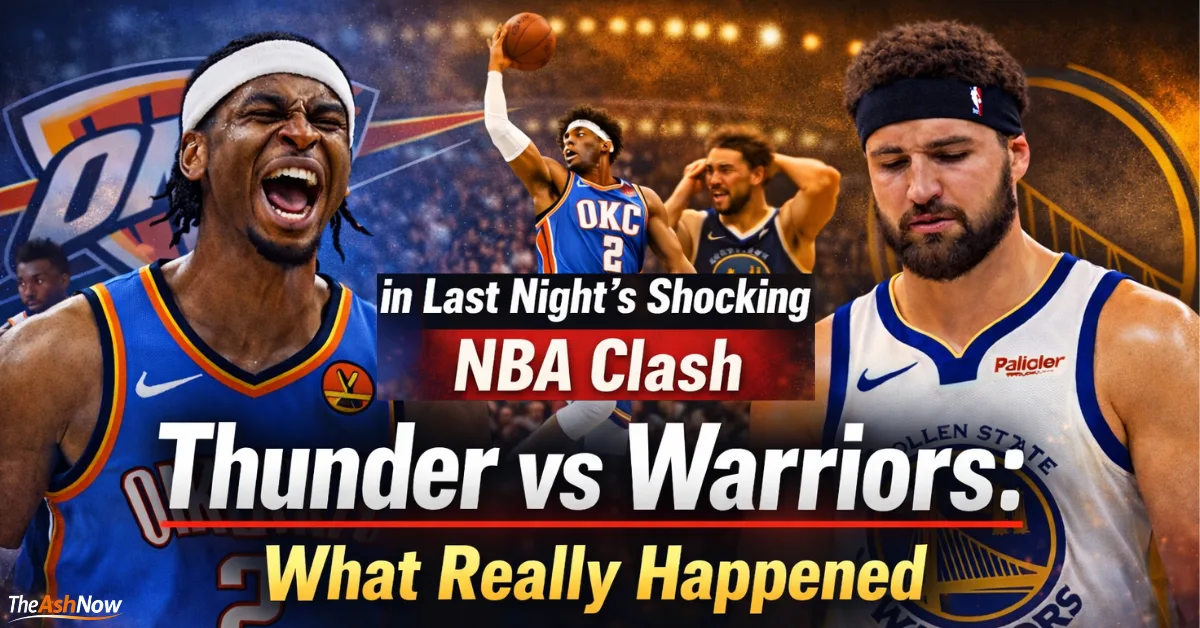
Thunder vs Warriors: Last night’s NBA game between the Oklahoma City Thunder and the Golden State Warriors was far more than a routine regular-season meeting. The Thunder delivered a commanding performance, dominating a depleted Warriors squad in a way that left analysts and fans debating what it signals about the current state of the league. The result matters not just for standings but for what it reveals about competition, roster strategies, and the evolving balance of power in the NBA. Understanding this game helps illuminate deeper trends reshaping how teams win and how fans engage with the sport.
Table of Contents
What is really happening?
The Oklahoma City Thunder convincingly defeated the Golden State Warriors in their recent matchup. Oklahoma City, league leaders and defending champions, entered the game with a commanding record and executed at both ends of the court, showcasing balanced scoring, defensive discipline, and depth beyond their star players. The Warriors, meanwhile, were missing key contributors, including Stephen Curry, Jimmy Butler, and Draymond Green, due to injury, rest, and illness — a combination that significantly weakened their typical lineup. As a result, what was expected to be a competitive contest became a decisive win for the Thunder.
Why is this happening now?
There are several interlocking forces behind this result. First, roster construction and player health management have become central to NBA performance. Teams now prioritize load management to preserve their star players for deep playoff runs, particularly in seasons with a dense schedule. The Warriors’ decision to rest or sit key veterans ahead of a back-to-back schedule reflects this broader shift.
Second, the Thunder’s rise is no accident. Their core — led by Shai Gilgeous-Alexander, a reigning MVP contender — combines scoring efficiency, defensive versatility, and a youth movement hungry for sustained success. This balance reflects a league trend where elite organizations build deep rosters rather than relying solely on individual brilliance.
Your Leadership Story Deserves the Spotlight
Get featured on TheAshNow — the editorial platform trusted by founders, CEOs & executives worldwide for Google visibility, LinkedIn authority & global recognition.
Apply for Featured Profile →Ultimately, strategic adaptation is reshaping the game. Coaches emphasize pace and floor spacing, analytics-driven shot selection, and rotational flexibility. Teams like Oklahoma City are blending traditional defensive principles with modern offensive creativity — a duality that gives them an edge over lineups weakened by absence or imbalance.
Why this matters to people
For fans and casual observers alike, this game offers practical insights:
Work: The Thunder’s emphasis on depth and adaptability mirrors organizational trends in business where resilience, cross-functional skills, and bench strength matter more than individual star power.
Money: Betting markets and fantasy basketball valuations shift rapidly based on injury status and strategic choices. Understanding the deeper patterns — not just headline scores — improves decision-making for stakeholders across the ecosystem.
Relationships: Shared narratives around teams and players form social bonds. When a franchise like the Thunder asserts dominance, it reshapes fan identity and community discussion, influencing how people connect around the sport.
Mental health: Fans invest emotionally in star players and expected outcomes. When those expectations are disrupted — especially by tactical rest decisions — it can create frustration, but also an opportunity to appreciate depth and unpredictability.
Society: As the NBA’s competitive landscape evolves, so too do broader cultural conversations about merit, fairness, and strategic planning. This one game serves as a microcosm of how professional sports reflect larger societal dynamics.
What most coverage gets wrong
Much of the commentary around this matchup reduces it to “Warriors missing Curry” or “Thunder expected to win.” Those explanations are surface-level. The more consequential narrative is about structural evolution: teams managing talent over time, league-wide emphasis on data, and the maturation of emergent contenders. Focusing solely on absences obscures the strategic and developmental choices that define successful franchises today.
What this means for the future
Looking ahead 5–10 years, this result underscores several trajectories. The Thunder are positioning themselves as a long-term powerhouse, not merely a fleeting contender. Their model — blending star leadership with depth and strategic flexibility — anticipates a league where injury management, analytics, and holistic player development dominate. For the Warriors, this period could signal transition and reinvention as core veterans age and new talent emerges. Fans should expect more variability in outcomes, a premium on adaptive coaching, and a continued blurring between regular-season strategy and playoff foresight.
- Why FIFA World Cup 2026 Is the Biggest World Cup in History?

- The Most Expensive Play in NFL History
- Lakers–Trail Blazers: Latest Score, Key Moments, and Game-Changing Plays
- World Cup 2026: Latest Standings and What It Means for Every Team
- Thunder vs Warriors: What Really Happened in Last Night’s Shocking NBA Clash



What should I do now?
Approach NBA analysis with nuance. Look beyond final scores to roster context, injury management strategies, and long-term planning. For fans, invest in understanding playing styles and front office decisions rather than fixating on individual star narratives. For those participating in fantasy leagues or betting, adjust expectations dynamically based on deeper context. Curiosity and informed observation will yield a richer, more grounded engagement with the sport.
BUILD YOUR LEGACY IN PRINT
Editorial features for founders, CEOs & executives — engineered for search visibility, LinkedIn credibility & industry authority.
APPLY NOW →CONCLUSION
Last night’s Thunder-Warriors game was not simply a lopsided scoreline. It was a snapshot of shifting competitive dynamics in the NBA — one shaped by strategic planning, roster depth, and the ongoing balance between tradition and innovation. Understanding these underlying forces offers both clarity and confidence as the season unfolds.
Faqs Related To Thunder vs Warriors
1. What was the final result of the Thunder vs Warriors game last night?
The Oklahoma City Thunder won decisively, controlling the pace from early on and maintaining a strong lead throughout the game.
2. Why did the Warriors struggle so much against the Thunder?
Golden State was missing key players and lacked their usual defensive cohesion and offensive rhythm, which the Thunder exploited with speed and depth.
3. Who was the standout performer in the Thunder vs Warriors clash?
Shai Gilgeous-Alexander led Oklahoma City with efficient scoring and playmaking, setting the tone for the Thunder’s dominant performance.
4. Did injuries affect the outcome of the Thunder vs Warriors game?
Yes. The absence of several core Warriors players significantly weakened their rotations and limited their ability to respond to the Thunder’s pressure.
5. What does this game mean for the Thunder’s title chances this season?
It reinforces the Thunder’s status as a serious contender, showing they can dominate both strategically and physically against established teams.
6. Is this loss a sign of decline for the Golden State Warriors?
Not necessarily. It highlights transition challenges and health issues rather than a permanent drop in competitiveness.
- Government Constitutes High-Powered Task Force on Examination Reforms Under Nandan Nilekani
- Dr. Ashwini Kumar Ashraf: A Life That Refused to Remain in the Dark
- How Vladimir Putin Is Quietly Reshaping the Global Power in 2026?
- How YouTubers Like Dhruv Rathee Are Reshaping Political Awareness in India
- Jensen Huang — The Man Quietly Powering the AI World





Disclaimer: This article is an independent editorial analysis based on publicly available game information, performance trends, and professional interpretation. It is intended for informational and educational purposes only and does not represent official statements from the NBA, its teams, or players.
Sources: The analysis draws on official game results, team injury reports, player performance data, and post-game coverage from mainstream sports media, league communications, and statistical tracking platforms.




[…] Thunder vs Warriors: What Really Happened in Last Night’s Shocking NBA Clashby TheAshNow Team […]