
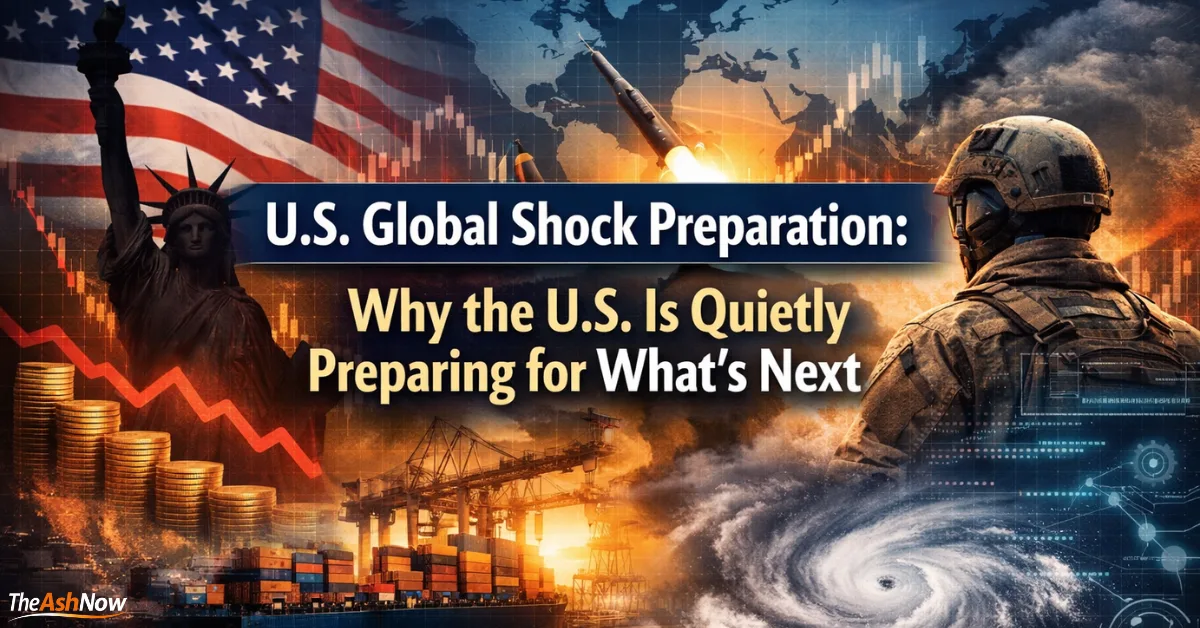
U.S. Global Shock Preparation: Over the past year, a subtle shift has been taking place inside U.S. government language, corporate planning, and international coordination. The word “crisis” is rarely used. Instead, the emphasis has moved to something more neutral, more technical — and arguably more revealing: preparedness.
Across economic policy, national security briefings, infrastructure planning, and even public health frameworks, the same idea keeps appearing in different forms. The U.S. is not reacting to a single threat. It is quietly preparing for the possibility that the next global disruption will not look like the last one.
This emerging posture is best understood not as panic, but as institutional memory. After a decade defined by financial shocks, supply chain collapses, pandemics, wars, and rapid technological change, U.S. planners are treating systemic instability as the new baseline.
That is what U.S. global shock preparation really means.
Your Leadership Story Deserves the Spotlight
Get featured on TheAshNow — the editorial platform trusted by founders, CEOs & executives worldwide for Google visibility, LinkedIn authority & global recognition.
Apply for Featured Profile →
A Shift From Crisis Response to Shock Anticipation
Historically, major U.S. policy responses have been reactive. Financial bailouts followed market crashes. Emergency laws followed terrorist attacks. Stimulus followed recessions. Vaccines followed outbreaks.
What is different now is the timing.
Instead of building responses after disruption, policymakers are building frameworks before the next one arrives. This is visible in the way institutions now talk about “stress scenarios,” “resilience planning,” “strategic redundancy,” and “continuity frameworks.” These are not dramatic phrases, but they are structurally significant.
They signal a transition from a world where shocks were considered rare exceptions to one where shocks are treated as regular features of the global system.
- Why Sugar Prices Are Rising in India: Is Ethanol Behind the Price Surge?

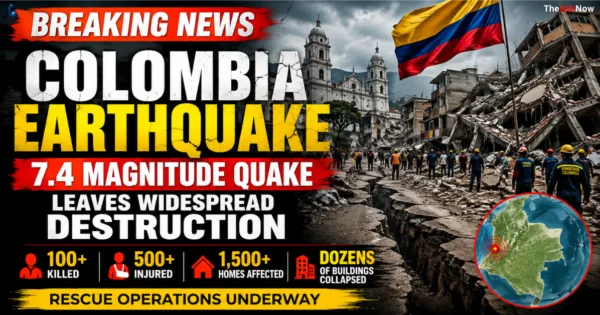
- Colombia Earthquake: A 7.4-Magnitude Disaster Exposes the Human Cost of Seismic Risk Across Western Colombia
- Bankipur By-Election Result 2026 LIVE: Counting Updates, Vote Margin & Latest Trends
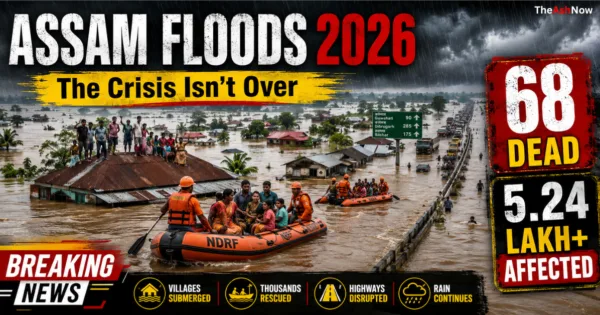
- Assam Floods 2026: When the Brahmaputra Turns Into a Sea
- Pralhad Joshi Takes Charge as India’s New Education Minister




What Kind of “Shock” Is the U.S. Preparing For?
Importantly, U.S. global shock preparation is not aimed at one specific event. It is a response to a convergence of risks that reinforce one another.
Economic and Financial Volatility
High sovereign debt, fragile banking sectors, geopolitical sanctions, and algorithm-driven markets have increased the probability of sudden financial dislocations. Even small triggers can cascade quickly through global systems.
Geopolitical Fragmentation
The world is no longer organized around a single dominant economic order. Trade blocs are fragmenting. Strategic alliances are becoming more conditional. This makes supply chains, energy markets, and capital flows more sensitive to political shocks.
Technological Systemic Risk
Artificial intelligence, cyber infrastructure, and digital finance have introduced new forms of vulnerability. A software failure, cyberattack, or AI-driven misinformation event can now produce effects similar to traditional physical crises.
Climate and Environmental Disruption
Extreme weather events, water scarcity, and environmental migration are no longer distant risks. They are already affecting food prices, insurance markets, and regional stability.
The U.S. is not predicting a single disaster. It acknowledges that the probability of overlapping disruptions is rising.
BUILD YOUR LEGACY IN PRINT
Editorial features for founders, CEOs & executives — engineered for search visibility, LinkedIn credibility & industry authority.
APPLY NOW →
Why This Preparation Is Largely Invisible
Much of this planning happens quietly because it is embedded in technical systems, not political speeches.
It appears in:
• Infrastructure redundancy projects
• Strategic stockpile adjustments
• Supply chain diversification policies
• Cybersecurity standards
• Financial stress-testing
• Defense scenario modeling
• Emergency coordination protocols
These are not headline-friendly initiatives. They do not mobilize voters. But they shape how resilient a society is when disruption arrives.
In that sense, the absence of dramatic public messaging is itself part of the strategy. Calm planning reduces panic risk. Visible overreaction can become a destabilizing force of its own.
- Anmol Jaiswal – The Story Behind Indian Backpacker and India’s Most Adventurous Travel Creator
- Joshua Freedman: Emotional Intelligence Leader & CEO
- Alex Hormozi: The Entrepreneur Who Turned Business Growth Into a $100M Playbook
- Alakh Pandey: The Founder of Physics Wallah Who Turned Affordable Education Into a National EdTech Movement
- Kunal Shah: How the FreeCharge and CRED Founder Came to Lead WhatsApp Globally





Why This Matters Globally
The U.S. sits at the center of global finance, technology, security, and trade. When it shifts its internal assumptions, the entire world feels the consequences.
U.S. global shock preparation affects:
• How capital moves across borders
• How companies design supply chains
• How allies align defense and cyber policy
• How markets price long-term risk
• How international institutions plan for emergencies
Even countries that disagree with U.S. politics are influenced by U.S. planning, simply because of the size and integration of the American system.
Preparedness in one system forces preparedness in others.
Not Fear — But Structural Realism
It is tempting to interpret this trend as evidence of a looming catastrophe. But the more accurate interpretation is institutional maturity.
Complex systems eventually learn that stability is not permanent. They learn that resilience matters more than prediction. They learn that the cost of preparation is lower than the cost of surprise.
In that sense, U.S. global shock preparation is not a sign of fear. It is a recognition that the world has entered a phase where volatility is structural, not cyclical.
And in such a world, the most rational response is not alarm — it is readiness.
The Quiet Lesson
The most important change is not that the U.S. is preparing.
It is that preparation itself has become normal.
That is the real signal. Not that something terrible is certain to happen, but that global systems are finally being designed with the assumption that disruption is no longer exceptional.
The future is not necessarily darker.
It is simply less predictable.
And that is exactly what the U.S. is preparing for.
FAQs — U.S. Global Shock Preparation
What does “U.S. global shock preparation” mean?
U.S. global shock preparation refers to how U.S. institutions are planning for large, unpredictable global disruptions such as economic crises, geopolitical conflicts, cyber events, pandemics, or climate shocks.
Is the U.S. expecting a global crisis soon?
Not necessarily. The focus is on preparedness rather than prediction. It reflects a shift toward building resilience before disruptions occur, not a belief that a crisis is imminent.
What types of global shocks is the U.S. preparing for?
Primarily, economic volatility, geopolitical instability, cyber and technology risks, climate-related disruptions, and large-scale supply chain failures.
Why is this preparation happening quietly?
Because it is embedded in technical systems like infrastructure planning, financial stress testing, cybersecurity standards, and emergency coordination — not in political announcements.
How does U.S. global shock preparation affect other countries?
Since the U.S. is central to global finance and trade, its planning influences markets, supply chains, alliances, and risk assessments worldwide.
Is this preparation a sign of fear or instability?
More of institutional realism than fear. It reflects an understanding that modern global systems are interconnected and vulnerable to cascading disruptions.
Does this mean a recession or war is coming?
No. Preparation does not imply inevitability. It simply lowers the impact if something unexpected happens.
How does this affect everyday people?
It can influence inflation control, energy stability, cybersecurity protections, disaster response capacity, and job market resilience.
Is this different from how the U.S. planned in the past?
Yes. Earlier planning was mostly reactive. Now the emphasis is on scenario-based planning and resilience frameworks in advance.
Which institutions are involved in U.S. global shock preparation?
Government agencies, central banks, defense and security institutions, infrastructure planners, technology regulators, and major corporations.
Why is the U.S. preparing for a global shock?
Because global systems have become more interconnected and fragile. Economic markets, supply chains, technology networks, and geopolitics now interact in ways that can turn small disruptions into global shocks. The U.S. is preparing to reduce vulnerability, not because a crisis is certain, but because the cost of being unprepared is higher than the cost of readiness.
What global crisis is coming next?
There is no single identifiable “next crisis.” Risks include financial instability, geopolitical conflict, cyber disruption, climate-related events, and supply chain breakdowns. The exact trigger is unpredictable, which is why preparation focuses on resilience rather than forecasting a specific event.
What are the main future global disruption risks?
The main risks include global debt stress, regional conflicts escalating into wider instability, cyber and AI-driven system failures, extreme climate events, resource shortages, and fragmentation of trade and financial systems.
Is the U.S. expecting a global crisis soon?
Not officially. Preparation does not imply expectation. It reflects an understanding that global volatility is increasing, and that institutions function better when they are designed for uncertainty rather than stability alone.
Disclaimer: This article is intended for general informational and analytical purposes only. It does not constitute financial, legal, political, or investment advice. The content reflects a high-level interpretation of publicly observable trends in policy, economics, technology, and global affairs and should not be treated as a prediction of future events. Readers should consult appropriate professionals before making decisions based on information related to economic, security, or geopolitical matters.
References: This article draws on widely discussed themes and frameworks from global institutions, policy research bodies, and economic and security analysis organizations, including:
- U.S. Federal Reserve and central bank publications on financial stress testing and systemic risk
- International Monetary Fund (IMF) and World Bank reports on global economic volatility and resilience
- U.S. Department of Homeland Security and National Security Strategy documents on preparedness and resilience
- Academic research on systemic risk, complex systems, and global shock propagation
- Global supply chain risk assessments and resilience studies from logistics and economic research institutions
- Cybersecurity and technology risk frameworks from international standards bodies and research organizations
- Climate risk and environmental disruption assessments from scientific and intergovernmental panels
These sources are referenced conceptually to inform the analytical perspective presented, rather than cited as direct quotations.




[…] U.S. Global Shock Preparation: Why the U.S. Is Quietly Preparing for What’s Next […]
[…] U.S. Global Shock Preparation: Why the U.S. Is Quietly Preparing for What’s Next […]
[…] U.S. Global Shock Preparation: How AI Is Being Used to Predict the Next Global Crisis […]