
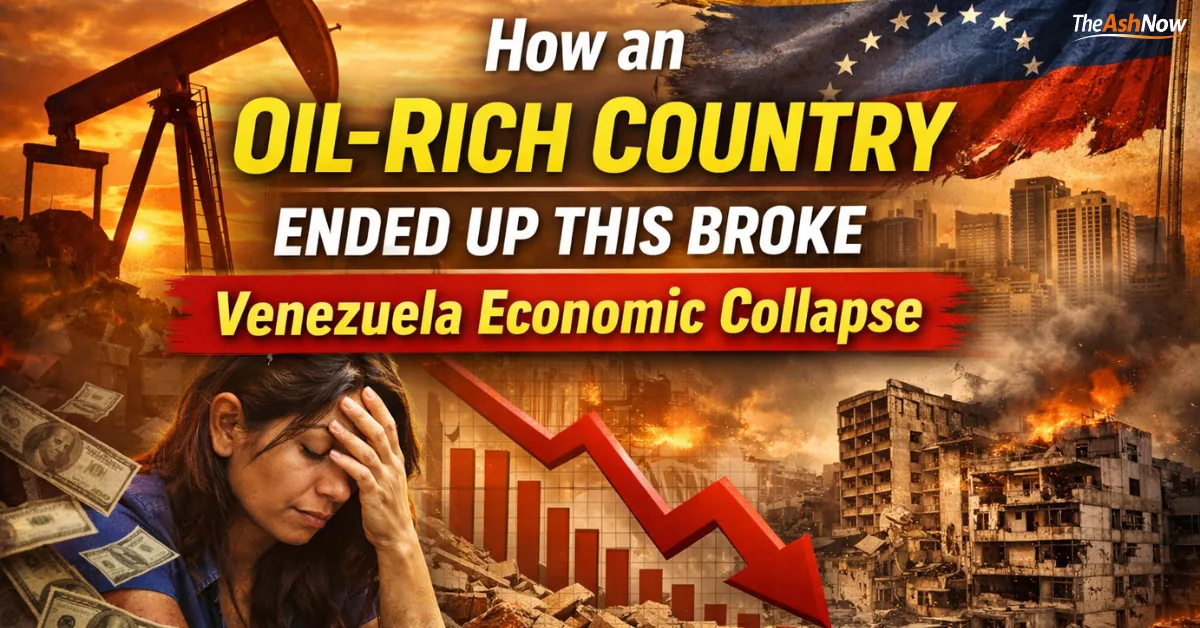
Venezuela Economic Collapse: For much of the twentieth century, Venezuela was not a symbol of crisis. It was a symbol of promise.
Blessed with the largest proven oil reserves on Earth, Venezuela was once Latin America’s wealthiest country. Its capital, Caracas, looked more like a European city than a developing one. It attracted immigrants, investment, and admiration. Today, however, Venezuela is cited globally as a warning: a nation that collapsed economically despite having extraordinary natural wealth.
How did that happen?
The answer is not a single event, but a chain of political, economic, and institutional decisions that slowly converted abundance into fragility.
Your Leadership Story Deserves the Spotlight
Get featured on TheAshNow — the editorial platform trusted by founders, CEOs & executives worldwide for Google visibility, LinkedIn authority & global recognition.
Apply for Featured Profile →This is the Venezuela case — and why economists still find it unsettling.
1. The Illusion of Permanent Wealth
Oil is both a blessing and a trap.
For decades, Venezuela relied almost entirely on oil exports to fund government spending, imports, and social programs. When oil prices were high, money flowed easily. This created an illusion that the country was rich by default — that prosperity was automatic, not something that had to be continuously built.
Other sectors — manufacturing, agriculture, technology, and exports — were neglected. The economy became dangerously one-dimensional.
When oil prices eventually fell, there was nothing strong enough to replace that lost income.
This overdependence on a single resource is known as the “resource curse,” and Venezuela became its most dramatic modern example.
2. Politics Replaced Institutions
In healthy economies, institutions matter more than personalities.
Over time, Venezuela shifted from institutional governance toward highly centralized political control. Key economic institutions — the central bank, courts, regulators, and national companies — became extensions of political power rather than independent guardians of stability.
This had three major consequences:
- Economic decisions became political decisions
- Short-term popularity replaced long-term planning
- Accountability weakened dramatically
Once this shift happens, economic correction becomes nearly impossible because every reform is seen as a political threat rather than a technical necessity.
BUILD YOUR LEGACY IN PRINT
Editorial features for founders, CEOs & executives — engineered for search visibility, LinkedIn credibility & industry authority.
APPLY NOW →3. Price Controls and Market Distortions
To fight inflation and inequality, the government imposed heavy price controls on basic goods — food, fuel, medicine, and household items.
The intention was social protection.
The result was economic paralysis.
When producers were forced to sell below cost:
- Production stopped
- Imports declined
- Black markets emerged
- Shortages spread everywhere
People were not facing high prices — they were facing empty shelves.
Price controls did not eliminate scarcity. They institutionalized it.

4. The Destruction of the Currency
As government spending grew and oil revenues shrank, the state began financing itself by printing money.
This is where Venezuela crossed into disaster.
The money supply expanded massively without real economic output to support it. The result was hyperinflation — one of the worst in modern history.
At its peak:
- Prices doubled within weeks
- Salaries became meaningless
- Savings were wiped out
- The national currency lost almost all credibility
Once trust in a currency collapses, rebuilding it is extremely difficult. People stop thinking in money and start thinking in survival.

5. Brain Drain and Social Collapse
As the economy failed, people left.
Doctors, engineers, teachers, entrepreneurs — anyone with the skills to move did so. Over seven million Venezuelans emigrated, creating one of the largest migration crises in the world.
This created a vicious cycle:
Economic collapse → emigration → loss of skills → further collapse
The state lost not only money but the human capital needed to recover.
6. Why This Still Shocks Economists
Venezuela did not collapse because of war, natural disaster, or foreign invasion.
It collapsed through policy.
That is what makes it disturbing.
It shows that:
- Wealth does not guarantee stability
- Resources cannot replace institutions
- Politics can override economic reality
- Collapse can happen slowly, then suddenly
The Venezuelan case is not just a national story. It is a structural warning about how fragile modern economies become when governance fails.

7. The Global Lesson
Venezuela is not unique — it is extreme.
But the mechanisms that destroyed it exist everywhere:
- Overreliance on one sector
- Political capture of institutions
- Suppression of market signals
- Debt and money creation without productivity
- Loss of public trust
The difference is in degree, not type.
That is why economists continue to study Venezuela. Not to judge it — but to understand how easily prosperity can be dismantled when systems fail.
Conclusion
Venezuela did not fall because it lacked wealth.
It fell because it misunderstood wealth.
Wealth is not oil.
Wealth is institutions, trust, stability, productivity, and competence.
Oil can buy time. It cannot buy discipline.
And when discipline is lost, even the richest countries can become poor.
That is the real lesson of Venezuela.
FAQs: Venezuela Economic Collapse
Was Venezuela ever truly rich?
Yes. In the mid-20th century, Venezuela had one of the highest per-capita incomes in Latin America and attracted global investment.
Why do people think the U.S. attacked or captured Maduro?
This belief spread due to a mix of social media rumors, misleading headlines, recycled content from unrelated events, and confusion with historical cases such as Manuel Noriega’s capture in Panama in 1989.
Who is Nicolás Maduro?
Nicolás Maduro is the current president of Venezuela. He took office after Hugo Chávez and has remained in power amid controversial elections, political repression accusations, and economic collapse.
Was Maduro democratically elected?
His elections have been widely criticized by international observers for lacking fairness, transparency, and competition. Some countries recognize his government; others do not.
Why is Maduro wanted or sanctioned by the United States?
The U.S. accuses Maduro and senior officials of corruption, drug trafficking links, and undermining democracy. Sanctions target individuals and state institutions, not ordinary citizens.
Disclaimer: This article is intended for general informational and educational purposes only. It is not political advocacy, legal advice, financial guidance, or an endorsement or opposition of any government, individual, or policy. All information presented is based on publicly available reporting, historical records, and widely cited international analyses as of the time of writing. While every effort has been made to ensure accuracy, geopolitical situations evolve rapidly, and some details may change over time. The publisher does not claim that any allegation mentioned has been legally proven in a court of law unless explicitly stated. Readers are encouraged to consult multiple reputable news and institutional sources for real-time updates and official confirmations. The content aims to explain trends and context, not to promote any political position, ideology, or narrative.
References (Information Sources Used)
This article was informed by reporting, data, and analysis from the following types of reputable global sources:
- International news agencies such as Reuters, Associated Press, Bloomberg, and Agence France-Presse
- Major global news organizations, including BBC News, CNN, Al Jazeera, The New York Times, The Washington Post, and The Wall Street Journal
- Economic and financial institutions such as the International Monetary Fund (IMF), World Bank, and United Nations Development Programme (UNDP)
- Human rights and governance organizations,s including Human Rights Watch and Amnesty International
- Official statements and releases from the United States Department of Justice, U.S. Treasury Department, and Venezuelan government agencies
- Academic research and policy analysis from universities, economic think tanks, and international affairs institutes
- Historical records related to Latin American political and economic history
These sources were used collectively to cross-verify facts, understand differing perspectives, and avoid reliance on any single narrative.



[…] How an Oil-Rich Country Ended Up This Broke — Venezuela Economic Collapse […]
[…] How an Oil-Rich Country Ended Up This Broke — Venezuela Economic Collapse […]
[…] How an Oil-Rich Country Ended Up This Broke — Venezuela Economic Collapseby TheAshNow Team […]
[…] How an Oil-Rich Country Ended Up This Broke — Venezuela Economic Collapse […]