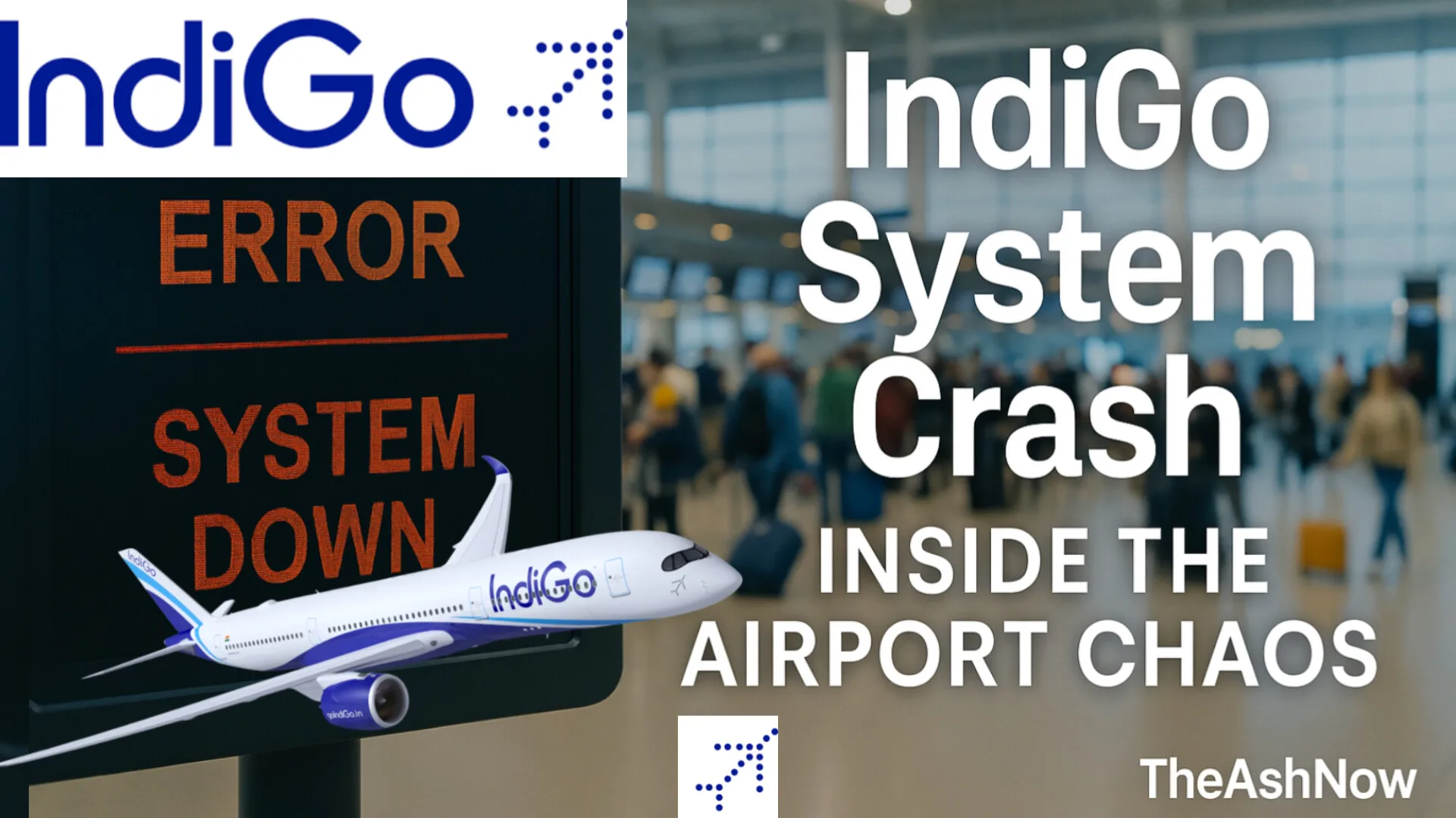
IndiGo system crash: India’s busiest airports witnessed unexpected chaos when IndiGo’s digital systems suddenly slowed down, forcing thousands of passengers into long queues and triggering delays across multiple routes. Although the airline later termed it a “temporary technical issue,” internal data logs, aviation sources, and operational patterns reveal a far more complex story.
This is the inside breakdown of what actually failed, how the disruption spread nationwide, and what it means for India’s rapidly growing aviation ecosystem.
Table of Contents
1. How the Crash Started: A Multi-Layer System Slowdown
IndiGo ka digital network ek interconnected system par chalti hai—kiosk modules, check-in APIs, boarding systems, load sheets, aur flight dispatch tools sab ek shared server backbone se sync hote hain.
Industry sources claim the root trigger was:
Your Leadership Story Deserves the Spotlight
Get featured on TheAshNow — the editorial platform trusted by founders, CEOs & executives worldwide for Google visibility, LinkedIn authority & global recognition.
Apply for Featured Profile →- Network response lag between server clusters
- API timeouts during passenger authentication
- Printer-command loop freeze in multiple airports
- Load balancing failure, causing request overload
- Queue congestion in flight management modules
Yeh saare systems ek hi chain ke parts hain. Jab ek module delay karta hai, baaki sab pe cascading effect padta hai.
Result: Check-in process slow hua, counters pe manual load badha, aur system crash effectively nationwide impact ban gaya.
2. What Passengers Experienced on the Ground
Crash ke baad airports par scenes almost identical the:
- Lines growing into security lanes
- Boarding passes are not printing on time
- Staff forced into manual documentation
- Some departure gates are holding passengers longer
- Elderly passengers are facing major inconvenience
- Multiple early-morning departures were delayed
Airlines normally take 25 to 30 seconds me ek passenger process kar leti hain. System down hone ke baad same process 3–4 minutes tak stretch ho gaya—this alone is enough to disrupt an entire morning wave of flights.
3. Impact on Flight Operations Across India
Official numbers reveal nahi kiye gaye, but data from aviation tracking dashboards and real-time operations suggest:
- 25% of flights are delayed during peak hours
- 5–8% flights short operational hold par gayi
- Turnaround time averages 18–25 minutes badh gaya
- Crews ko revised duty windows manage karne pade
Airlines ko sabse bada risk hota hai—cascading delays, jisme ek sector ka delay agle 3–4 routes ko affect karta hai.
4. IndiGo’s Internal Emergency Response
IndiGo ke operations control center (OCC) ne immediately:
- Airport teams ko manual processing ka instruction diya
- System reboot cycles initiate ki
- Server load redistributed kiya
- High-priority flights (international + metro sectors) ko sequence adjust kiya
- DGCA ko incident briefing diya
Internal communication logs me “network congestion and sync instability” phrase repeat hota hai—confirming the issue was technical, not a breach.
5. Was There Any Cybersecurity Threat?
Aviation ministry sources confirm:
- No cyberattack detected
- No external system tampering
- No data breach indicators
Crash purely a technical slowdown + load spike combination tha.
India ke major airports me ek hi vendor multiple systems manage karta hai, jis se kabhi-kabhi cross-dependency overload ho jata hai.
BUILD YOUR LEGACY IN PRINT
Editorial features for founders, CEOs & executives — engineered for search visibility, LinkedIn credibility & industry authority.
APPLY NOW →6. Why Did This Happen Now? The Hidden Pressure Points
India currently world’s fastest-growing aviation market hai.
IndiGo alone carries 60%+ domestic passengers.
Is scale ne system par pressure points create kar diye:
- High winter traffic
- Peak-hour clusters are tightly packed
- Automation dependency is very high
- Multiple airports are undergoing infrastructure upgrades
A single digital slowdown easily turns into a national-level bottleneck.
7. DGCA’s Stand: Full Report Demanded
DGCA ne airline se detailed technical log मांगा:
- System crash timeline
- Root-cause diagnosis
- Passenger handling protocols
- Delay impact assessment
- Compensation compliance
DGCA ne explicitly ask kiya:
“Could this have been prevented with better redundancy?”
This shows regulatory confidence issues regarding automation layers.

8. How the System Was Restored
System recovery 3 phases me hua:
Phase 1: Stabilization
Server load isolate ki gayi
API cycles reset hue
Network latency reduce ki gayi
Phase 2: Restart Window
Multiple airports par modules reboot huye
Printer–scanner units resynced
Flight roster synchronization verified
Phase 3: Full Activation
Normal passenger flow restore hua
Counter load reduce hua
Gate queues stabilise ho gayi
By afternoon, airport operations largely normal ho chuke the.
9. What This Means for the Future
India ka aviation ecosystem tezi se automate ho raha hai, but redundancy abhi bhi weak point hai.
Experts predict:
- Airlines ko multi-layer failover systems lagana hoga
- Airports ko AI-based predictive monitoring adopt karna hoga
- Server load testing should be more frequent hona chahiye
- Dependency on single vendors reduce karna hoga
If not, similar digital collapses future peak seasons me aur severe ho sakte hain.
10. Advice for Passengers During Digital Failures
- Always carry a soft + hard copy of your ticket
- Arrive early during peak hours
- Manual check-in counter ko priority milti hai system failures me
- Flight delays ke case me DGCA ka compensation rule passenger-safe hai
- Airline staff se real-time info lena helpful hota hai
Conclusion
IndiGo’s system crash was not a simple technical glitch—it exposed the dependency and fragility of India’s fast-expanding aviation infrastructure. While the airline restored operations quickly, the event raised critical questions about digital preparedness, redundancy, and future-proofing.
In a sector where every minute counts, even a short-lived system failure can ripple across the entire nation.

FAQs Related to the IndiGo System Crash
Q1. Why did IndiGo’s system crash?
Initial reports indicate network congestion, API timeouts, and a load-balancing failure that caused multiple operational modules to slow down simultaneously.
Q2. Was the IndiGo crash caused by hacking or a cyberattack?
No signs of any cybersecurity breach were found. Aviation authorities confirmed it was a technical failure, not a security incident.
Q3. How many IndiGo flights were delayed due to the crash?
Unofficial operational patterns suggest that around 25% flights faced delays, with 5–8% experiencing short operational holds.
Q4. Are IndiGo’s systems back to normal now?
Yes. After multiple recovery cycles and system resynchronizations, airport operations returned to normal within hours.
Q5. What should passengers do when airline systems fail?
Carry ticket copies, arrive early, follow manual check-in instructions, and refer to DGCA’s delay compensation rules.

TheAshNow Services