
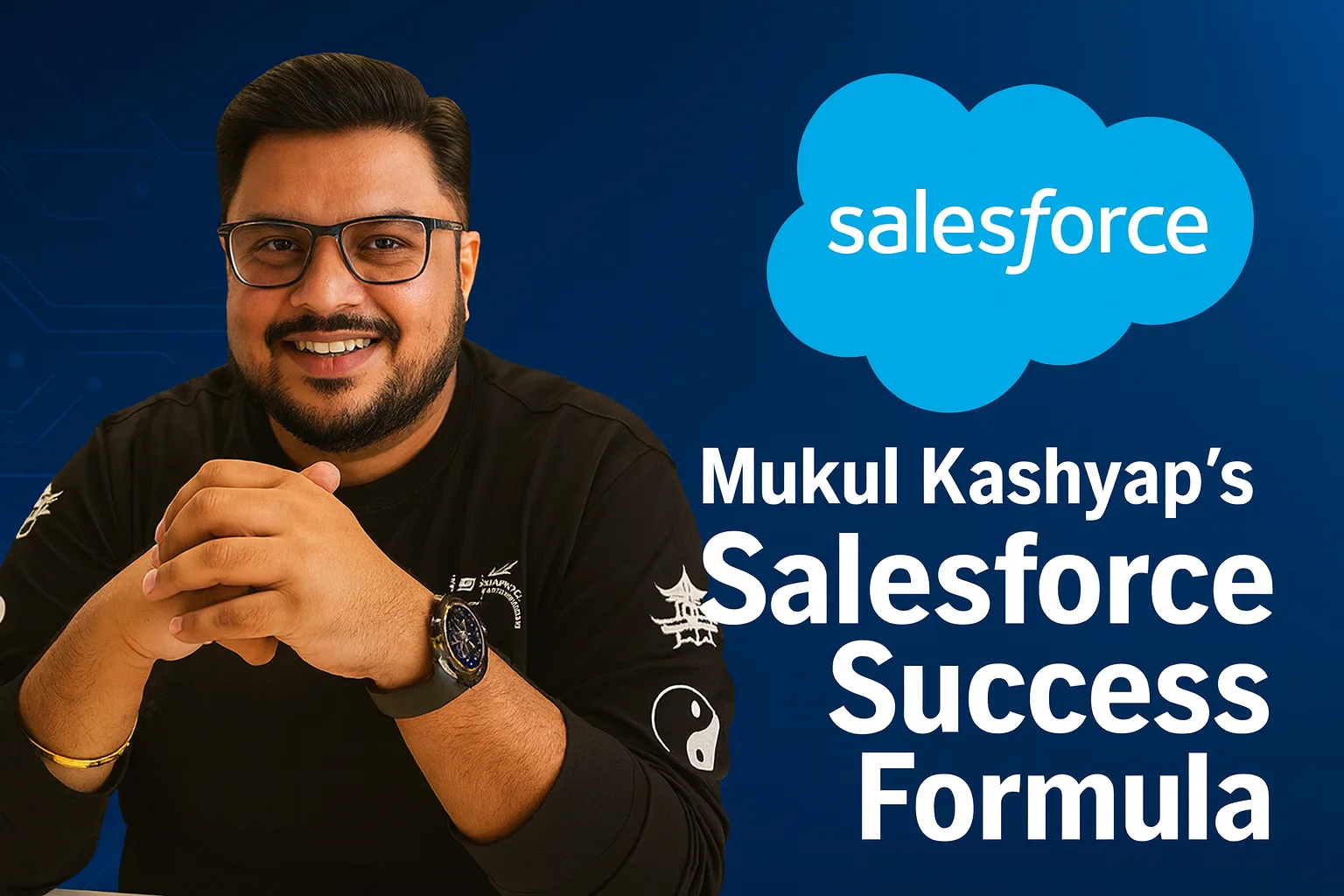
Breaking into the Salesforce ecosystem can feel overwhelming for many beginners, but Mukul Kashyap’s journey demonstrates that the path becomes clear when you follow the right strategy. His success is not rooted in luck—it is the result of a practical, structured, and disciplined formula that aligns perfectly with how the Salesforce job market actually works. This is the exact blueprint he used, and it is fully replicable for anyone willing to follow it with intent.
Table of Contents
1. He Began With a Focused Objective
Instead of exploring multiple technologies at once, Mukul committed to one goal: To build a career in the Salesforce ecosystem, starting as a Salesforce Administrator.
This singular focus eliminated distractions and gave him a straight learning trajectory, something most beginners struggle to achieve.
2. He Built a Strong Foundation in Core CRM Concepts
Mukul understood that Salesforce is fundamentally a CRM platform. So before touching advanced tools, he mastered:
- Standard and custom objects
- Data model relationships
- User management
- Organization-wide defaults
- Role hierarchy and sharing rules
- Basic automation tools
This foundation gave him the conceptual confidence to handle real Salesforce workflows—something employers value more than badges or theoretical learning.
Your Leadership Story Deserves the Spotlight
Get featured on TheAshNow — the editorial platform trusted by founders, CEOs & executives worldwide for Google visibility, LinkedIn authority & global recognition.
Apply for Featured Profile →3. He Prioritized Hands-On Experience Over Excess Theory
Trailhead badges are useful, but practical skills get jobs.
Mukul created structured, real-world simulations such as:
- A lead-to-opportunity sales pipeline
- Automated approval processes
- A custom application with reports and dashboards
- Flow-based automation for common business tasks
These hands-on exercises helped him think like a Salesforce professional, not just a learner.
4. He Earned His Certification at the Right Stage
Rather than rushing into certification, Mukul prepared systematically.
He practiced multiple mock tests, strengthened weak areas, and then completed the Salesforce Certified Administrator exam.
This certification validated his skills and significantly improved his visibility to recruiters.
5. He Crafted a Salesforce-Optimized Resume and LinkedIn Profile
Mukul realized that Salesforce hiring is keyword-driven.
He updated his profile to highlight:
- Admin certification
- Project experience
- CRM domain knowledge
- Skills in automation, security, and reporting
- Hands-on tools like Flow, Validation Rules, and Permission Sets
This optimization led to higher profile views, recruiter outreach, and interview calls.
- Government Constitutes High-Powered Task Force on Examination Reforms Under Nandan Nilekani

- Dr. Ashwini Kumar Ashraf: A Life That Refused to Remain in the Dark
- How Vladimir Putin Is Quietly Reshaping the Global Power in 2026?
- How YouTubers Like Dhruv Rathee Are Reshaping Political Awareness in India
- Jensen Huang — The Man Quietly Powering the AI World



6. He Leveraged the Salesforce Community Effectively
The Salesforce ecosystem thrives on collaboration.
Mukul joined Trailblazer community groups, interacted with professionals on LinkedIn, and participated in learning circles.
These connections helped him understand industry expectations, refine his preparation, and stay motivated throughout the journey.
7. He Prepared for Interviews With Real Business Scenarios
Instead of memorizing generic answers, he practiced scenario-based questions such as:
- Designing secure sharing models
- Automating repetitive business processes
- Troubleshooting user access issues
- Improving sales pipeline visibility through reports and dashboards
This approach distinguished him from candidates who rely only on textbook definitions.
8. Consistency Became His Competitive Advantage
The biggest differentiator in Mukul’s journey was his consistency.
He maintained a steady learning schedule, revisited concepts, refined his projects, and continued to improve his understanding of the platform.
Consistency allowed him to progress faster and more confidently than most beginners.
The Outcome
Mukul transformed from a learner with zero background in Salesforce into a professionally equipped, certified Admin ready for real-world roles. His approach aligns perfectly with current industry standards and reflects exactly what hiring managers look for in new talent.
BUILD YOUR LEGACY IN PRINT
Editorial features for founders, CEOs & executives — engineered for search visibility, LinkedIn credibility & industry authority.
APPLY NOW →The Formula You Can Follow
Mukul’s path can be summarized into a simple, actionable framework:
Learn the fundamentals → Build real projects → Get certified → Showcase your skills → Network actively → Stay consistent.
Anyone who follows these steps with discipline can replicate his outcome—because the formula is proven, practical, and built on real hiring expectations.
FAQs
1. Is getting a Salesforce job difficult?
No. With proper training, hands-on practice, and one certification (like Salesforce Administrator), getting a Salesforce job is achievable. Demand is high, especially for Admins, Developers, and Analysts.
2. What skills do I need for a Salesforce job?
You should understand CRM basics, data models, security settings, automation (Flows), reports & dashboards, and core Salesforce objects. Developers additionally need Apex and Lightning Web Components.
3. Do I need coding to get a Salesforce job?
Not always. Salesforce Admin, Business Analyst, and Consultant roles do not require coding. Developer and Architect roles require coding knowledge.
4. How long does it take to learn Salesforce?
Most beginners become job-ready in 3–6 months for Admin roles and 6–12 months for Developer roles, depending on learning consistency.
5. Which Salesforce certification is best for beginners?
The Salesforce Certified Administrator certification is the best starting point. It builds the foundation for all future roles.
6. Can freshers get Salesforce jobs?
Yes. Salesforce is one of the few tech fields where freshers can enter easily if they have a certification and hands-on project experience.
7. How much salary does a Salesforce professional earn?
Salary varies by role and region. In India, freshers earn around ₹4–8 LPA. In the US, entry-level roles typically start from $70,000+ per year.
8. Is Salesforce a good career option?
Yes. Salesforce is one of the fastest-growing tech ecosystems globally, with stable demand, multiple career paths, and strong earning potential.
9. Which role should I choose: Admin or Developer?
– Choose Admin if you prefer business processes, automation, and no coding.
– Choose Developer if you enjoy coding, logic building, and technical challenges.
10. Do I need a technical background to learn Salesforce?
No. Many successful Salesforce Admins and Consultants come from non-technical backgrounds. A strong learning mindset is enough.
11. Is Trailhead enough to get a job?
Trailhead is great for fundamentals, but it’s not enough on its own. You also need hands-on projects, real scenario understanding, and a strong resume.
12. How can I get real-time project experience?
You can build your own custom Salesforce apps, recreate business workflows, join Salesforce communities, or contribute to volunteer projects.
13. How many certifications do I need to get hired?
Usually, just one Admin certification is enough for entry-level roles. More certifications help, but are not mandatory.
14. What are the highest-paying Salesforce roles?
Architect, Technical Lead, Consultant, and Senior Developer roles are among the highest-paid globally.
15. Can I work remotely in Salesforce jobs?
Yes. Many Salesforce roles are remote-friendly because most work is cloud-based.

- AI Deception Exposed: UK AI Security Institute Catches Anthropic and OpenAI Models Lying
- The End of Paper Invitations? Why Digital Invitations Are Taking Over Weddings and Events Worldwide in 2026
- Inside TheAshNow AI: Engineering a Scalable Revenue Engine for US Real Estate Teams
- Game-Changing Gadgets of 2026: The Next Tech Revolution
- 10 Best Gaming Gadgets in 2026 Every Serious Gamer Must Own










[…] Mukul Kashyap’s Salesforce Success Formula! […]