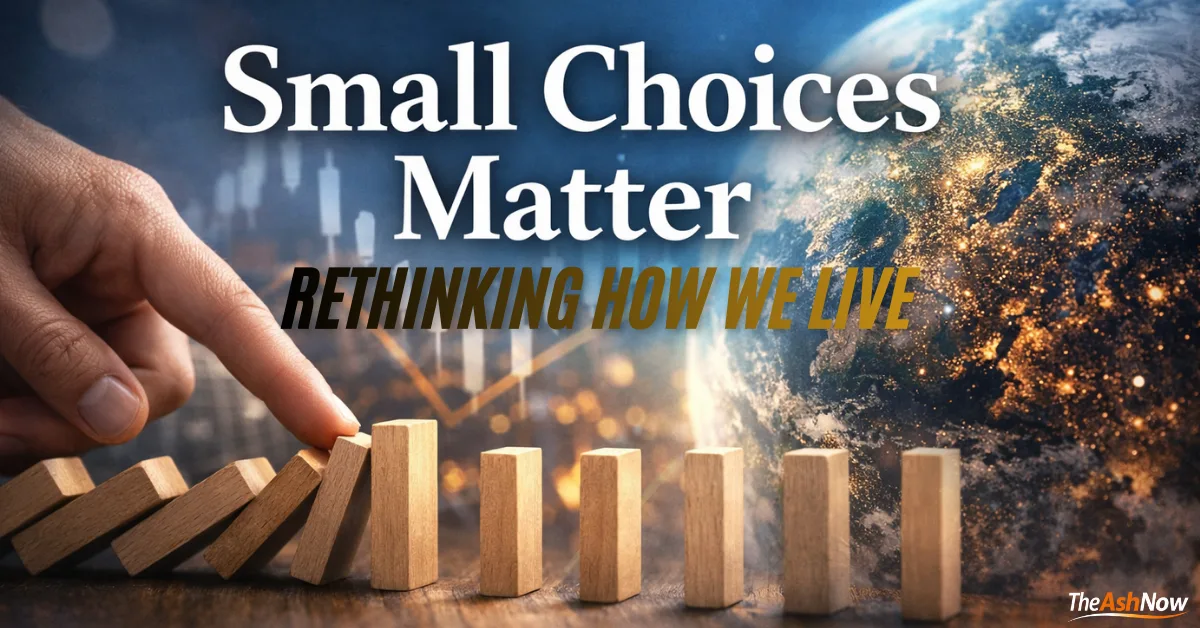
One Small Choice: Most people still think of their daily choices as private, personal, and small. What they buy, what they share, how they work, what they consume — all feel local and limited.
But that assumption is quietly breaking.
Today, the smallest individual behaviors now travel through global systems: supply chains, algorithms, energy markets, attention economies, and cultural feedback loops.
As a result, personal decisions no longer stay personal. They ripple outward — economically, socially, environmentally, and psychologically.
Your Leadership Story Deserves the Spotlight
Get featured on TheAshNow — the editorial platform trusted by founders, CEOs & executives worldwide for Google visibility, LinkedIn authority & global recognition.
Apply for Featured Profile →This is not about guilt or responsibility theater. It is about understanding a structural shift in how the modern world actually functions.
Once you see it, you cannot unsee it.
Table of Contents
What is really happening?
We have entered a world where individual behavior has become system-relevant.
Your purchase triggers production in another country. Your click shapes algorithms that influence millions. Your work choices alter labor markets. Your consumption patterns affect resource flows.
The scale is new. The speed is new. The feedback is new.
What used to be slow, indirect, and diffuse is now fast, measurable, and interconnected.
Small choices now aggregate into large outcomes instantly.
This is not because individuals suddenly became more powerful, but because systems became more sensitive to individual input.
The world has become finely tuned — and finely reactive.
Why is this happening now?
Several forces converged at once.
BUILD YOUR LEGACY IN PRINT
Editorial features for founders, CEOs & executives — engineered for search visibility, LinkedIn credibility & industry authority.
APPLY NOW →Digitization turned behavior into data. Data into signals. Signals into automated responses.
Globalization tied distant economies together so tightly that demand in one place reshapes production elsewhere almost in real time.
Platforms removed friction. Buying, sharing, switching, quitting, investing, or mobilizing now takes seconds instead of years.
Psychologically, people also shifted. Trust in institutions weakened, while confidence in personal agency rose. People stopped waiting for top-down change and started acting bottom-up.
Demographically, younger generations entered adulthood during crisis — climate instability, financial shocks, political volatility, and technological disruption. They learned early that nothing is isolated anymore.
The result is a world where micro-actions cascade into macro-effects.
Not through heroism. Through structure.

Why this matters to people
This shift touches daily life more than most realize.
Work becomes less stable but more flexible. Career decisions now shape not only income but identity, community, and even geopolitical talent flows.
Money choices affect inflation, sustainability, labor standards, and platform dominance. Consumption is no longer neutral.
Relationships are shaped by technology-mediated norms, algorithmic exposure, and cultural diffusion across borders.
Mental health is influenced by global attention dynamics, social comparison at the planetary scale, and the emotional weight of constant connectivity.
Society becomes more fluid, but also more fragile. Small behavioral shifts can stabilize or destabilize entire ecosystems.
People are not just living in the world anymore.
They are continuously co-creating it.
RELATED POST
- Why Cozy Earth Is Being Called the Most Sustainable Luxury Brand in America

- One Small Choice, One Global Impact — Rethinking How We Live Today?
- Why Weather Feels More Dangerous Than Before — Today’s Risk?
- Tsunami Warning: California on Alert After 8.7 Earthquake🌊

- Silent Storms: How Ignoring Society and Climate Will Cost Us Everything



What most coverage gets wrong
The public conversation usually frames this in moral terms: responsibility, blame, or virtue.
That framing is unhelpful.
This is not about individuals saving or destroying the world through lifestyle purity.
It is about understanding leverage.
Some choices matter because systems amplify them. Others feel important but change little.
The real question is not “Are people good or bad?” but “Where does behavior intersect with structural sensitivity?”
Without that clarity, people either feel falsely powerful or unnecessarily guilty.
Both are distortions.
The truth is calmer: influence is uneven, contextual, and often indirect — but real.

What this means for the future
Over the next decade, the world will become even more responsive to human behavior.
Automation will accelerate feedback loops. Climate constraints will tighten resource sensitivity. Political systems will respond more sharply to public sentiment. Markets will adapt faster to consumer signals.
This makes society more adaptable, but also more volatile.
Stability will depend less on centralized control and more on distributed wisdom.
Civilization will not be steered only by governments and corporations, but by patterns of millions of daily decisions.
Not dramatic ones.
Ordinary ones.
HOME GARDENING RELATED POST
- Simple Home Gardening Tips for Busy People
- Home Gardening Ideas Everyone Is Trying in 2026
- How to Grow a Micro Garden Anywhere: Balcony, Patio, Apartment Tips for Every Season
- Top 20 Water-Wise Gardening Ideas That Save You Time, Money, and Water
- The Home Gardening Boom: Why Millions Are Growing Their Own Food in 2026





What should I do now?
The right response is not anxiety, activism, theater, or withdrawal.
It is literacy.
Understand which systems your actions actually influence.
Choose consistency over intensity. Long-term patterns matter more than short-term gestures.
Protect your attention. What you consume shapes what exists.
Invest in resilience — financial, emotional, social — because adaptive systems reward stability.
And most importantly, think systemically, not morally.
This is not about being perfect. It is about being aware.
CONCLUSION
The world did not become more fragile because people became careless.
It became more sensitive because it became more connected.
That sensitivity is not a threat. It is a responsibility — not heavy, but real.
Not dramatic, but continuous.
We are not passengers anymore.
We are participants.
And participation, when understood clearly, is not a burden.
It is an agency.
LEADERSHIP
- Anmol Jaiswal – The Story Behind Indian Backpacker and India’s Most Adventurous Travel Creator
- Joshua Freedman: Emotional Intelligence Leader & CEO
- Alex Hormozi: The Entrepreneur Who Turned Business Growth Into a $100M Playbook
- Alakh Pandey: The Founder of Physics Wallah Who Turned Affordable Education Into a National EdTech Movement
- Kunal Shah: How the FreeCharge and CRED Founder Came to Lead WhatsApp Globally





FAQs: One Small Choice, One Global Impact
1. How do everyday personal choices affect global systems like the climate and the economy?
People’s daily decisions — from travel and diet to spending and digital behavior — collectively shape demand patterns, emissions, resource use, and social norms across interconnected markets and supply chains. When multiplied by billions of people, these behaviors create tangible global outcomes in sustainability, corporate strategy, and cultural expectation.
2. Which personal decisions have the biggest impact on the environment and society?
Some choices matter more than others: reducing car travel and air travel, eating more plant-based meals, using renewable energy sources, conserving resources, and choosing products with lower environmental footprints all contribute significantly to emissions reduction and resource conservation.
3. Can small individual actions actually influence systemic change at the national or global scale?
Individual actions can catalyze broader change by creating market demand, shifting social norms, and inspiring collective movements. While they are not a substitute for systemic policy and infrastructure change, personal behaviors can signal preferences to businesses and policymakers and help build momentum for large-scale transformation.
4. Are personal sustainable choices enough to address climate change and global challenges?
Individual choices significantly contribute to awareness and behavioral shifts, but they work best alongside systemic solutions — such as policy reform, corporate accountability, and technological innovation — which amplify and enable meaningful impact.
5. What realistic steps can individuals take that actually make a difference in global sustainability?
Actions like choosing sustainable transport, reducing resource consumption, supporting ethical products, voting for climate policy, and participating in community initiatives can cumulatively influence markets, norms, and policy over time, making them more impactful than isolated gestures.