
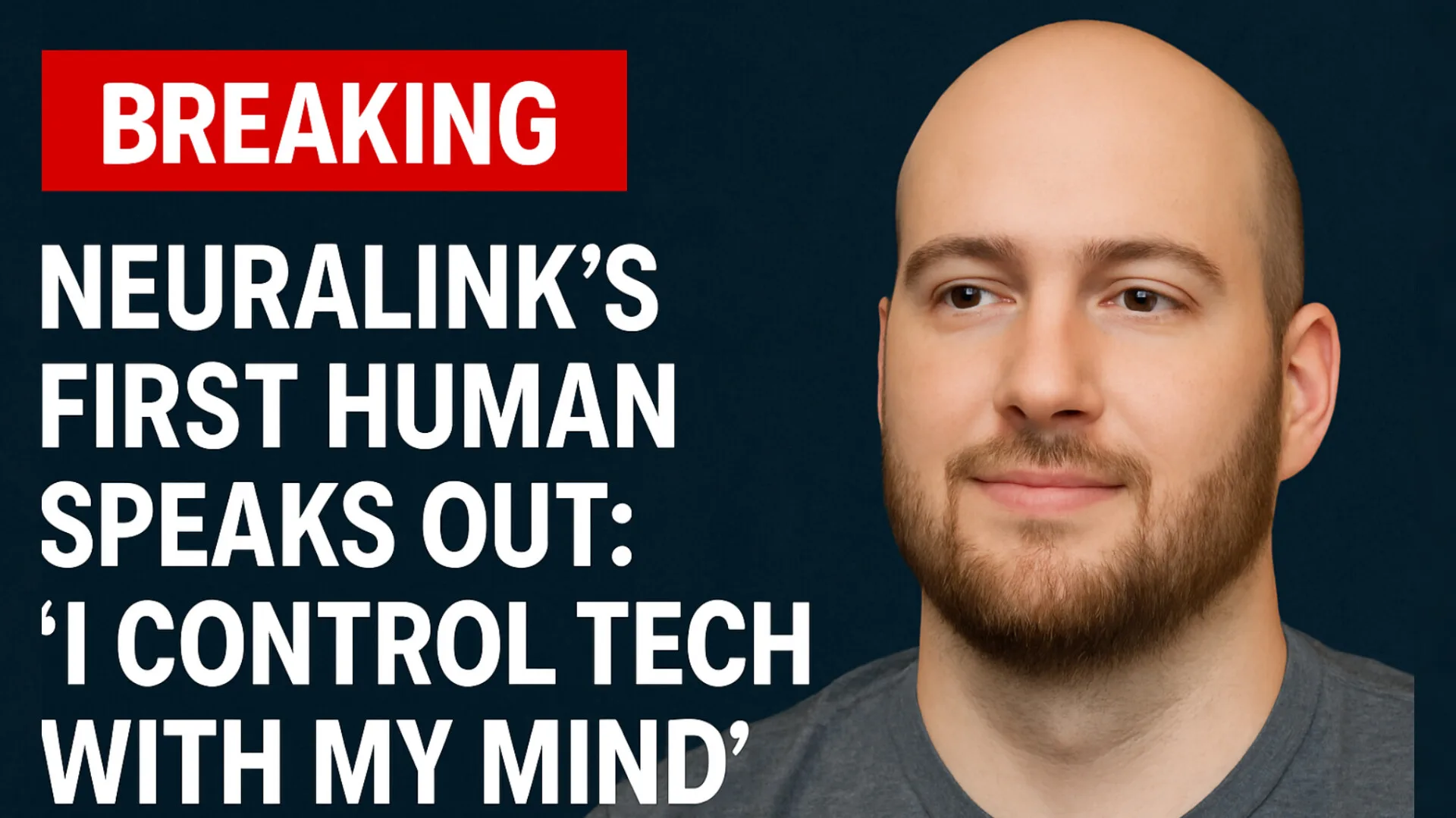
Imagine controlling a computer without a keyboard, mouse, or even your voice. Just by thinking. That’s not a sci-fi movie anymore. It’s real, and a 29-year-old American named Noland Arbaugh is living proof.
In a breakthrough that’s shaking the tech world, Elon Musk’s Neuralink has revealed its first human implant success, and the subject himself has gone public, explaining how he now interacts with the world just using his thoughts.
Let’s break down what happened, what it means, and why this moment may be the start of a whole new chapter in human evolution.
Table of Contents
🧑⚕️ Meet the First Neuralink Human: Noland Arbaugh
Noland Arbaugh was a normal, athletic young man until a tragic diving accident in 2016 left him paralyzed from the shoulders down. Unable to move his arms or legs, his life changed forever.
Your Leadership Story Deserves the Spotlight
Get featured on TheAshNow — the editorial platform trusted by founders, CEOs & executives worldwide for Google visibility, LinkedIn authority & global recognition.
Apply for Featured Profile →Fast forward to January 2024: Arbaugh volunteers to become the first person ever implanted with Neuralink’s brain-computer interface. The experimental device, called the Link, was placed in his brain through robot-assisted surgery. The goal? To see if a human could control technology directly with their mind.
And it worked.
- Why Sugar Prices Are Rising in India: Is Ethanol Behind the Price Surge?

- Colombia Earthquake: A 7.4-Magnitude Disaster Exposes the Human Cost of Seismic Risk Across Western Colombia
- Bankipur By-Election Result 2026 LIVE: Counting Updates, Vote Margin & Latest Trends
- Assam Floods 2026: When the Brahmaputra Turns Into a Sea
- Pralhad Joshi Takes Charge as India’s New Education Minister





⚙️ What Can He Actually Do?
Within days of the surgery, Neuralink announced that Arbaugh could move a computer cursor on a screen just by thinking. No wires. No external gear. Just his thoughts.
He later amazed the internet when he showed he could:
- Browse the internet
- Play online games like Chess and Civilization VI
- Chat and message people
- Control a music player
- Use basic apps and tools
This wasn’t just a small improvement. For someone who had to depend on caregivers for every digital task, this was a digital rebirth.
In his own words:
“If y’all can see the cursor moving… that’s all me. It’s pretty cool, huh?”
- Digital Detox Strategies the World Needs Right Now
- Benefits of Digital Detox in a Hyper-Connected World
- Inside a Digital Detox Retreat — Life Without Screens
- Best Digital Detox Apps to Beat Phone Addiction in 2026
- The Digital Detox Book for a Calmer Mind





😢 A Setback in the Journey
Just when the excitement was peaking, Arbaugh experienced a major issue.
About a month after the implant, many of the thin electrode threads in his brain began to retract, which reduced the device’s ability to function. It was a tough emotional moment for Arbaugh, who had just experienced a taste of independence.
But Neuralink engineers didn’t give up. With software updates and calibration fixes, they were able to restore most of the function. Arbaugh was back online, once again controlling the computer with his mind.
This incident revealed both the power and the fragility of this revolutionary technology.
BUILD YOUR LEGACY IN PRINT
Editorial features for founders, CEOs & executives — engineered for search visibility, LinkedIn credibility & industry authority.
APPLY NOW →🧬 Life After the Implant
Since the procedure, Arbaugh says his life has changed completely.
He now wakes up with a sense of purpose. He doesn’t need a mouth stick or a caregiver to use a computer. He can think—and things happen. He even dreams of one day using Neuralink to:
- Drive a Tesla
- Control a robotic assistant
- Travel more independently
- Help others with similar disabilities
He’s already become an inspiration for millions and a symbol of the future.
- Simple Home Gardening Tips for Busy People
- Home Gardening Ideas Everyone Is Trying in 2026
- How to Grow a Micro Garden Anywhere: Balcony, Patio, Apartment Tips for Every Season
- Top 20 Water-Wise Gardening Ideas That Save You Time, Money, and Water
- The Home Gardening Boom: Why Millions Are Growing Their Own Food in 2026





🧑🔬 What Exactly Is Neuralink?
Neuralink is a company founded by Elon Musk that aims to build direct communication pathways between the human brain and computers. The “Link” device they developed is a coin-sized implant with ultra-thin threads that read signals from the brain and send them to a computer wirelessly.
In simple terms: It’s a brain chip that allows you to think commands instead of typing or speaking them.
While the technology is still in its early stages, its potential is enormous—not just for people with paralysis, but possibly for everyone.
⚖️ But Is It Safe? The Ethical Debate
As exciting as this sounds, Neuralink’s experiment raises major ethical and medical questions:
- What happens if the device fails inside the brain?
- Could long-term use cause damage?
- Who controls the data from your brain?
- Will this lead to a world where the rich become superhumans?
Many scientists, doctors, and ethicists are cautiously optimistic but urge extreme transparency and long-term studies before mass adoption.
🔥 Why This Story Is Blowing Up Online
This isn’t just another tech update. This is real-life science fiction becoming reality.
| 🔍 Reason | 📈 Impact |
|---|---|
| Real human story | Emotionally powerful and relatable |
| Futuristic tech | AI, mind control, brain chips—all trending topics |
| Elon Musk effect | Anything Musk touches goes viral |
| Hope & drama | Personal victory + public controversy = viral gold |
This story hits the perfect mix of emotion, innovation, debate, and mass appeal. That’s why it’s going viral across platforms.

🧠 What’s Next for Neuralink?
After Arbaugh, Neuralink has already begun working with more patients. These include:
- An ALS patient who can now communicate using a cloned voice controlled by thoughts
- A woman paralyzed for 20 years who can now draw hearts and pizzas with her mind
- A second male patient who reportedly had a better implantation experience with improved results
Elon Musk has hinted that Neuralink may one day allow people to upload memories, control robots, or even merge with AI.
That future may be closer than we think.
💡 Final Thoughts
Noland Arbaugh’s story isn’t just about Neuralink—it’s about what’s possible when human courage meets cutting-edge science. It’s about giving back freedom, dignity, and hope to millions of people living with disabilities.
It also opens the door to profound possibilities—and serious questions—about how far we should go in merging our minds with machines.
Whether you’re excited or cautious, one thing is clear:
The age of thought-controlled technology has officially begun.
🔍 Neuralink FAQs
1. What is Neuralink?
Neuralink is a neurotechnology company founded by Elon Musk in 2016. Its goal is to develop tiny implantable brain‑computer interface (BCI) devices—like the coin‑sized “Link” chip—that enable direct communication between the human brain and external devices.
2. How does the Neuralink brain chip work?
After a surgical procedure, a robot places ultra‑thin electrode threads into the motor cortex of the brain. These electrodes record neural signals, which are transmitted wirelessly to a computer and decoded to control digital devices.
3. Who was the first human to receive a Neuralink implant and why?
The first human recipient is Noland Arbaugh, a 29‑year‑old quadriplegic who was paralyzed after a diving accident. He received the implant in January 2024 as part of a clinical trial, and it allowed him to control a computer using only his thoughts.
4. Is Neuralink FDA‑approved?
Yes. Neuralink received FDA approval for human clinical trials in May 2023. This allowed the company to begin testing the implant on human volunteers starting in 2024.
5. Who is eligible to participate in Neuralink trials?
Participants must typically be U.S. citizens or permanent residents, at least 18 years old, and suffer from conditions such as quadriplegia, paraplegia, ALS, blindness, deafness, aphasia, or limb amputation. They must pass medical evaluations and provide informed consent.
6. What are the benefits and possible uses of Neuralink?
Neuralink aims to give people with severe physical disabilities the ability to control computers and smart devices using only their thoughts. Future applications may include restoring vision or hearing, treating neurological conditions, and enhancing human cognitive abilities.
7. What are the risks and ethical concerns?
Risks include infection, bleeding, seizures, brain tissue damage, and potential device failure. Ethical concerns involve data privacy, long-term safety, informed consent, and whether such technology might one day create inequality or be used for non-medical enhancement.
8. What challenges did the first patient experience?
About one month after the procedure, many of the implant’s electrode threads retracted, reducing performance. However, Neuralink was able to restore most functionality through software updates and recalibration.
9. What’s the timeline before the technology becomes widely available?
Neuralink is still in the early trial phase. Experts estimate that if all goes well, medical versions of the device could become available within 5–10 years, though general commercial use may take longer due to regulatory and ethical hurdles.
10. Are there other Neuralink patients now?
Yes. Since Noland Arbaugh, Neuralink has implanted the device in additional patients, including individuals with ALS and long-term paralysis. These patients have shown improved results, and the company continues to expand its clinical trials.





[…] Breaking: Neuralink’s First Human Speaks Out — “I Control Tech with My Mind”by TheAshNow Team […]
[…] Breaking: Neuralink’s First Human Speaks Out — “I Control Tech with My Mind” How to Set Healthy Boundaries with Technology […]