
✈️ What Happened?
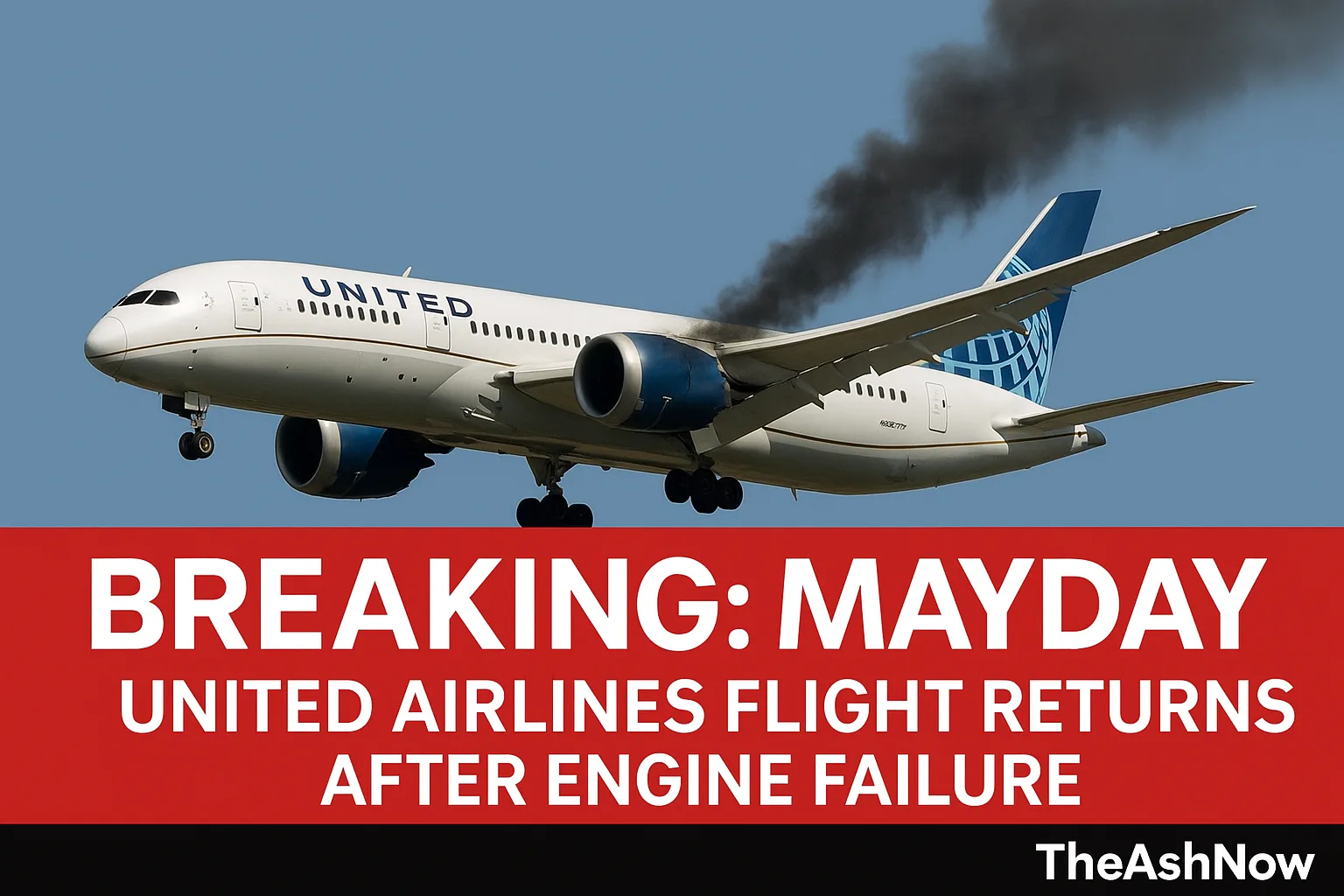
In a chilling mid-air emergency that has gripped global headlines, United Airlines Flight 108, a Boeing 787-8 Dreamliner bound for Munich, Germany, was forced to declare a “Mayday” emergency after experiencing a left engine failure shortly after takeoff from Washington Dulles International Airport (IAD) on July 25, 2025.
At approximately 10,000 feet, the flight crew radioed in the distress signal:
“Failure, engine failure, left engine… declaring an emergency. Mayday, mayday, mayday.”
This audio, released publicly on August 3rd by aviation trackers, triggered widespread public concern and quickly went viral across social media and news outlets.
Table of Contents
Timeline of the incident:
- 6:02 PM EDT — Flight 108 took off from Washington Dulles.
- 6:20 PM EDT — At ~10,000 feet, the left engine failed and pilots declared: “Failure, engine failure, left engine… declaring an emergency. Mayday, mayday, mayday.”
- 6:56 PM EDT — After fuel dump and a holding pattern, the aircraft landed safely back at Dulles.
This audio, released publicly on August 3rd by aviation trackers, triggered widespread public concern and quickly went viral across social media and news outlets.
Your Leadership Story Deserves the Spotlight
Get featured on TheAshNow — the editorial platform trusted by founders, CEOs & executives worldwide for Google visibility, LinkedIn authority & global recognition.
Apply for Featured Profile →- Why Sugar Prices Are Rising in India: Is Ethanol Behind the Price Surge?

- Colombia Earthquake: A 7.4-Magnitude Disaster Exposes the Human Cost of Seismic Risk Across Western Colombia
- Bankipur By-Election Result 2026 LIVE: Counting Updates, Vote Margin & Latest Trends
- Assam Floods 2026: When the Brahmaputra Turns Into a Sea
- Pralhad Joshi Takes Charge as India’s New Education Minister





🛬 Emergency Protocols Activated
Despite the terrifying engine failure, the crew remained calm and followed strict aviation protocols:
- Fuel Dump: Since the plane was fully fueled for a transatlantic flight, it was too heavy to land safely. The crew initiated a controlled fuel dump over an unpopulated area while descending to around 6,000 feet.
- Holding Pattern: The plane circled to burn fuel and stabilize systems before being cleared to return.
- Safe Landing: Approximately 30–35 minutes later, the aircraft landed safely back at Dulles International Airport. The plane was towed off the runway due to the mechanical issue.
There were no injuries reported among the 219 passengers and 11 crew members on board.

🧑✈️ Passenger & Crew Response
Passengers reportedly remained calm, and the crew’s professionalism ensured a smooth handling of the emergency. Several passengers later praised the pilot’s communication and the flight attendants’ control during the ordeal.
🛠️ Investigation Underway
United Airlines confirmed a mechanical failure in the left engine and grounded the aircraft for inspection. The airline stated:
“We’re working closely with authorities and Boeing to determine what caused the engine failure. Safety remains our top priority.”
The Federal Aviation Administration (FAA) is also investigating the incident, reviewing both the engine telemetry data and flight crew actions.
- Simple Home Gardening Tips for Busy People
- Home Gardening Ideas Everyone Is Trying in 2026
- How to Grow a Micro Garden Anywhere: Balcony, Patio, Apartment Tips for Every Season
- Top 20 Water-Wise Gardening Ideas That Save You Time, Money, and Water
- The Home Gardening Boom: Why Millions Are Growing Their Own Food in 2026





📸 Why It’s Trending Now
Although the event occurred on July 25, it only gained global attention on August 3, after:
- The pilot’s audio declaring the emergency was published on aviation monitoring platforms.
- Major media houses, including People.com, News.com.au, and Economic Times, released full coverage.
- Social media users began speculating on aviation safety, especially involving Boeing aircraft.
🌐 Global Reaction
Aviation experts have praised the crew’s quick thinking, calling the incident a “textbook example of safe emergency handling.” Others are now demanding stricter inspections of long-haul aircraft before international departures.
🧾FAQs: United Airlines Flight Declares Mayday After Engine Fails Mid-Air
Q1. What caused the engine failure?
The exact cause is still under investigation by United Airlines and the FAA. Initial reports suggest a possible mechanical fault in the left engine.
Q2. Was anyone hurt during the emergency?
No. All 230 people on board (219 passengers and 11 crew) were safe.
Q3. Why did they dump fuel mid-air?
Fuel was dumped because the aircraft was too heavy to land safely immediately after takeoff.
BUILD YOUR LEGACY IN PRINT
Editorial features for founders, CEOs & executives — engineered for search visibility, LinkedIn credibility & industry authority.
APPLY NOW →Q4. Was this a Boeing plane?
Yes, a Boeing 787-8 Dreamliner.
Q5. Is flying United Airlines safe?
Yes. This incident demonstrates that modern aircraft and trained crews can handle emergencies effectively.
🧠 Editor’s Note
This emergency highlights the importance of crew training, technical redundancies, and rigorous aviation safety standards. While engine failures are rare, the flawless response by the pilots and ATC prevented a potential disaster.


- India’s 80th Independence Day 2026: History, Significance & Celebrations
- The Truth About Wife Swapping: History, Facts, Laws, Psychology, and Global Trends
- The Time When Bihar Ruled the World: History You Never Knew!

- 20 Next-Level Welcome 2026 Prompts for Ultra-Realistic AI Images
- 2025 World Rewind: The 25 Moments That Defined Our World











[…] […]
[…] […]